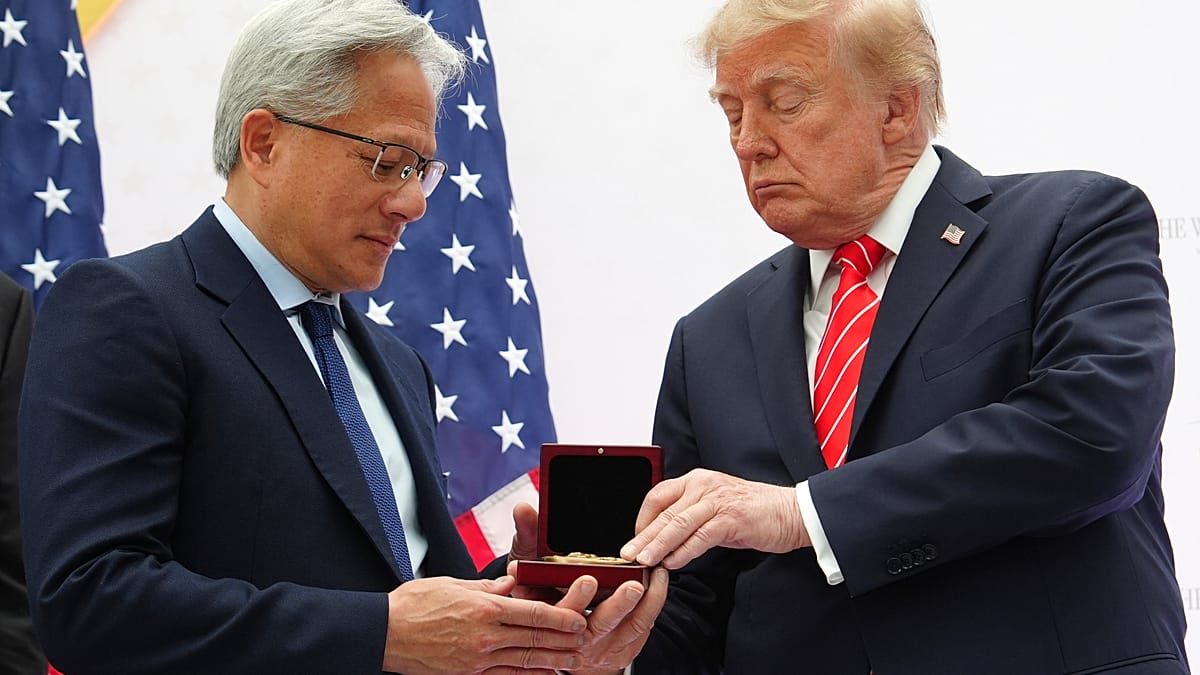
US President Donald Trump has said he believes Nvidia CEO Jensen Huang was unaware that a business associate was allegedly working for Chinese intelligence. Speaking at the White House on Monday, Trump said he had spoken to Huang earlier in the day and that the tech executive denied knowing the person was a spy.
"I asked him that question, 'Did you have any idea that she was a spy?' He said, 'I had no idea that he was a spy.' And I really believe him," Trump told reporters. He added that he had been hearing about the allegations for some time but did not specify when he was first informed.
The controversy centres on Huang's personal relationship with a business executive suspected by US intelligence of gathering information for Beijing. Huang, who leads one of the world's most valuable technology companies, has acknowledged to Nvidia's board that he had been unfaithful to his wife with this individual.
European implications
While the story is rooted in US politics and corporate governance, it carries significant weight for Europe. Nvidia is a key supplier of advanced chips used in artificial intelligence and data centres across the continent. European tech firms and governments have been increasingly reliant on Nvidia's hardware for everything from research to defence applications. Any instability at the top of the company could ripple through supply chains and investment plans in the EU and the UK.
The allegations also come at a time when European regulators are scrutinising the influence of foreign technology and potential espionage risks. The board's investigation has already affected market sentiment, with Nvidia shares slipping as investors weigh the potential fallout.
For European policymakers, the case underscores the delicate balance between embracing cutting-edge technology and safeguarding national security. Several EU member states, including France and Germany, have been expanding their own AI capabilities, often in partnership with American firms. A prolonged controversy at Nvidia could prompt European companies to diversify their chip suppliers, potentially benefiting European semiconductor initiatives such as the EU Chips Act.
The FBI's involvement adds another layer of complexity. While the investigation is a US matter, its outcome could influence how European governments assess the reliability of American tech partners. Some analysts have drawn parallels to earlier espionage cases involving Chinese nationals in Europe, such as the businesswoman at the centre of these allegations, whose activities may have extended beyond US borders.
Trump's public defence of Huang is notable, given his administration's tough stance on China. The president has frequently criticised Chinese trade practices and has pushed for stricter export controls on advanced technology. His willingness to vouch for Huang suggests a desire to avoid destabilising a key American tech champion, even as the FBI continues its work.
For now, Huang retains the support of Nvidia's board, which has launched its own internal review. The company has not commented publicly on the allegations beyond confirming the board's investigation. In Europe, industry observers will be watching closely to see whether the affair affects Nvidia's ability to secure contracts with European governments and corporations.
The broader context is one of heightened transatlantic tension over technology and security. Recent events, such as the record Chinese presence at Web Summit 2026 in Lisbon, highlight the growing interplay between European tech hubs and Chinese innovation. At the same time, European leaders are grappling with how to respond to US pressure on issues ranging from trade to defence.
As the investigation unfolds, the key question for Europe is whether Nvidia can maintain its position as a trusted partner. The company's chips are integral to many European AI projects, and any prolonged uncertainty could have knock-on effects. For now, the immediate impact appears limited, but the long-term consequences remain unclear.