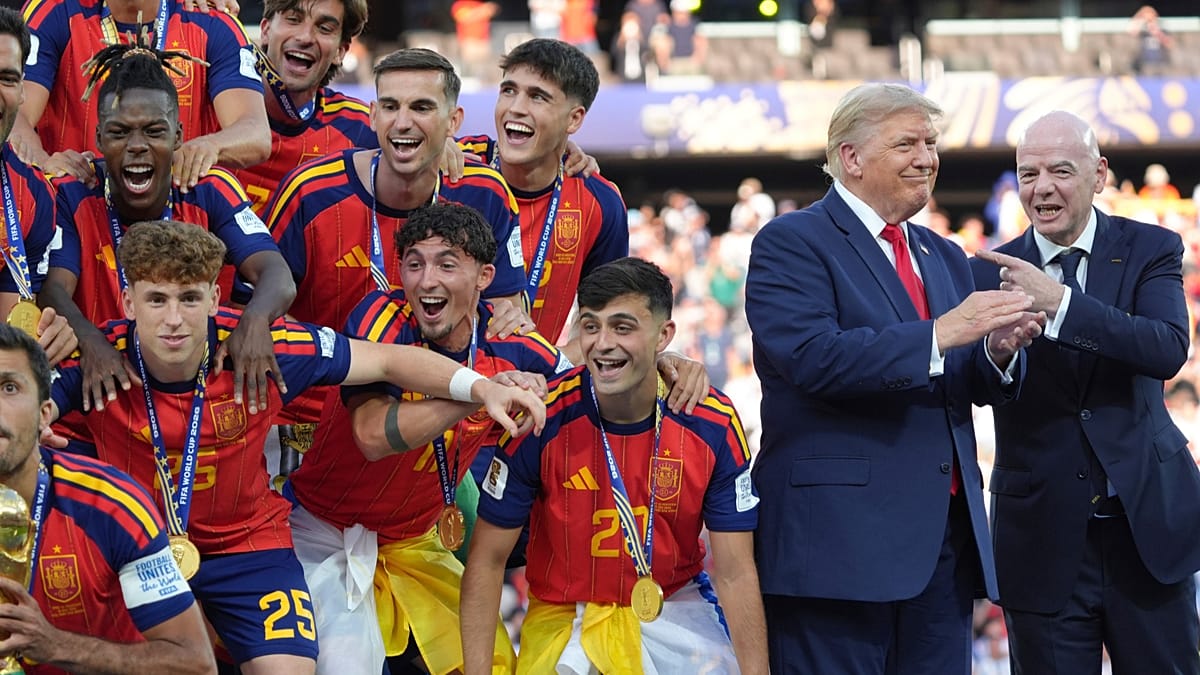
Spain's national football team, La Roja, secured their second World Cup title with a hard-fought 1-0 victory over Argentina in the final held in New York. The match, which went into extra time, was a tense affair that saw Spain's disciplined defense and a decisive goal seal the win. The triumph was celebrated across the Iberian Peninsula and among European football fans, but the post-match ceremony quickly became the focus of global attention for an entirely different reason.
Trump's Lingering Presence Sparks Controversy
US President Donald Trump, who attended the final as the first sitting American president to do so on home soil, presented the World Cup trophy to the Spanish team. However, after handing over the trophy, Trump remained on stage, hovering near the players as they posed for victory photographs. FIFA President Gianni Infantino was seen attempting to usher Trump away, but the US president stayed put, standing at the edge of the stage and inserting himself into the frame.
The awkward moment was captured by photographers and quickly went viral on social media. Many users accused Trump of trying to steal the spotlight from Spain's historic achievement, with comments describing his behavior as "inappropriate," "beyond pathetic," and "embarrassing." Observers noted that this was not the first time Trump had inserted himself into a team's celebration; he did the same during Chelsea's Club World Cup victory last year, standing front and center as the team held the trophy aloft.
The incident also revived the so-called "Trump curse" theory, which posits that Trump's endorsements or presence at sporting events often lead to defeat for his preferred side. Before the match, Trump had publicly backed Argentina, praising President Javier Milei as a "friend" and saying, "It's hard to bet against Messi." The theory gained traction earlier in the tournament after the US team's humiliating loss to Belgium, a match overshadowed by a major scandal. Following Spain's victory, the term "Trump curse" trended on social media platforms.
Spain's victory was a moment of national pride, coming 16 years after their first World Cup win in 2010. The team's journey to the final was marked by strong performances and tactical discipline, as detailed in our coverage of Spain's extra-time triumph over Argentina. The match also drew attention to the political dynamics between the US and Spain, with Prime Minister Pedro Sánchez and Trump meeting at the final after months of tension, as reported in our earlier article.
In a post-match interview, Trump discussed the possibility of the World Cup returning to the US, claiming he had "an idea" for Infantino. "I said: 'You have to do two countries. So announce us for next time, and then announce another country after that and it'll take out some of the anger and the shock!'" Trump stated. He added, "Based on the numbers, we will be requesting it again immediately." The numbers he referred to are likely the $15 billion in revenues FIFA is reportedly planning to announce from this year's World Cup, as reported by The Guardian.
The incident has sparked debate about the role of political figures in sports ceremonies and the appropriateness of such behavior. For European audiences, the focus remains on Spain's achievement and the broader implications for European football. The victory underscores the strength of Spanish football, which has produced world-class players and a cohesive team under the guidance of coach Luis de la Fuente. For more on the team's dynamics, see our piece on Rodri crediting the coach-player bond for Spain's World Cup final run.
As Europe celebrates Spain's triumph, the controversy surrounding Trump's behavior serves as a reminder of the intersection between sports and politics. While the US president's actions may have been intended to share in the glory, they ultimately detracted from the moment that belonged to La Roja and their fans across the continent.