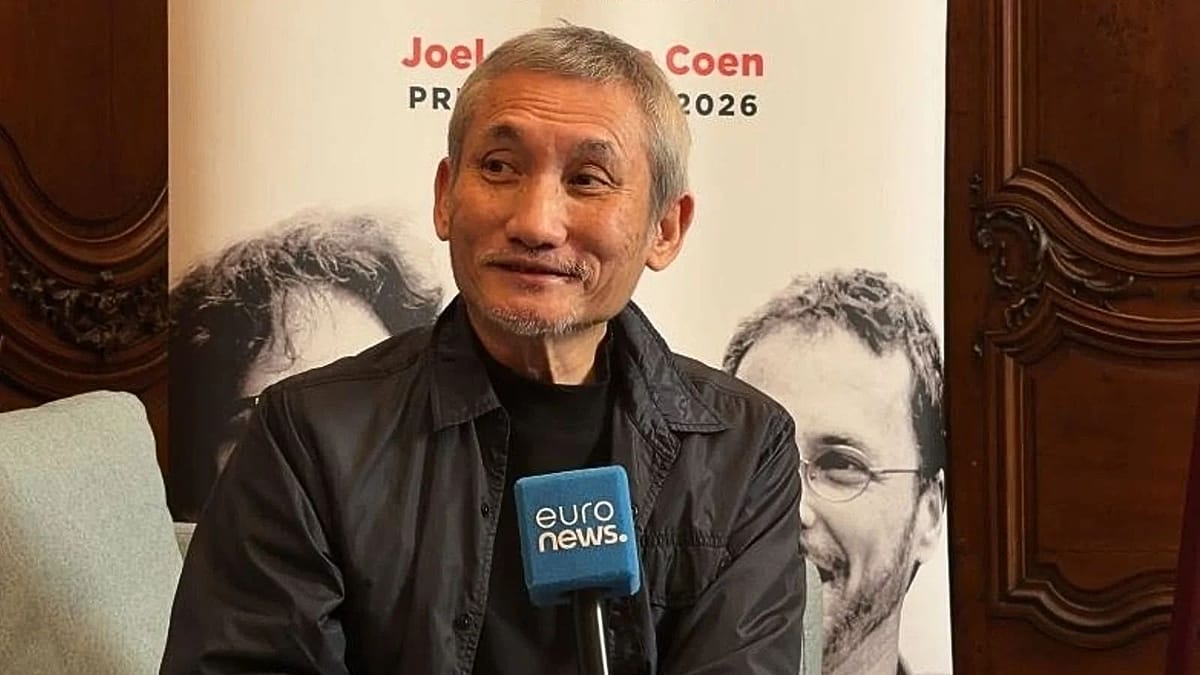
For anyone who follows Hong Kong cinema, Tsui Hark needs no introduction. A central figure of the territory's New Wave, he reinvented martial arts films and launched the careers of Chow Yun-fat, Jet Li, and John Woo. His 2021 war epic The Battle at Lake Changjin was the highest-grossing Chinese film until last year's Ne Zha 2. Now, at 75, he is being celebrated at the Lumière Festival in Lyon, where four of his films are screening: Shanghai Blues (1984), Peking Opera Blues (1986), Once Upon a Time in China (1991), and Time and Tide (2000).
During the festival, Tsui received a golden plaque on the Rue du Premier Film, beside the Institut Lumière, the birthplace of cinema. In an interview with Euronews Culture, he described the experience as surreal. "I feel very dreamy," he said. "I never thought I would come to a place where motion pictures started. It becomes a very surreal thing. You come to a place where your career was started by someone you don't know, but they are the source of your creativity. I feel very blessed."
Revisiting four decades of cinema
Seeing his films restored and projected again in Lyon was emotional. "It's strange with the films I made 40 years ago," Tsui admitted. "For me, it's like they are very far away, and suddenly they come back. You go to a theater showing your film from 40 years ago, and people still like it. It's a wonderful feeling."
The selection at Lumière highlights his comedic and romantic side, a departure from his action reputation. "I actually think of myself as a comedy person," he said. "But in 1979, I was given a job to make a costume action drama, The Butterfly Murders. Since then, I've been associated with the action genre. For me, it's a bit weird."
Tsui's ability to balance epic action with intimate emotion is legendary. He insists there is no secret. "It all depends on my take on something I really like," he explained. "When I was a kid, I felt exhilarated watching this genre. When I make a movie, I go in that direction. I'm very serious about making people identify with the story. The quality of humanity in the characters is a major concern. I always try to make the story understandable for everyone, not just a certain age or culture."
European audiences have embraced his work, which still surprises him. "Sometimes I go to a place and they say, 'I've seen your movie,' and I'm quite surprised," he said. "The first time in Cannes, I was shocked. But it's encouragement. It gives me energy to make movies that can be shared by all people and bring cultures together."
Asked about genres he still wants to explore, Tsui mentioned horror. "Horror is a genre I always want to explore," he said. "It's not just about making people scared but about making them feel a different kind of energy. I've seen a lot of horror films, and they are often very negative about humanity. That's why I'd like to try..."
His comments come as the festival also highlights the future of cinema, with discussions on AI and digital filmmaking. The Lumière Festival's stars have been recalling their first cinema moments, and Tsui's presence underscores the enduring power of the medium.
Tsui's reflections also touched on broader anxieties. "We all know that the thing about humanity is that we always fear being replaced by something," he said, echoing a sentiment that resonates in an era of rapid technological change. His own career, spanning analog and digital eras, is a testament to adaptation.
As the festival continues, Tsui's legacy is secure. His films, from Peking Opera Blues to Time and Tide, remain touchstones for filmmakers across Europe and beyond. For those interested in the intersection of cinema and technology, the Latvian filmmaker's AI festival win offers a glimpse of what's next. But for Tsui, the future is uncertain. "We don't know where the future will bring us," he said, "but we keep making stories."