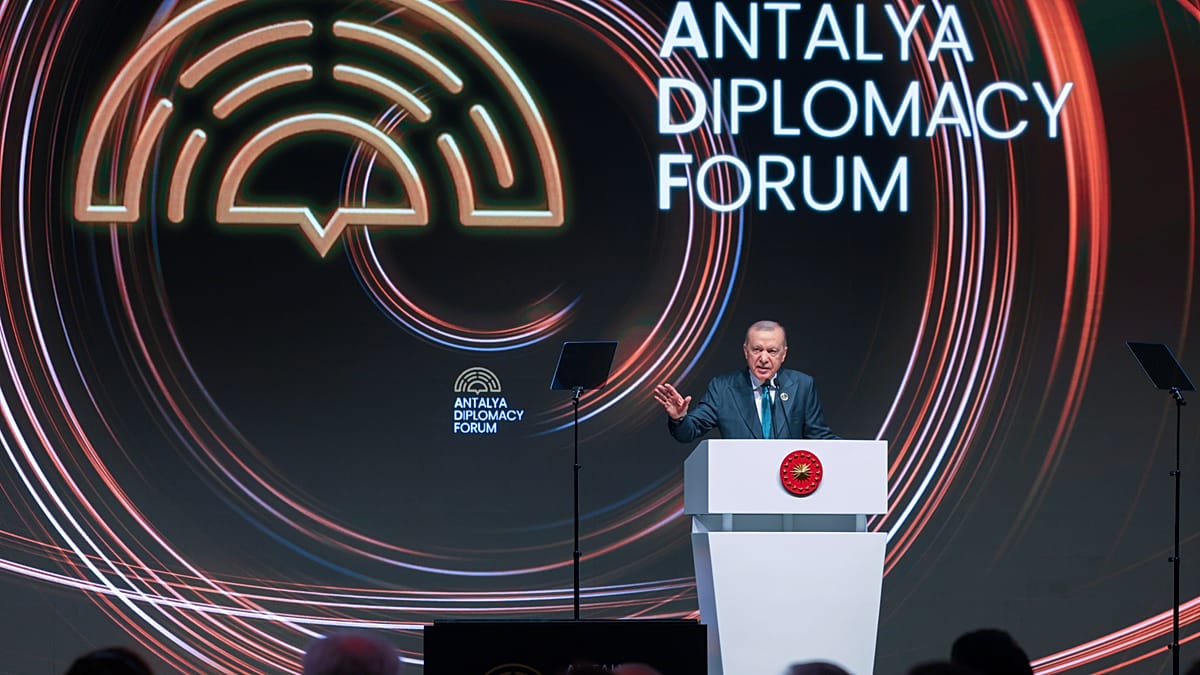
Turkey solidified its role as a regional and global diplomatic hub over the weekend, hosting political leaders from 150 countries at the Antalya Diplomacy Forum. The gathering, spearheaded by President Recep Tayyip Erdoğan, brought together representatives from the Middle East, Central Asia, South America, and Europe—including figures from Egypt, Syria, Pakistan, Qatar, the UAE, Saudi Arabia, Azerbaijan, Kazakhstan, Georgia, Moldova, Ukraine, and even a delegation from Iran. The forum underscored a shift in global diplomacy, as middle and regional powers seek joint solutions to systemic crises.
“Today the world is experiencing not only a crisis of power but also a crisis of development trajectory, and we are facing a serious and dangerous turning point,” Erdoğan told attendees. He added that international institutions are “increasingly unable to respond to contemporary challenges, which signals a systemic crisis.” The Turkish president framed diplomacy as “no longer merely a realm where conflicts and interests are discussed” but “a platform where the future of humanity is determined.”
Hormuz Crisis and the Search for Alternatives
A central focus of the summit was the ongoing crisis in the Strait of Hormuz, where Iran has seized ships amid an extended US ceasefire. Turkey, Egypt, and Pakistan continued mediation efforts, while Qatar’s Amir Sheikh Tamim bin Hamad Al Thani joined Erdoğan and Pakistan’s Prime Minister Shehbaz Sharif for a trilateral meeting on developments in the Iran war. Regional diplomacy has taken center stage, with Gulf states—once key mediators—now drawn into the conflict.
Beyond mediation, participating countries explored immediate alternatives to the Strait of Hormuz. The Middle Corridor, also known as the Trans-Caspian International Transport Route (TITR), emerged as a strategic transit route linking Asia and Europe. This network of rail and maritime connections runs from China and Southeast Asia through Kazakhstan, Azerbaijan, and Georgia, onward to Turkey and Europe. Secretary-General of the Organisation of Turkic States Kubanychbek Kasymovich Omuraliev described it as “more efficient, safer, shorter, and cheaper” than routes affected by ongoing conflicts.
Azerbaijan, a key transit hub for the Middle Corridor, highlighted its potential. Hikmet Hajiyev, assistant to the president of Azerbaijan, told the forum that “the disruption of global logistics and supply chains has once again demonstrated the importance of the Middle Corridor.” He also mentioned the “Four Seas” concept, building a network linking the Caspian, Black, Mediterranean, and Adriatic seas. Hajiyev noted that Baku is “applying an inclusive approach by considering Armenia as a transit country,” with cooperation continuing on the Nakhchivan corridor. The South Caucasus, he said, “is increasingly becoming an important partner in global supply chains and energy security.”
Elchin Amirbayov, a special assignments aide to the president of Azerbaijan, hailed a “positive interdependence between Armenia and Azerbaijan” and called the Middle Corridor “an intercontinental transport route and perhaps the most cost-effective, secure, and shortest path connecting two continents.” He added that the corridor “is now becoming an increasingly vital pathway in addressing current challenges,” after being merely an alternative route until now.
The summit’s emphasis on the Middle Corridor comes amid broader supply chain disruptions linked to the Middle East conflict, which have also driven EU energy price warnings and affected global markets. The corridor’s development could offer European nations a more stable route for energy and goods, reducing reliance on volatile chokepoints like Hormuz.
Erdoğan’s ability to convene such a diverse group—including rival states—reflects a growing trend: middle powers are coalescing to address shared challenges, from energy security to geopolitical instability. For Europe, the Antalya forum signals that alternative trade and energy corridors are no longer theoretical but are being actively pursued by key regional players.