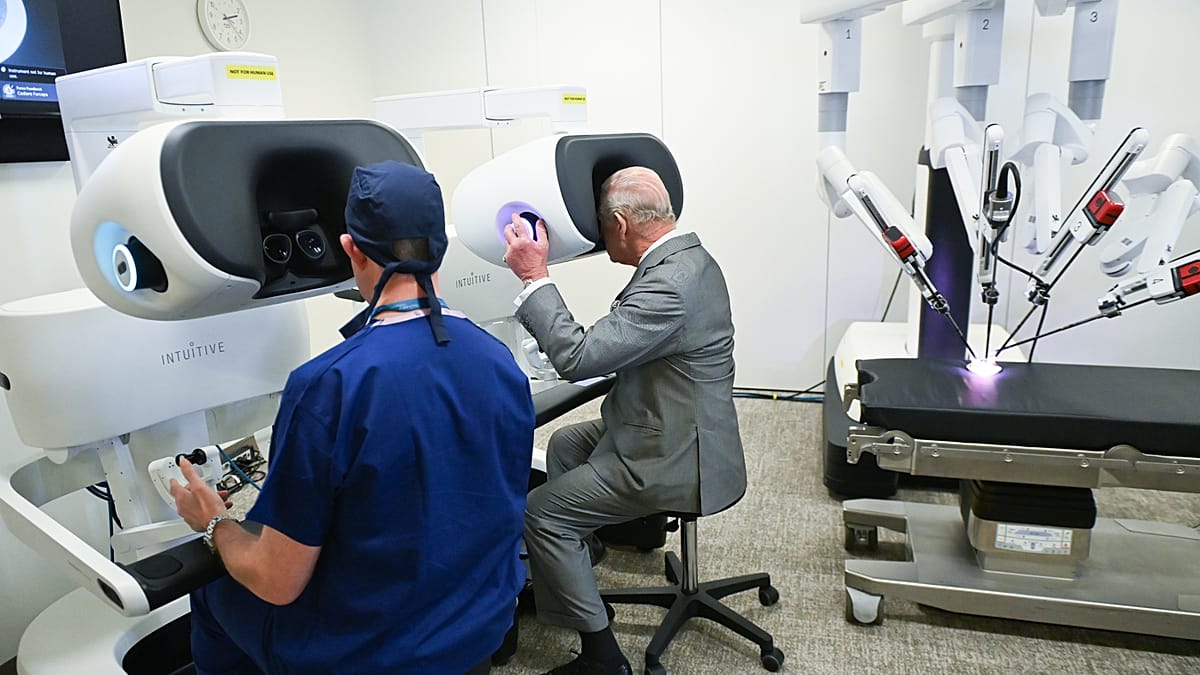
At St Bartholomew's Hospital in central London, consultant thoracic surgeon Sasha Stamenković peers into an immersive 3D headset, his hands guiding robotic arms through a delicate lung tumour removal. The 60-year-old has just completed an operation that he describes as "very, very intricate," saving healthy tissue while navigating around tiny vessels and airways.
Stamenković is demonstrating the da Vinci 5, a robotic-assisted surgical system made by US firm Intuitive, to three visiting surgeons from another English hospital. Their own operating theatre will receive the equipment later this year, part of a broader push to embed robotics into keyhole surgery across the UK's National Health Service (NHS).
The UK government has set a target for robotic assistance to be used in nine out of ten keyhole surgeries in England by 2035. Keyhole, or laparoscopic, surgery involves operating through small incisions rather than one large cut, which typically means less pain, scarring, and a faster recovery.
Surgery as an 'art form'
At first glance, the setup resembles a video game. Stamenković operates from a console at the side of the room, his hand movements translated into the actions of three robotic arms holding instruments over the patient, who lies a few metres away. A fourth arm holds a camera, providing a 3D stream to the surgeon and to screens in the operating theatre.
The robotic systems can be used across a range of specialities, including urology, gynaecology, colorectal, thoracic, and general surgery. Ali Ansaripour, a senior cardiothoracic trainee on a year-long fellowship, is one of the doctors learning under Stamenković. He says stepping away from the patient was the "biggest challenge."
"I think that almost kind of separates you from the patient slightly," Ansaripour admits. "But it gives you incredible vision and makes you very objective in terms of how you deal with the patient."
Despite the futuristic appearance, Stamenković argues that robotics has actually brought keyhole surgery closer to "how the original open surgery used to be." The slim robotic arms can move more easily than human hands inside the restricted space of a keyhole incision. "Robotic surgery has brought you back to what surgeons wanted to do, which was to have an art form able to create something with their hands," he says.
The greater precision also reduces the risk of complications such as air leaks, a common cause of longer hospital stays after lung surgery.
Sped-up recovery
This more precise surgery within a smaller wound should mean shorter hospital stays and faster recovery times. For an overstretched public health service, the hope is that patients will leave hospitals sooner, freeing up bed space and reducing waiting lists.
Ian Macleod, a 76-year-old retired detective, didn't realise until he was about to be anaesthetised that he would be the first NHS patient to undergo lung cancer surgery using the new system. The news "didn't faze" him, and he was back on his feet just 30 minutes after returning to the ward. He describes the recovery as "extraordinary." Having previously undergone non-robotic keyhole surgery for a different cancer, he says that recovery time was "much longer." This time, he left hospital with just one stitch and was driving his wife to the garden centre for coffee less than a week later.
Robots coupled with training
The government has highlighted robotics as one of five "big bets" in its 10-year health plan for England. However, the Royal College of Surgeons of England has criticised a "postcode lottery" in the availability of robotic surgery across different parts of the country. The body also points to the lack of a "standard, consistent funding model" for robotics across the NHS, which has left some hospitals relying on charitable donations to fund the equipment.
Stamenković stresses that training is essential. "We need to embed robotics into training programmes," he says. He notes that younger surgeons in training tend to be "more adept" than older counterparts when it comes to adapting to the technology. His fellowship at Barts Health is shaping what he calls the "surgeon of the future."
As the NHS moves towards its 2035 target, the combination of advanced robotics and structured training will be key to ensuring that patients across England benefit equally from this technological shift.