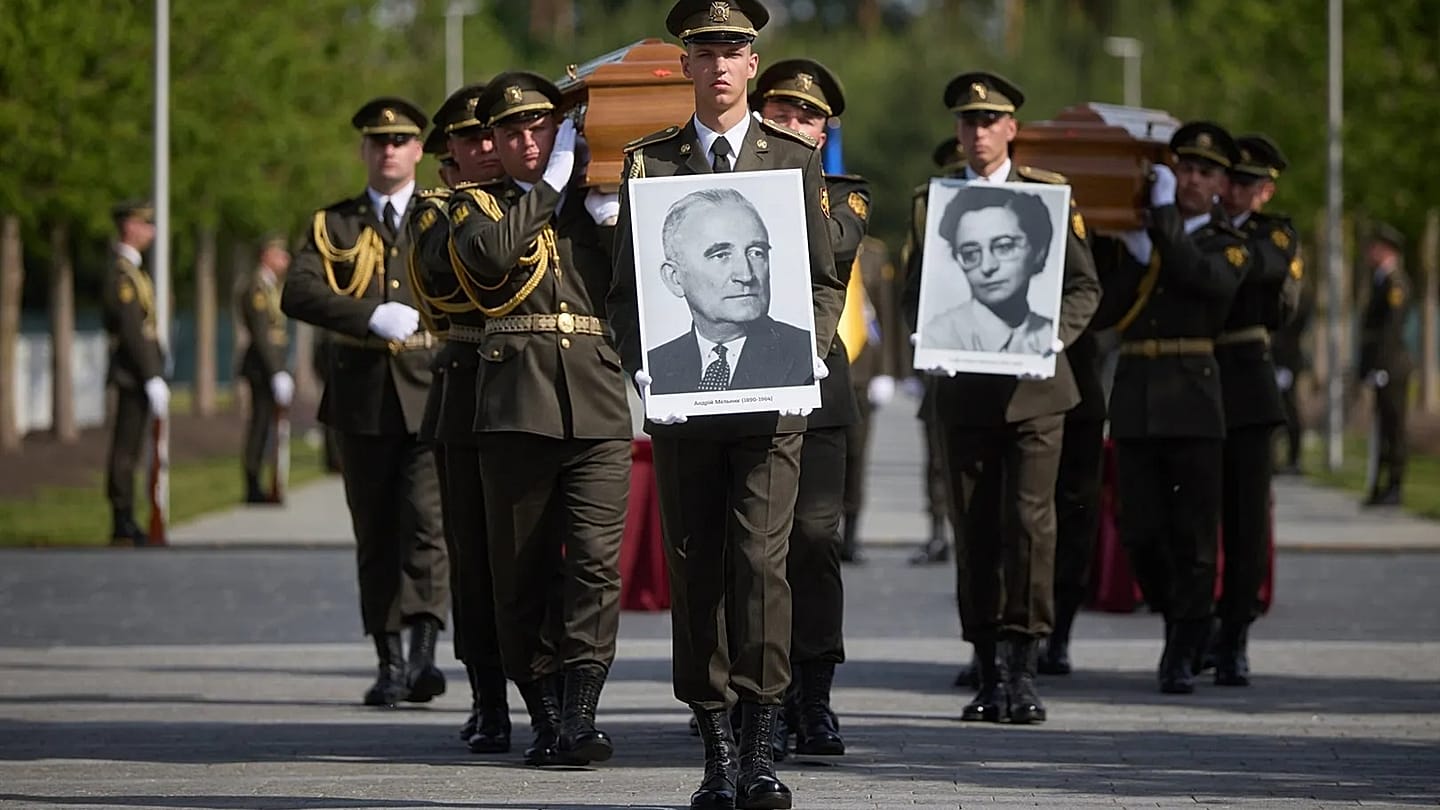
Ukraine has reburied the remains of Andrii Melnyk, a controversial nationalist leader from the World War II era, in a ceremony that underscores the country's ongoing struggle with its historical legacy. Melnyk, who led the Organisation of Ukrainian Nationalists (OUN), was repatriated from Germany and interred in Lviv, a city in western Ukraine that has long been a center of Ukrainian nationalism.
Melnyk's role during the war remains deeply divisive. While he fought for Ukrainian independence from Soviet domination, his faction of the OUN collaborated with Nazi Germany in the early 1940s, hoping to secure support for an independent Ukrainian state. This collaboration has made him a polarizing figure, particularly in light of the Holocaust and Nazi atrocities in Ukraine.
Historical Context and Controversy
The OUN split into two factions in 1940: one led by Melnyk, the other by Stepan Bandera. Both sought to exploit the chaos of war to achieve independence, but their tactics, including alliances with the Nazis, have been condemned by many historians. Melnyk's followers participated in some of the same violent campaigns that targeted Poles, Jews, and Soviet partisans, though the extent of his direct involvement remains debated.
For modern Ukraine, reburying Melnyk is part of a broader effort to reclaim national heroes from the Soviet era, when figures like him were vilified. However, it also risks alienating European allies who view such nationalist movements with suspicion. The ceremony in Lviv took place amid the ongoing war with Russia, which has used accusations of Nazi collaboration to justify its invasion.
European reactions have been mixed. Some historians argue that Ukraine must confront the darker aspects of its nationalist past, while others see the reburial as a legitimate act of historical reconciliation. The European Union, which has granted Ukraine candidate status, has not officially commented, but the issue touches on broader debates about memory politics in Central and Eastern Europe.
In a related development, Merz's 'Associate EU Membership' plan for Ukraine faces skepticism in Brussels, highlighting the complexities of Ukraine's integration into European structures. Meanwhile, European leaders have condemned Russia's use of the Oreshnik missile, a reminder of the ongoing conflict that shapes Ukraine's present.
The reburial also comes as Ukraine continues to grapple with its wartime history. Ukraine's drone pilots have turned combat training into high-speed tournaments, a sign of how the war is reshaping national identity. Yet, the legacy of figures like Melnyk remains a sensitive topic, especially as Ukraine seeks to build a democratic, European future.
For many Ukrainians, Melnyk represents a flawed but genuine patriot who resisted Soviet oppression. For others, especially Jewish and Polish communities, he is a reminder of the dark alliances that led to mass murder. The reburial in Lviv, a city that itself has a complex history of Polish, Ukrainian, and Jewish coexistence, reflects these tensions.
As Ukraine fights for its survival against Russian aggression, the reburial of Melnyk serves as a reminder that history is never simple. The country must navigate its past while building a future that aligns with European values of democracy and human rights. Whether this ceremony helps or hinders that process remains to be seen.