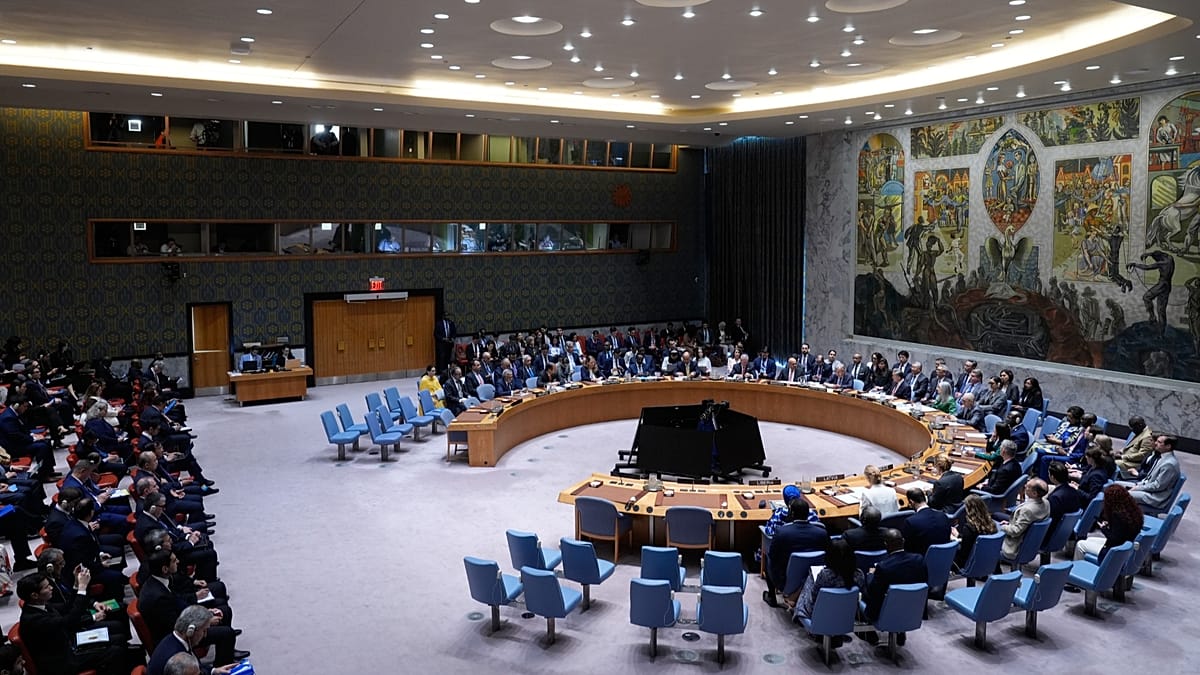
The United Nations Security Council is set to conduct its second informal straw poll on Friday to assess the standing of a growing list of contenders for the organisation's top administrative post. The vote, which carries no formal weight, offers a confidential snapshot of how the council's 15 members—including the five permanent veto-wielding nations—view each candidate.
Costa Rica's Rebeca Grynspan emerged as the front-runner after the first informal ballot in July, according to diplomatic sources. Her lead, however, is far from decisive, and the field has since expanded. Among the candidates are Rafael Grossi, the Argentine head of the International Atomic Energy Agency (IAEA); Michelle Bachelet, the former Chilean president; María Fernanda Espinosa of Ecuador; Carolyn Rodrigues-Birkett of Guyana; Olara Otunnu of Uganda; and Macky Sall, the former president of Senegal.
After the initial round, Ecuador's Ivonne A-Baki also entered the race to succeed António Guterres, whose second five-year term concludes on 31 December. The informal voting process, first devised in the early 1980s to break a deadlock between two vetoed candidates, has persisted despite criticism over its opacity.
What to watch in Friday's poll
Daniel Forti, a senior analyst at the International Crisis Group, noted that the second straw poll could provide clearer signals about the trajectory of the race. "While the first straw poll set the scene for the Secretary-General race, the second may give us some direction about where it is headed," he said. "Diplomats expect fluctuations in the vote distribution compared to the July poll. Most will be watching to see whether the early front-runners consolidate their support or slip in the standings."
Forti cautioned that no candidate is likely to emerge with a decisive lead from Friday's vote. He also suggested that the permanent members—France, Russia, China, the United Kingdom, and the United States—might hold back their preferences for now, and that new contenders could still appear. Russia's ambassador to the UN, Vassily Nebenzia, did not rule out that possibility. "If, for example, I'm speculating now, if there is a deadlock on any of the candidates we are seeing today, if nobody... flies, then I think that we may see other candidates as well," Nebenzia said on Thursday.
The straw poll requires each member state to anonymously label each candidate as "encourage," "discourage," or "no opinion." This mechanism allows candidates with little support to withdraw gracefully, though they are under no obligation to do so. In the early rounds, all ballots are identical in colour. After an unspecified number of votes, the ballots of the five permanent members are printed on a different colour paper, making it possible to identify potential vetoes without revealing which country cast them.
To secure the nomination, a candidate must obtain at least nine votes in favour from the 15 council members and avoid a veto from any of the five permanent powers. If successful, the name is forwarded to the General Assembly for confirmation. The permanent members are deeply divided on many global issues, which could complicate the selection process.
Forti added that some candidates may conclude after Friday's vote that their campaigns have reached the end of the road. "There is a good chance that some nominees realise after (Friday's) vote that their campaigns have reached the end of the road," he said.
Traditionally, the secretary-general role rotates among regions. Under that convention, the next secretary general should come from Latin America, which explains the large number of candidates from that region. However, Sall and Otunnu are from Africa, and their candidacies could complicate the regional calculus.
The outcome of Friday's poll will be closely watched in European capitals, where the UN's leadership is seen as crucial for multilateral cooperation on issues ranging from climate change to conflict resolution. The eventual appointment will shape the UN's agenda for the next five years, with implications for European foreign policy and global governance.