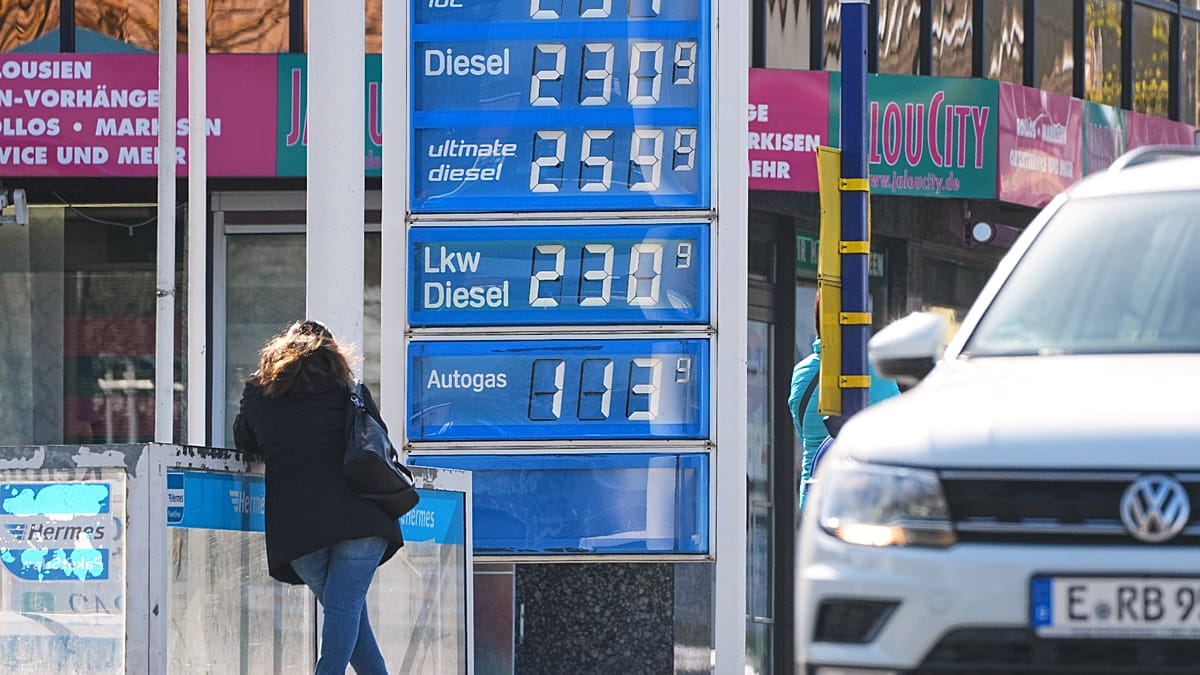
The prospect of Washington restricting diesel exports has unsettled European capitals, even if the immediate impact would not be empty pumps. The real concern is price pressure and the strategic exposure it reveals, just as households, farmers and hauliers are already grappling with high energy costs.
Brussels has acknowledged the bloc's growing reliance on American diesel since it turned away from Russian energy. The European Commission says it is discussing the matter with member states and industry, but the uncomfortable truth is that Europe has few quick alternatives if US barrels stay at home.
The timing is awkward. Europe is already dealing with a fuel squeeze after the war with Iran disrupted Middle Eastern supplies, and Russia has also restricted its diesel exports. European diesel prices have more than doubled since the start of the year and were roughly 38% higher year-on-year in mid-September. Refineries worldwide are running near full capacity, leaving little slack in the system.
A tight market gets tighter
Analysts argue that a US export ban would remove a crucial source from an already exceptionally tight global market. Zameer Yusof, an energy analyst at market intelligence platform Kpler, told Euronews: “For Europe, the immediate effect is higher prices. North-West Europe would have to bid up to pull in replacement cargoes, and it would be bidding against the Mediterranean, Latin America and West Africa for the same limited pool of barrels.”
The EU's dependence on US diesel has grown sharply since the loss of Russian supplies. This year, the US has provided around 180,000 barrels per day (b/d) of the EU's roughly 580,000 b/d of extra-EU diesel imports — about 32%, up from 17% in 2025. The concentration is even more striking in North-West Europe, where US supplies account for about 200,000 b/d out of 350,000 b/d from outside the region — roughly 57%, compared with 37% last year, according to Kpler.
That concentration means even a partial US ban could have a sizeable impact on prices. However, Kpler notes that removing 30% of US supplies would not necessarily translate into a 30% price rise. Instead, buyers would be forced to compete aggressively for replacement barrels, potentially pushing prices sharply higher.
France and the UK in the firing line
Within the EU, France appears the most vulnerable. President Emmanuel Macron has called the proposed ban “catastrophic”. The country faces elections in 2027, and the energy crisis is fuelling far-right rhetoric. Macron has already asked the Commission to temporarily relax fuel specifications so European refineries could produce more diesel and jet fuel, and urged Brussels to coordinate a second release of emergency oil reserves.
A US export ban would strengthen that argument: if Europe cannot count on imported refined fuel, it needs to squeeze more output from its own refineries. But European refineries cannot manufacture hundreds of thousands of additional barrels overnight. Paris imported about 63,000 b/d of US diesel this year, around 36% of its diesel imports. Its dependence is compounded by refinery closures at Grandpuits and Donges, leaving the country structurally short of diesel, Kpler warned.
The UK is also heavily exposed, importing about 50,000 b/d from the US, or 26% of its diesel imports. The closure of the Grangemouth refinery has increased its reliance on imports.
There is one cushion: diesel is among Europe's most heavily stored oil products, meaning inventories could absorb at least part of an initial disruption. That could prevent an immediate shortage, though it would not eliminate the underlying price pressure if the ban were to last.
Southern European markets have somewhat more protection from domestic and Mediterranean refining. Italy gets only around 4% of its diesel imports from the US, while Spain gets about 19%. Portugal is barely exposed. Spain's Cartagena, Bilbao and Huelva refineries provide an important domestic supply buffer.
Few obvious replacements
The bigger problem is what happens after the initial stocks are used. Europe cannot simply replace American diesel with another major supplier. “India is the only credible substitute, but its export availability has been affected sharply,” Yusof said.
Indian exports have already fallen sharply — from around 582,000 b/d last year to 352,000 b/d this year. Indian diesel shipments to Europe have declined even more dramatically, from about 163,000 b/d to roughly 50,000 b/d. Indian refiners are instead finding better returns in East Africa and Southeast Asia, while questions over Russian crude used in some Indian refineries also complicate European trade.
China and South Korea cannot realistically fill the gap either. Their diesel shipments to Europe this year were tiny — roughly 1,000 b/d from China and 2,000 b/d from South Korea. China faces EU restrictions on products made from Russian crude, while South Korea's exports are tied up by established contracts in Asian markets and its overall export availability has declined.
Rethinking energy security
The diesel episode exposes a deeper weakness in Europe's energy strategy. The EU's current predicament raises questions about whether the bloc needs larger strategic stocks of refined fuels, more refinery capacity, and a more diversified set of suppliers. As Brussels warns that US curbs could backfire on both sides, the underlying issue remains: Europe's energy security cannot be taken for granted.
The immediate focus is on price relief, but the longer-term lesson is that dependence on a single supplier — even a friendly one — is a risk. The EU has already seen how quickly commercial ties can become strategic vulnerabilities, and the diesel case is a stark reminder. As rising prices push up food costs across the continent, the pressure on governments to act is mounting.
Some member states are already taking steps. Czechia has capped fuel margins and trimmed diesel duty to ease the burden on consumers. But such measures are stopgaps. The real test is whether Europe can build a more resilient fuel supply chain before the next crisis hits.