More than four years into its full-scale war against Ukraine, Russia has transformed its unmanned aerial arsenal from a reliance on a single Iranian design into a diversified family of attack drones. The shift is not merely tactical; it reflects an industrial push that now threatens European territory far beyond the front lines.
According to a recent CIA assessment, Moscow is exploring the possibility of launching drone strikes against targets in Spain, France, or Italy from containers aboard vessels of its so-called shadow fleet in the Mediterranean. The warning has prompted reactions from European leaders, including French President Emmanuel Macron, who dismissed the claim that the CIA had directly warned France. Nevertheless, the threat is taken seriously by NATO planners, especially after repeated incursions into Polish and Bulgarian airspace by Russian drones.
A night of 233 targets over Ukraine
Ukrainian air defences faced one of the most intense bombardments of the war on the night of 27 August, when they intercepted or neutralised 233 Russian targets. The barrage included 258 attack drones, two Oniks anti-ship missiles, and several Iskander-M and KN-23 ballistic missiles. According to the Ukrainian Air Force, roughly a third of those drones were jet-powered, while the remainder comprised Shahed-type systems, Gerbera decoys, and Banderol missiles.
That mix illustrates the evolution of Russia's unmanned fleet: it is no longer a single model but a coordinated set of systems designed to saturate defences with cheap swarms and punch through with high-speed jets. The economic logic is brutal. Intercepting a drone worth between €25,000 and €40,000 with a missile costing over a million euros is unsustainable, and Moscow is exploiting that asymmetry by launching waves that exhaust Western-supplied air-defence systems.
Alabuga: the drone factory under threat
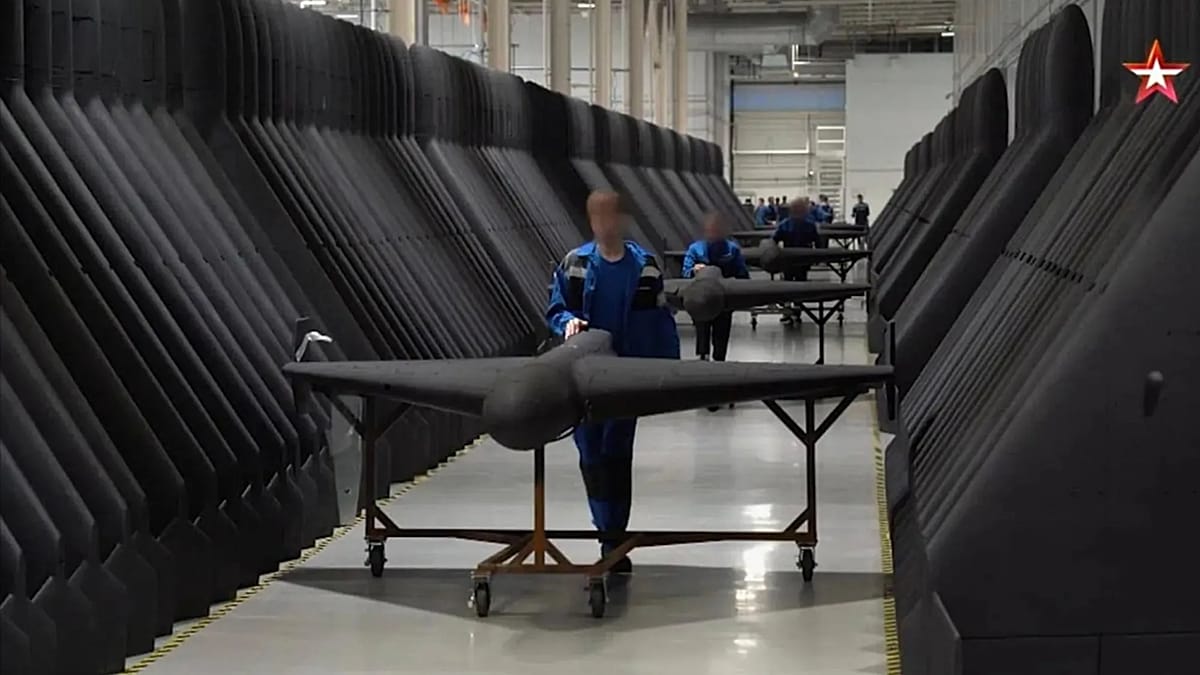
The heart of Russia's drone production lies in the Alabuga Special Economic Zone in Tatarstan, about 1,200 kilometres from Ukraine. The complex spans more than 2.8 million square metres, with an estimated 15% of its facilities dedicated to war production. There, composite fuselages are moulded, engines manufactured, and electronics assembled.
Ukrainian strikes have forced Moscow to move much of this production underground. A Ukrainian open-source analyst estimates that around 42,000 square metres of underground space have been built at Alabuga—the equivalent of six football pitches. According to Russian media cited by The Economist, daily production of Geran-2 drones already exceeds 100 units, with plans to reach 500 a day. The Geran-2 is the Russian version of the Iranian Shahed-136.
Overall output estimates vary, but they all point upward. The Centre for Strategic and International Studies calculated that in March 2026 Russia was producing around 5,500 drones a month. Ukrainian military intelligence put August output at roughly 3,000 Geran-4 and Geran-5 drones and some 2,800 Geran-2s. In March 2026 alone, Russia launched 6,462 Shahed-type drones and related systems, an average of 208 per day, with peaks exceeding 900.
From Shahed to Geran: the evolution of speed
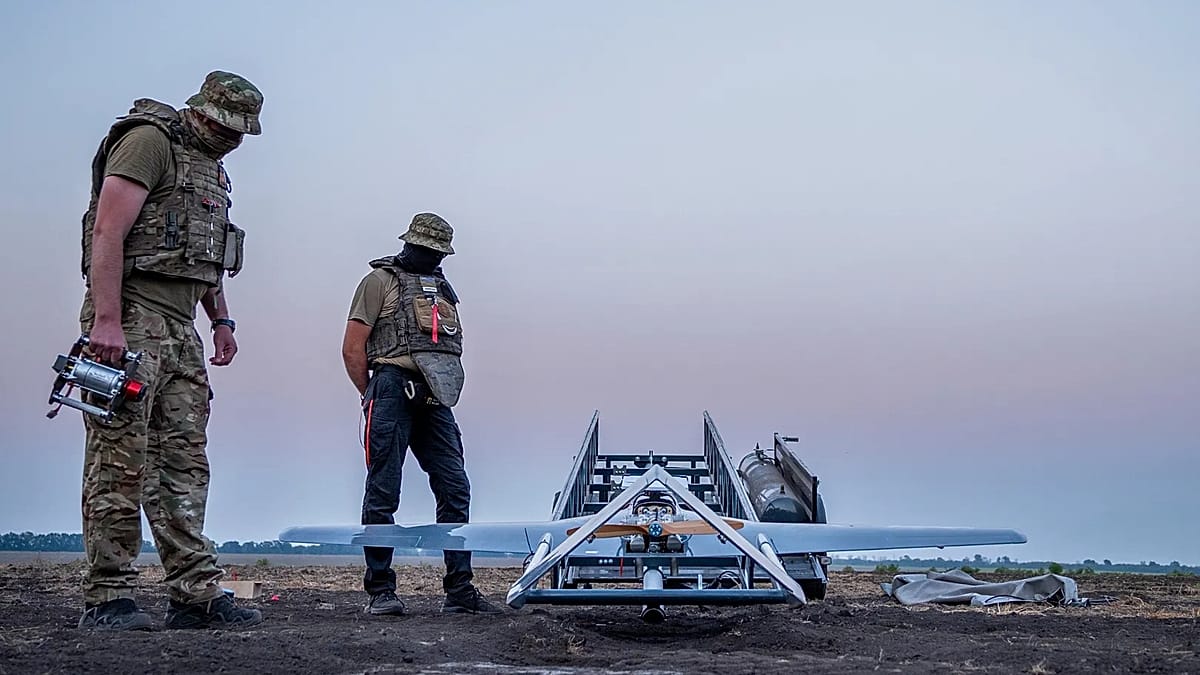
The Geran-2, based on the Iranian Shahed-136, has been the workhorse since 2022. It is 3.5 metres long with a 2.5-metre wingspan, weighs around 200 kilograms, and is powered by a Mado MD-550 piston engine. It cruises at about 185 km/h and has a range of 1,000 to 2,500 kilometres depending on the version. Its warhead typically weighs between 30 and 50 kilograms, combining conventional explosives with thermobaric material. Each unit costs between $20,000 and $50,000, making it a cheap weapon against expensive defences.
As Ukrainian interceptors improved, Russia introduced jet-powered variants. The Geran-3, based on the Shahed-238, reused the Geran-2 fuselage with an added turbojet, reaching speeds of 300 to 370 km/h and a range of nearly 1,000 kilometres. Ukrainian intelligence found dozens of foreign components in its wreckage, including parts from US, Chinese, and European manufacturers.
The Geran-4 followed with a completely redesigned fuselage, featuring integrated fixed wings to reduce drag. It maintains similar dimensions to the Shahed but with improved aerodynamics. The Geran-5, the latest in the series, is believed to be even faster and more capable, though details remain scarce.
This technological leap has implications beyond Ukraine. If Russia can launch drones from ships in the Mediterranean, southern European countries like Spain, France, and Italy would face a new aerial threat. The CIA's warning, though disputed by Macron, underscores the need for vigilance. As Danish intelligence notes, a Russian attack on NATO is unlikely but possible, and the drone threat is one of the more plausible scenarios.
Meanwhile, Russia's reliance on foreign components and even North Korean labour highlights the strain on its industrial base. The EU has continued to condemn Russia's actions at international forums, and will keep doing so regardless of Putin's attendance. But the drone threat is a reminder that the war's reach extends far beyond the Donbas, and Europe must prepare for a new era of unmanned warfare.