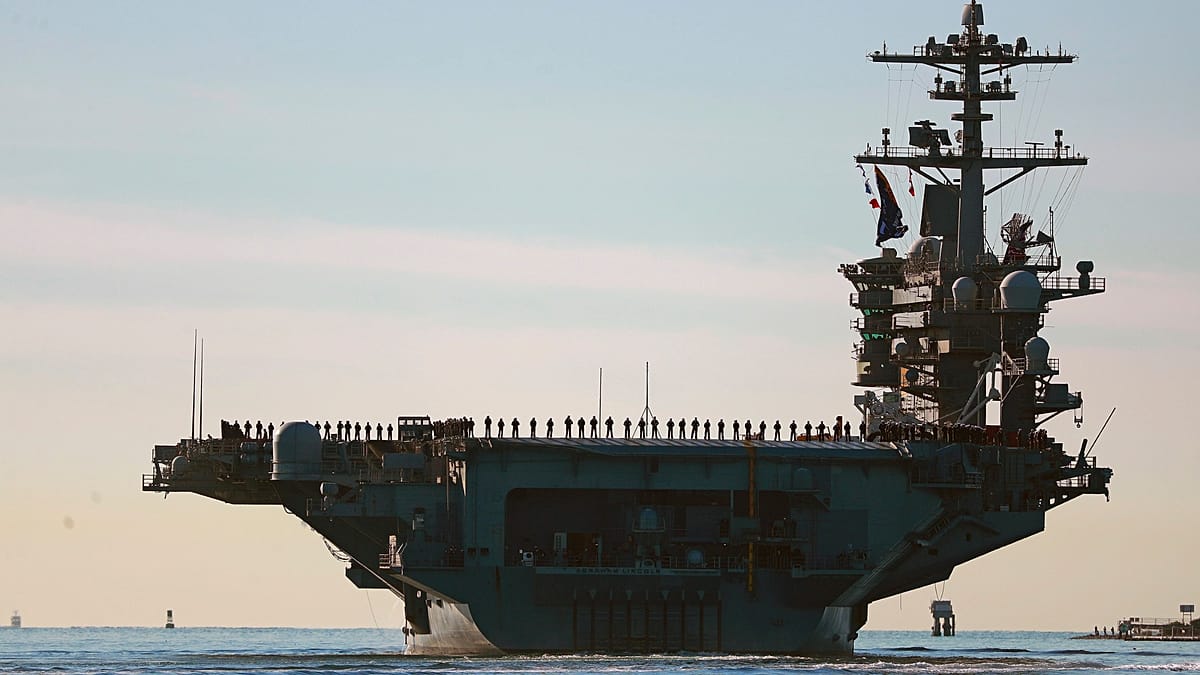
The US military has pushed back against mounting reports of a mental health crisis and deteriorating living conditions aboard the USS Abraham Lincoln, an aircraft carrier that has been deployed for more than 260 days in support of operations in the Middle East. In a social media post, US Central Command (CENTCOM) dismissed the reports as “several false claims” and “rampant misreporting,” insisting that the crew remains “resilient and resolved.”
The Abraham Lincoln, one of the largest warships in the world and a Nimitz-class carrier, has been at sea far longer than originally planned, as Washington’s military campaign against Iran continues. Concerns about the welfare of the roughly 5,000 sailors on board have grown in recent days, with reports of shortages of basic supplies, water contamination, plumbing failures, deck safety issues, and disruptions to mail delivery that have delayed care packages for months.
Senator Richard Blumenthal, a Democrat from Connecticut, wrote to Secretary of Defense Pete Hegseth and acting Secretary of the Navy Hung Cao on Wednesday, demanding answers. In his letter, Blumenthal cited “widespread reports” of the problems and noted that “recent carrier deployments have repeatedly stretched beyond their originally anticipated durations.” He asked what steps the Pentagon is taking to address the situation.
Speaking during a trip to Panama on Thursday, Hegseth rejected the accounts, which were first published by military outlets such as the Navy Times and Stars and Stripes. “Completely misrepresented,” he said. “We make sure that every ship, every crew, every captain has everything we can provide them at every single moment. Some deployments are longer than others, and I have more respect and gratitude for those sailors than anybody.”
CENTCOM has confirmed that one sailor “fell overboard” on 3 August but said the individual was “quickly and safely recovered” from the water. No further details were provided.
The controversy comes as the US military reportedly prepares to rotate the USS George Washington into the region to take over from the Abraham Lincoln. The move, if confirmed, would end one of the longest carrier deployments in recent memory, though the Pentagon has not officially announced a timeline.
Long deployments and crew strain
The Abraham Lincoln has been operating as part of Operation Epic Fury, the military campaign ordered by President Donald Trump against Iran. The carrier’s role includes launching fighter aircraft, supporting ground troops, and conducting maritime security operations, including protecting merchant shipping in the strategically vital waters near the Strait of Hormuz.
Extended deployments are not new for the US Navy, but they have become more frequent as the military juggles multiple global commitments. The strain on crews is a growing concern, not only for the US but also for its allies in Europe, who rely on the stability of the region and on US naval power to safeguard trade routes. European navies, including those of France and the UK, often operate alongside US carriers in the region, and any degradation in US readiness has ripple effects on NATO’s broader posture.
The reports from the Abraham Lincoln echo broader discussions about the mental health of military personnel, a topic that has also gained attention in European armed forces. As research on isolation and mental health shows, prolonged confinement and high-stress environments can take a toll, whether in space or at sea.
While the US military insists that conditions on the Lincoln are being misrepresented, the senator’s letter and the reported relief suggest that the issue is being taken seriously at the highest levels. For now, the crew remains on station, but the prospect of a handover to the George Washington offers a glimmer of hope for sailors who have spent nearly nine months away from home.
The situation also highlights the broader strategic calculus in the Middle East, where tensions with Iran remain high. As Iran’s military has dismissed US claims about control of the Strait of Hormuz, the presence of US carriers remains a key element of deterrence. Any reduction in US naval capability could shift the balance in a region that Europe watches closely for its energy security and trade.
For now, the Abraham Lincoln’s crew continues its mission, but the debate over their welfare is unlikely to fade quickly. The Pentagon’s response, and the promised rotation, will be closely watched by both American lawmakers and European allies who depend on a stable and well-supported US military presence.