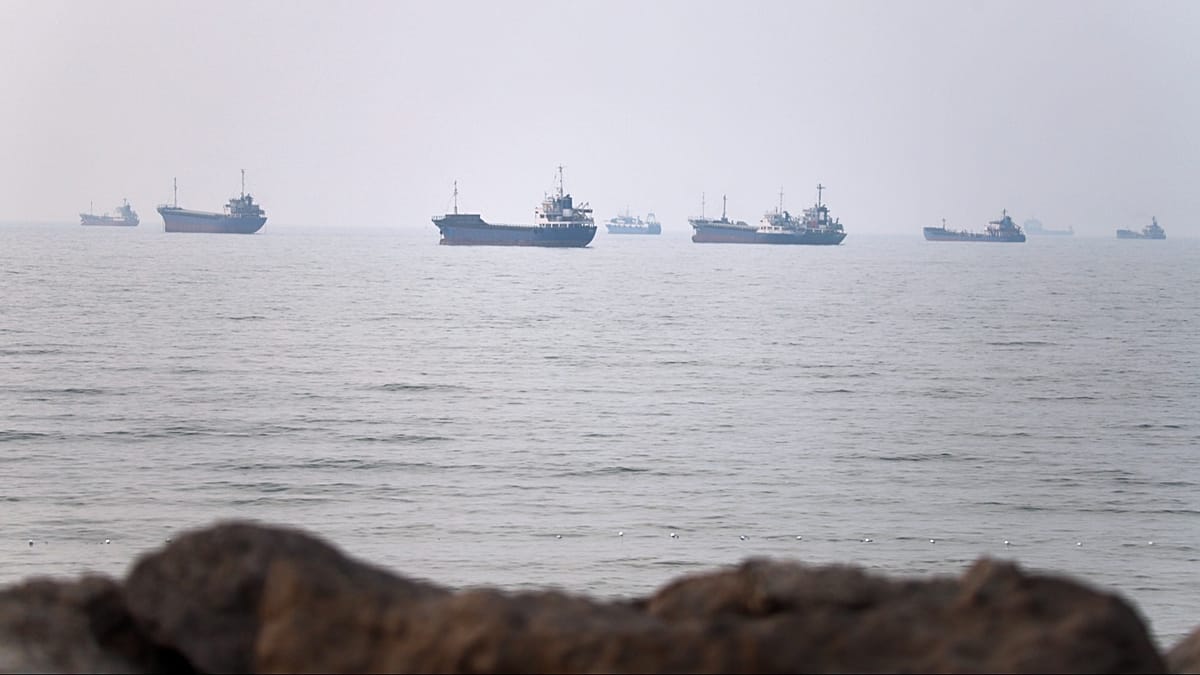
The conflict over the Strait of Hormuz escalated sharply on Tuesday as Iran's Revolutionary Guard Corps (IRGC) claimed to have struck US military installations in Bahrain and Kuwait, while a tanker was attacked in the strategic waterway, forcing its crew to abandon ship. The developments mark the tenth consecutive night of US strikes against Iranian targets, raising fears of a broader confrontation that could disrupt global energy markets.
According to Iranian state media, the IRGC said it hit two air defence systems and a radar at US posts in Bahrain, as well as missile defence radars and satellite receiving systems in Kuwait. In a statement, the Guards warned: "With this radar sweep, the enemy should prepare for even more decisive and powerful waves of drone and missile attacks."
The IRGC also claimed it stopped "two non-compliant oil tankers" attempting to pass through the "unsafe southern route of the Strait of Hormuz" after explosions caused fires on the vessels. The United Kingdom Maritime Trade Operations agency (UKMTO) confirmed it received reports of a tanker off Oman that had been hit by an unknown projectile, with the crew abandoning the ship in a lifeboat.
US Military Escalation
US Central Command (CENTCOM) announced that American forces had completed their tenth consecutive night of strikes against Iran, targeting sites aimed at degrading Tehran's ability to attack ships transiting the strait. "US forces struck Iranian military command centers, maritime capabilities, missile and drone launch sites, and air defence systems to degrade Iran's ability to continue attacking commercial vessels flowing through the Strait of Hormuz," CENTCOM wrote on X. The statement added that American forces "remain postured and prepared to hold Iran accountable for unwarranted aggression toward civilian mariners."
The strait, a narrow channel between Oman and Iran through which about 20% of the world's oil passes, has seen traffic come to an almost complete halt in recent weeks. Brent crude rose 3.2% to $90.95 per barrel, while US benchmark crude climbed 2.8% to $84.04 per barrel, as markets reacted to the growing instability.
For European consumers and businesses, the disruption poses a direct threat. The European Union imports roughly a quarter of its oil from the Middle East, and any sustained closure of the Strait of Hormuz would drive up energy prices across the continent, compounding inflationary pressures already felt from the war in Ukraine. The bloc's reliance on liquefied natural gas (LNG) from Qatar, which also transits the strait, adds another layer of vulnerability.
This latest escalation follows a pattern of tit-for-tat strikes that have intensified since the US began its campaign. As reported earlier, traffic through the strait had already stalled after the ninth night of bombardment, and the situation has only worsened.
Diplomatic Efforts Amid Conflict
Despite the military escalation, diplomatic channels remain open. On Monday, Iranian Interior Minister Eskandar Momeni arrived in Islamabad for talks with Prime Minister Shehbaz Sharif and other Pakistani officials. Pakistan has emerged as a key mediator in the conflict, though it remains unclear whether the talks will directly address mediation efforts.
A day earlier, US Secretary of State Marco Rubio signalled a willingness to negotiate, telling reporters that the US is open to talks with Iran but that any deal must be "real" and one that Iran is "willing to live by." The comments suggest that while both sides are engaged in military posturing, there may be room for a diplomatic resolution—though the path forward remains uncertain.
The broader regional context adds to the complexity. The Houthi movement in Yemen, backed by Iran, has threatened to close the Bab el-Mandeb Strait, another critical chokepoint for global shipping. As European Pulse has noted, such a move would further endanger European trade routes, particularly for container ships and oil tankers heading to Mediterranean ports.
For European policymakers, the crisis underscores the continent's dependence on stable maritime chokepoints. The European Commission has yet to issue a formal statement on the latest developments, but EU foreign ministers are expected to discuss the situation at their next meeting. Some member states, particularly France and Italy, have naval assets in the region that could be deployed to protect shipping, though any such move would require careful coordination with NATO allies.
As the conflict enters its tenth night, the human and economic toll continues to mount. The attack on the tanker off Oman is a stark reminder of the risks faced by civilian mariners, while the spike in oil prices threatens to squeeze households and businesses across Europe. Whether diplomacy can prevail over military action remains the central question.