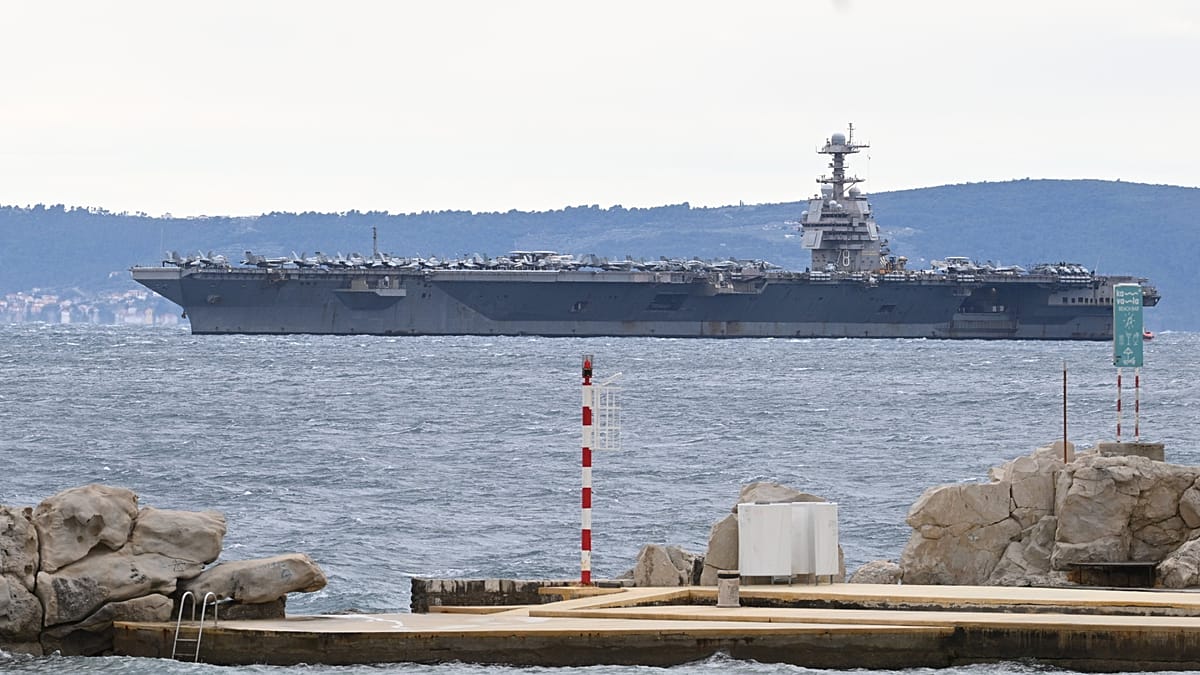
The world's largest aircraft carrier, the USS Gerald R. Ford, is returning to the United States after a deployment that has set a post-Cold War record. The vessel has spent more than 300 days at sea, surpassing the previous benchmark of 294 days set by the USS Abraham Lincoln in 2020. Its missions included operations in the Iran war and the US operation in Venezuela that led to the capture of Nicolás Maduro.
The Ford is expected to leave the Middle East shortly and arrive at its home port of Naval Station Norfolk, Virginia, in mid-May, according to US officials who spoke on condition of anonymity. The ship departed from Norfolk in late June 2025, initially heading to the Mediterranean Sea before being rerouted to the Caribbean in October.
A Deployment Marked by Repairs and Setbacks
The deployment was not without incident. On 12 March, a fire broke out in the carrier's laundry room, forcing it to return to the Mediterranean for repairs. The ship docked at a port in Greece before being transferred to Croatia for further maintenance. Despite these interruptions, the Ford's 295th day at sea broke the post-Cold War record, according to data from the US Naval Institute. The overall record remains with the USS Midway, which spent 332 days at sea during the Vietnam War.
With a displacement of 100,000 tonnes and a length of 334 metres, the Ford is a formidable presence. Its flight deck can accommodate more than 75 jets, though it typically operates with an air wing of 60 to 70 aircraft. The carrier is widely regarded as the most powerful and advanced in the US Navy.
The Ford's return comes as three US aircraft carriers are currently deployed to the Middle East, a concentration not seen since 2003. The USS Abraham Lincoln has been in the region since January, and the USS George HW Bush arrived last week, heading to the Arabian Sea to support the US blockade of Iranian ports.
For European observers, the Ford's deployment underscores the US Navy's enduring presence in the Mediterranean and Middle East, regions that directly affect European security and energy routes. The carrier's stops in Greece and Croatia also highlight the logistical ties between US naval operations and European ports. As the EU continues to debate its own defence autonomy, the reliance on US naval power remains a central factor in transatlantic relations.
The record-breaking deployment also coincides with broader geopolitical shifts. The Iran war has driven volatility in global energy markets, with European banks like Deutsche Bank and Santander posting record profits amid the turmoil. Meanwhile, the EU is pushing for stricter shipping emissions rules at the International Maritime Organization talks in London, a policy that could affect naval logistics and commercial shipping alike.
As the Ford heads home, its journey marks not just a naval milestone but a reminder of the interconnected security landscape that links the United States, Europe, and the Middle East.