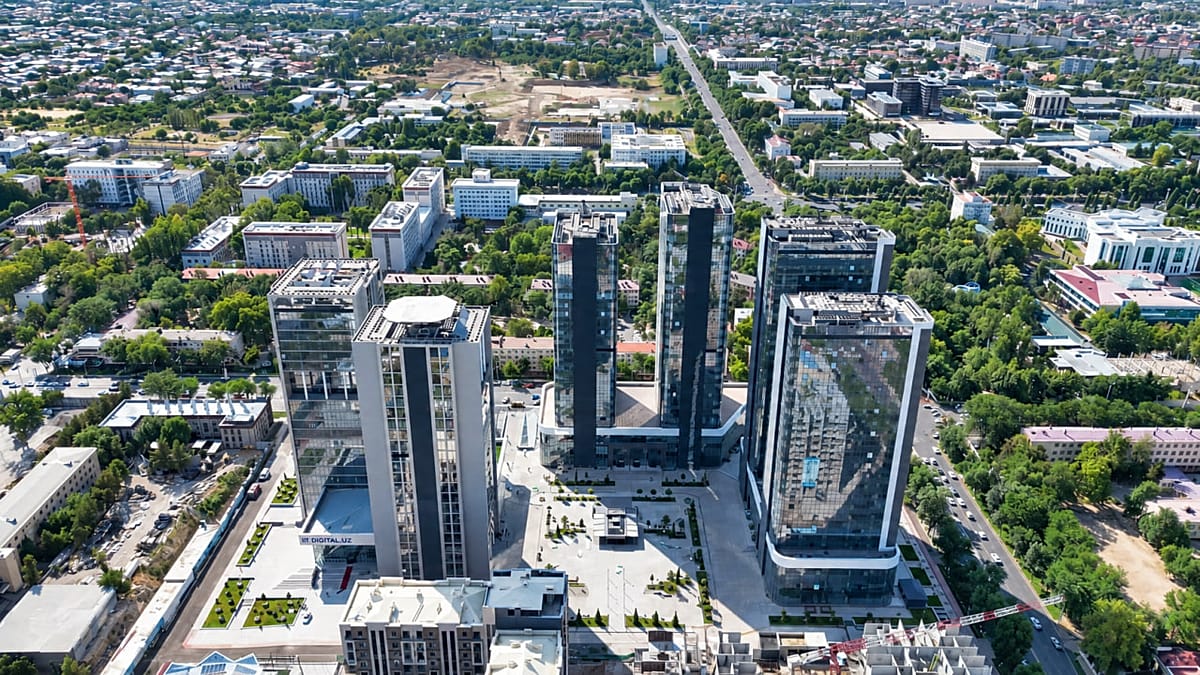
Uzbekistan is constructing a financial hub in Tashkent that would operate under English common-law principles, and officials are openly courting the City of London for legal and financial expertise as they try to convert diplomatic warmth into foreign investment.
The Tashkent International Financial Centre was created by presidential decree in March and will sit inside Uzbekistan's civil-law system while offering companies a separate commercial regime, an independent international commercial court and arbitration mechanisms. President Shavkat Mirziyoyev approved organisational measures to launch the centre on 10 September.
"The United Kingdom might offer its own investment expertise and of course English common law," Javlon Vakhabov, director of the International Institute for Central Asia, said at the inaugural Central Asia–UK Think Tank Forum in Tashkent. He said Uzbekistan wants the centre to cooperate with British counterparts, "particularly with the City of London".
English law as an investment signal
The arrangement would not displace Uzbekistan's wider civil-law framework. Instead, firms registered through the centre would gain access to rules and dispute-resolution machinery familiar to international business — a deliberate signal to investors who treat legal certainty as a precondition rather than a bonus.
That logic has already produced a concrete result. In May, the National Investment Fund of Uzbekistan, managed by Franklin Templeton, became the first Uzbek fund to list internationally when it debuted in London. Further state-linked companies are being prepared for potential listings as Tashkent seeks private capital alongside stronger financial reporting and corporate-governance standards.
The push fits a broader pattern of European and British institutions deepening ties with Central Asia. The first CA5+UK foreign ministers' meeting was held in London in February, and Vakhabov described relations as entering a "new and more structured phase". The wider trend of like-minded partners building investment blocs is visible elsewhere too, as with the Carpathian Eight investment bloc proposed by Ukraine's president.
From political dialogue to bankable projects
Across the Tashkent discussions, participants returned repeatedly to the gap between political interest and investable projects. Rebecca Nadin, director of global risks and resilience at ODI Global, identified critical minerals, agriculture, education, technology, digitalisation and artificial intelligence as areas of potential cooperation.
"What we need to do is find the mechanisms to make those opportunities into commercially viable projects," she said.
Critical minerals offered the clearest test case. Uzbekistan and other resource-rich Central Asian states have said they want to move beyond exporting raw materials and retain more of the value created through processing and manufacturing.
"It requires the legislative processes to be in place; it requires the investors to have confidence," Nadin said. "And it requires, most importantly, the ability to transport those goods from source to market."
A separate session on investor confidence catalogued what access to international capital typically demands: due diligence, anti-money-laundering rules, procurement standards, transparency, sanctions compliance and reputational risk management. Legal certainty, protection of investors' rights and commercial dispute-resolution mechanisms were also on the list. British expertise in finance, English law, arbitration and compliance was repeatedly cited as relevant to meeting those requirements.
Research, processing and finance
Kirsty Benham, co-founder and chief executive of the Critical Minerals Association UK, pointed to partnerships with British universities and research institutions, specialist training for geologists, engineers and environmental scientists, and cooperation on mineral processing. She also raised the recovery of materials from mining waste and tailings, and possible processing arrangements between countries.
Financing models were discussed as well. One option involved UK-backed finance for overseas critical-mineral projects tied to long-term agreements to supply British manufacturers. These were presented as possible areas for cooperation rather than announced commitments.
Annette Bohr, an associate fellow at Chatham House's Russia and Eurasia Programme, highlighted a structural difference between British economic engagement and models in which governments can mobilise state-controlled companies behind strategic projects. "These Western firms are not state-run," she said. "So that's automatically an impediment."
For Tashkent, the bet is that English common law, an independent court and a London listing pipeline will together persuade private investors that Uzbek assets are worth the diligence. Whether that bet pays off will depend less on the legal architecture itself than on the slower work of building the compliance, transport and governance record that international capital expects.