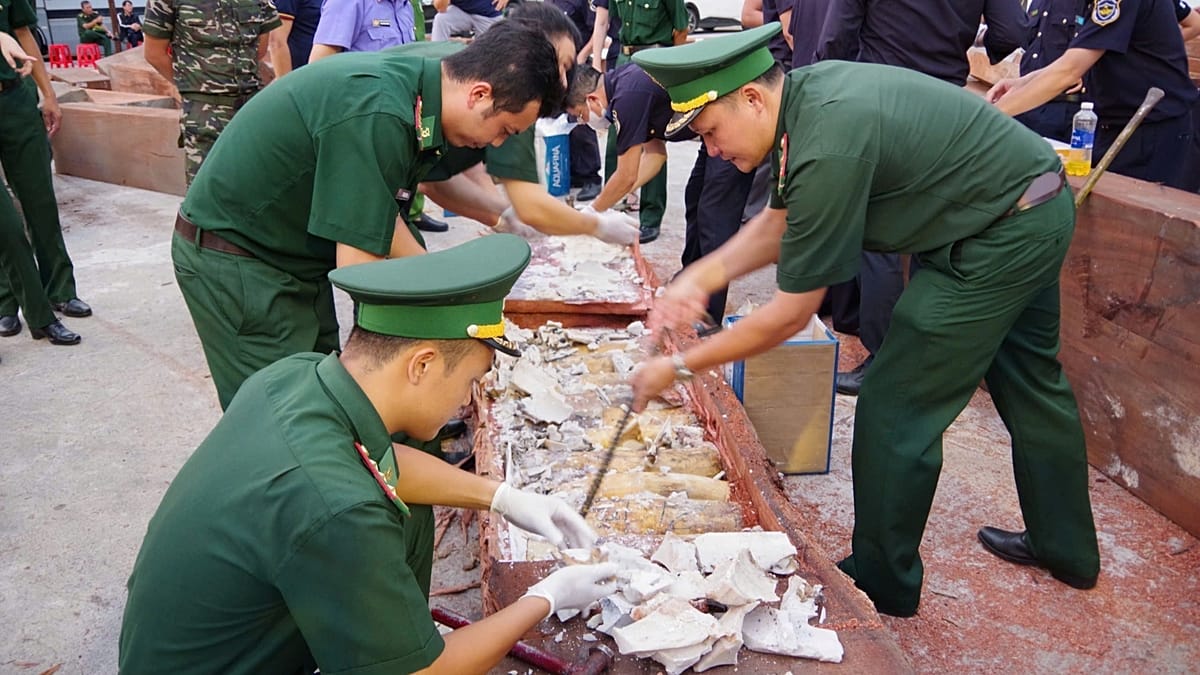
Vietnamese authorities have announced the seizure of more than a tonne of elephant ivory that was illegally shipped from Africa, according to state media reports on Thursday. The discovery was made at Quy Nhơn port in the central province of Gia Lai, where officials displayed 221 pieces of ivory weighing a total of 1,193 kilograms to journalists.
The contraband was hidden inside sawn timber in three containers that arrived on 9 July, according to the Vietnam News Agency and other outlets. Alongside the ivory, inspectors found 79.3 kilograms of animal bones believed to come from big cats such as tigers. Crushed bones of this kind are prized in traditional Chinese medicine, a factor that fuels the illicit trade.
Gia Lai Provincial Police said the shipment originated in the Republic of the Congo, and a criminal investigation has been opened for violating regulations on protected animals. The seizure is the largest ever recorded at Quy Nhơn, though it is dwarfed by previous hauls in Vietnam's larger ports: Danang and Haiphong have each seen ivory seizures exceeding seven tonnes in the past decade.
A persistent hub for wildlife trafficking
Vietnam has long been a major transit point for illegal wildlife products, both live animals and their parts. Much of the contraband is ultimately destined for China, but domestic demand in Vietnam and neighbouring Southeast Asian countries also sustains the trade. The country's extensive coastline and busy container ports make it an attractive entry point for smugglers.
The ivory trade is largely prohibited under the Convention on International Trade in Endangered Species of Wild Fauna and Flora (CITES), a treaty signed by nearly all UN member states. Despite the ban, enforcement remains uneven, and seizures like this one highlight the scale of the problem. Conservation groups have repeatedly called for stronger penalties and better cross-border cooperation to disrupt trafficking networks.
This latest bust comes as European authorities have also stepped up efforts to intercept illegal shipments. In a separate operation, Portuguese-led forces recently seized five tonnes of cocaine in the Atlantic, underscoring the broader challenge of maritime smuggling. While the commodities differ, the methods—concealment in cargo, false documentation, and exploitation of busy ports—are strikingly similar.
The ivory found at Quy Nhơn was reportedly packed in timber, a common technique used to evade X-ray scanners and physical inspections. Customs officials only discovered the contraband during a routine clearance check, raising questions about how much more goes undetected.
Vietnam's role in the illegal wildlife trade has drawn international criticism, but authorities have made some high-profile arrests in recent years. In 2019, police in Haiphong seized 7.5 tonnes of ivory hidden in containers from Nigeria, and in 2020, Danang customs intercepted 7.2 tonnes. These cases, however, rarely lead to convictions of the masterminds behind the networks.
The latest seizure also highlights the connection between wildlife trafficking and other forms of organised crime. Interpol has noted that the same routes used for ivory are often used for drugs, arms, and counterfeit goods. A recent EU operation that seized 20 million counterfeit cigarettes and 38 tonnes of tobacco illustrates the breadth of illicit trade that European agencies are tackling.
For now, the focus in Gia Lai is on identifying the individuals and companies behind the shipment. Police have not yet announced any arrests, but the investigation is ongoing. Conservationists hope that the publicity surrounding this seizure will deter others, though they remain sceptical given the lucrative nature of the trade.
As Europe and Africa grapple with the consequences of wildlife crime, the need for international cooperation has never been clearer. The ivory that arrived in Vietnam from the Congo travelled thousands of kilometres, crossing multiple borders and jurisdictions. Disrupting such networks requires not just vigilant customs officials, but also political will and shared intelligence across continents.