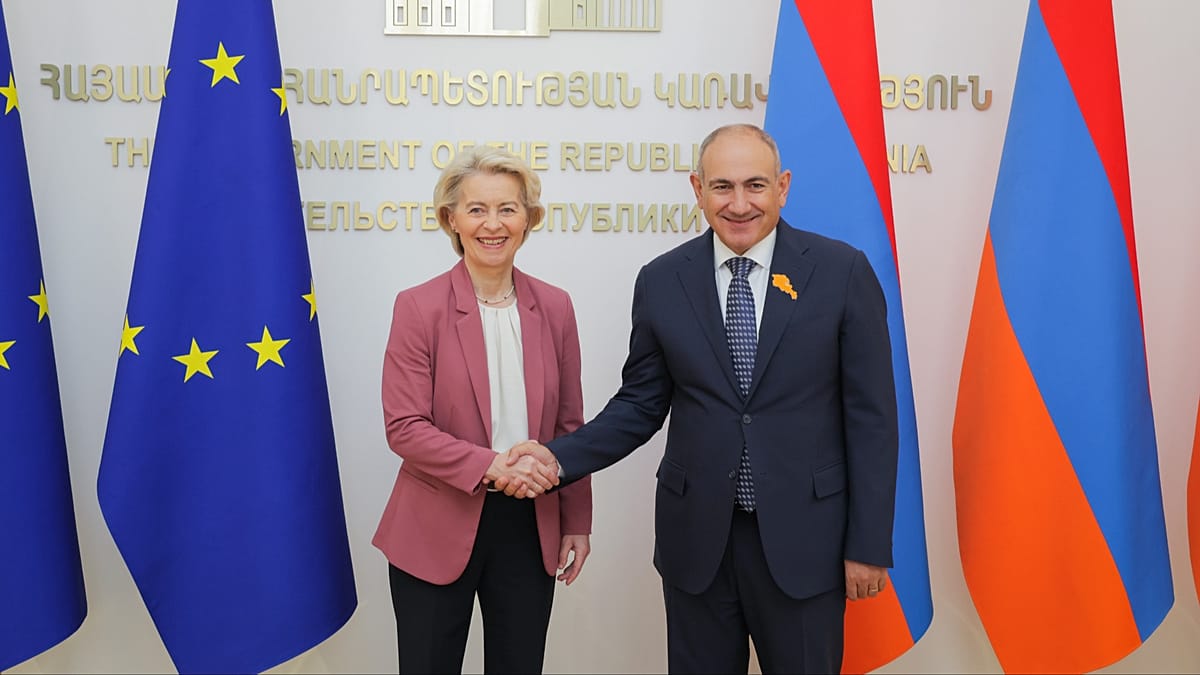
European Commission President Ursula von der Leyen arrived in Yerevan on Thursday as part of a strategic tour of the South Caucasus, announcing a broad package of economic and political measures to bolster Armenia’s pro-Western pivot. Speaking alongside Prime Minister Nikol Pashinyan, von der Leyen framed the visit as a response to what she described as Russia’s “economic coercion” of the country, and a signal of the EU’s commitment to the region’s peace process.
“The people of Armenia spoke clearly. They chose democracy. The rule of law. They chose reform and peace. They chose an open, welcoming, and inclusive society. And they chose to partner with the European Union,” von der Leyen said. “And together, we must now turn their aspirations into results.”
New Trade Measures to Bypass Russian Restrictions
Armenia will benefit from a novel EU instrument called Autonomous Trade Measures, which will liberalise nearly 80% of Armenian exports to the EU’s single market of 450 million consumers by removing customs duties. The proposal targets products that have traditionally been exported to Russia, including fresh fruits, vegetables, and plants—now covering almost 99% of those categories—as well as over 90% of Armenian beverages and spirits.
“Over the past month, we have seen more and more Armenian flowers arriving on our market. I think this is a beautiful symbol of a new chapter in our economic partnership. And this is only the beginning,” von der Leyen added.
The Commission also announced an additional €18 million to support trade, completing a wider €52 million package assembled ahead of Armenia’s June elections, which gave Pashinyan a strong mandate for closer ties with Europe.
Pashinyan reiterated a cautious line on relations with Moscow, stating that “we have never sought and will never seek to create a crisis in Armenia-Russia relations.” However, he made clear that “we act solely in the interests of our country, we respect the interests of all our international partners, but we cannot place the interests of any partner above those of Armenia.”
Billions Pledged for Regional Connectivity
Von der Leyen repeated the EU’s pledge, first made in Baku on Wednesday, to invest €200 million in a new connectivity initiative under the Global Gateway package, and to “mobilise up to €2 billion for strategic transport, energy, and digital projects all across the South Caucasus.” The Middle Corridor—also known as the Trans-Caspian International Transport Route (TITR)—is emerging as a strategic transit route between Asia and Europe, offering an alternative to disrupted supply chains in the Middle East.
The Commission also announced €20 million for a “peace-fostering programme” aimed at communities living along the Armenian-Azerbaijani border, supporting local economies and improving everyday life. “So that peace takes root in the hearts and minds of this generation – and the next,” von der Leyen said.
This visit builds on earlier EU engagement in the region, as detailed in Von der Leyen in Baku: EU Deepens South Caucasus Ties on Energy and Peace.
Visa Liberalisation and Energy Diversification
Pashinyan announced that Armenia aims to obtain visa liberalisation with the EU by 2029, depending on the pace of domestic reforms. Von der Leyen responded that the EU is conducting an assessment mission this autumn, noting that Armenia is the only country currently in an active visa liberalisation process with the bloc.
The visit also touched on energy diversification, with the EU exploring ways to reduce Armenia’s dependence on Russian energy supplies. The broader context of EU engagement in the South Caucasus was covered in Von der Leyen Visits Baku and Yerevan to Strengthen EU Ties in South Caucasus.
Von der Leyen’s trip underscores the EU’s strategic interest in a region long dominated by Russian influence, and its willingness to offer concrete economic incentives to support democratic reforms and peace. The measures announced in Yerevan represent one of the most significant EU support packages for a non-candidate country, signalling a new phase in Brussels’ engagement with the South Caucasus.