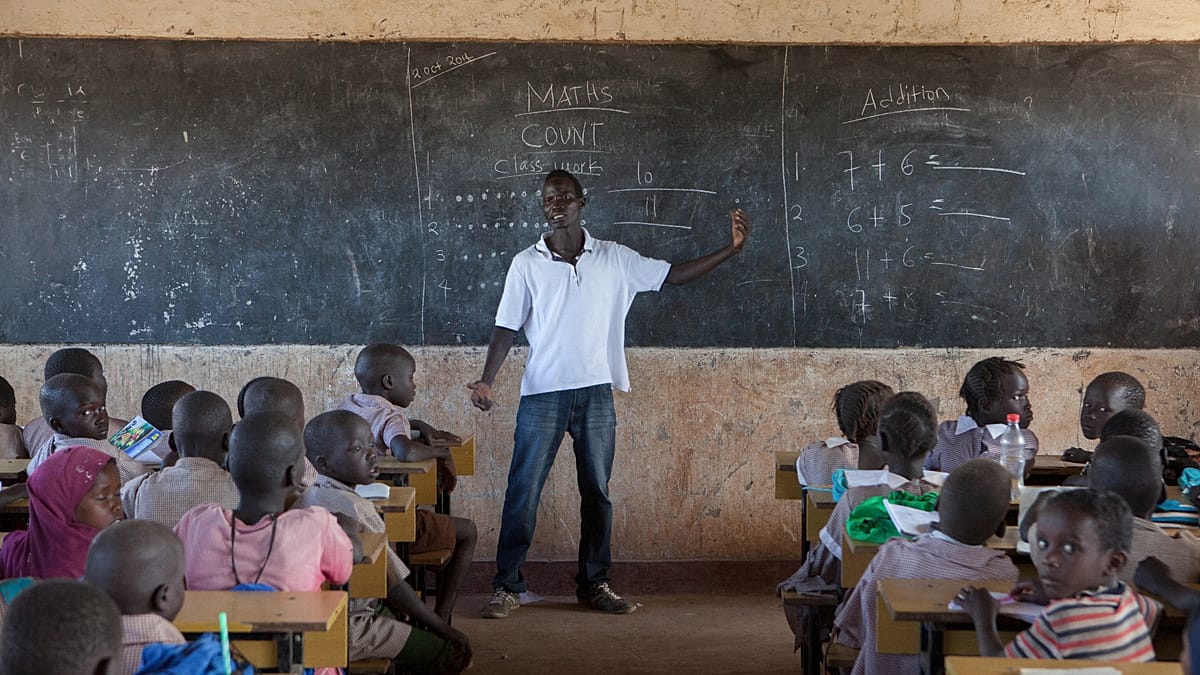
For millions of children living through conflict, war means months or even years without a classroom. From Ukraine's shattered schools to Sudan's closed universities and Gaza's rubble-strewn campuses, education systems are collapsing under the weight of violence.
As the world marks the International Day to Protect Education from Attack on 9 September, the latest Education Under Attack report documents at least 8,566 attacks on education and incidents involving the military use of schools and universities in 2024 and 2025. That is a surge of more than 40% compared with the previous reporting period, with at least 10,600 students, teachers, professors and other education personnel harmed.
For Dr Maleiha Malik, Executive Director of the Education Above All Foundation, these numbers represent more than statistics. They signal a generational crisis that will follow children long after the fighting stops.
“The impact of that is devastating,” Dr Malik told Euronews. She explained that the damage extends far beyond physical buildings, affecting entire education systems and potentially feeding “long-term poverty and cycles of violence.”
Can learning gaps be closed?
One of the most pressing questions is what happens to children who have already missed months or years of schooling. Dr Malik says accelerated learning programmes and technology can help close some gaps, but she is careful not to overpromise.
“We can have some accelerated learning, they can catch up, but I don't want to give the impression that there is any way we can compensate for the damage that conflict causes. We can't.”
The COVID-19 pandemic offered a glimpse of both the costs and possibilities of disrupted education. “During COVID we were able to look at new technologies, ways of delivering learning outside the traditional paradigm of a school building,” Dr Malik said. Digital tools, including virtual classrooms, proved that learning can continue even when physical schools are inaccessible.
But catching up academically is only part of the challenge. “Even before we think about knowledge gaps, learning gaps, we have to think about that child as a whole,” she stressed, highlighting the need to address trauma and the emotional toll of conflict.
A dangerous new red line
Dr Malik pointed to the sharp rise in attacks on education as a worrying trend. “A 40% increase isn't just a small increase, it's a surge,” she said. Citing a recent UN report on children and armed conflict, she singled out the role of government forces in attacking schools as one of the most alarming developments.
“I think the really alarming red line we've crossed this year is that government forces have crossed the line and are willing to use extreme state violence to attack schools, to attack education.” She added, “We haven't seen it to this level,” noting a greater willingness by states to risk attacking civilian targets and infrastructure.
This is not just a distant problem. In Europe, the war in Ukraine has led to new EU sanctions over the forced deportation of Ukrainian children, while Lithuania has warned that Russia may escalate attacks on the EU. The ripple effects of conflict are felt across the continent, from disrupted schooling to heightened security concerns.
Conflict closer to home
Dr Malik also noted that regional conflicts are affecting children in Qatar and other Gulf countries. She said children have had to become familiar with rocket fire and interceptions, sudden school closures, airports shutting down, and flights being grounded.
“Clearly, that is a kind of constant interference, constant stress, anxiety for children,” she said, adding that it can have psychosocial and emotional effects on children, parents and teachers. For parents trying to explain what is happening, Dr Malik recommended being honest without unnecessarily alarming children, using age-appropriate language.
International law is meant to protect schools and civilians during war. But as attacks on education rise, Dr Malik said the international system is falling short. “You can't help but reach that conclusion,” she said. “I think there's a huge failure in terms of the international community.”
She argued that the answer is not to abandon international institutions, but to strengthen them. The challenge, she said, is to ensure that the promise of education as a fundamental right is not hollowed out by the realities of conflict.