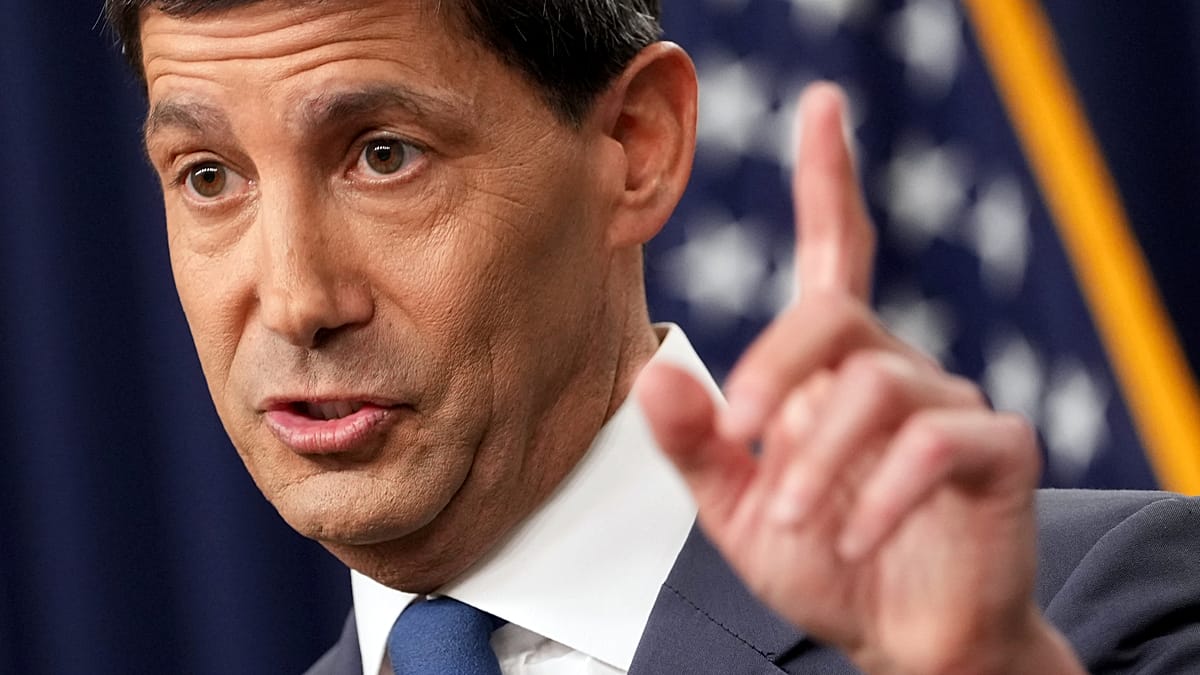
Kevin Warsh, chair of the US Federal Reserve, used his debut address at the Kansas City Fed's annual symposium in Jackson Hole, Wyoming, to deliver a hawkish message: the American economy is stronger than it appears, but inflation remains the central bank's overriding concern. Speaking on the 100th day of his tenure, Warsh pushed back against market expectations of imminent easing and explicitly rejected the use of forward guidance, a tool he once helped pioneer.
Warsh's assessment was unambiguous. He noted that the personal consumption expenditures (PCE) price index rose 3.7% year-on-year and 4.1% over the past six months. More tellingly, 54% of the index's components increased by more than 3% over the last year, compared with an average of 32% in the two decades before the pandemic. Summer data that beat forecasts, he said, "do not tell me that underlying trends have meaningfully improved."
His conclusion was blunt: "The Fed's predominant focus right now should be on prices." He set a high bar for any shift in policy, insisting that "we must be confident that underlying inflation is moving to our objective, clearly and at sufficient speed. Otherwise, we have work to do."
Markets react to a more hawkish Fed
The speech immediately reshaped market expectations. Traders raised the implied probability of a 25-basis-point rate hike at the Fed's 15–16 September meeting to 55%, up from roughly 35% before Warsh spoke. The 10-year Treasury yield fell 0.5% from its Friday high to 4.67%, while the 30-year yield dropped about 0.9% to 5.16%. The dollar index rose 0.4% from its intraday low to around 99.4 points.
Warsh's remarks also carried weight beyond US borders. European bond markets have been sensitive to Fed policy signals, especially as Iran tensions stoke inflation worries across the continent. A more aggressive Fed could tighten global financial conditions, affecting borrowing costs for European governments and businesses.
Economic strength and the AI factor
Warsh opened his speech by calling the current moment a "hinge point in history," pointing to the rapid advance of artificial intelligence. He noted that annualised AI token sales at the two leading labs alone exceed $100 billion, up more than 500% in a year. AI, he argued, is "a new variable, potentially a new factor of production," raising questions about productivity, labour displacement, and where returns will ultimately accrue. A new Fed task force on productivity and jobs is examining these issues, though Warsh stressed its findings will not influence near-term policy.
On the broader economy, Warsh cited robust business investment in equipment and intangibles, growing at around 9%—the fastest pace since 2021—with more than half of this year's capital expenditure growth attributed to the AI buildout. S&P 500 profits have risen more than 20% over the year, credit spreads are near historic lows, and banks are easing lending standards. While acknowledging strains in housing and agriculture, he said he "would be hard pressed to describe broad financial conditions as restrictive." Unemployment stands at 4.1%, with jobless claims near multi-decade lows, leaving inflation as the clear outlier.
No more forward guidance
A significant portion of Warsh's address was devoted to defending his refusal to signal future policy moves—a stance that has drawn criticism since he took office in May. He acknowledged that forward guidance was essential during the 2008 financial crisis, but argued that "the practice has overstayed its welcome" and now "risks creating ambiguity in the name of clarity."
Warsh warned of a "hall-of-mirrors" problem, where markets read the Fed and the Fed reads markets, leaving both blind to new developments. "We should not indulge a regime in which market participants are looking primarily to the Fed for their next trade," he said, adding that the costs of such errors fall not on "financial high-fliers" but on households facing high inflation or insecure jobs.
He also rejected calls to publish an explicit reaction function, arguing that economic knowledge does not permit a mechanical rule. Instead, he outlined six principles: interrogate incoming data rather than trust stale figures; accept that judging supply against demand is imprecise; treat the 2% PCE target as firm and fixed; pursue both mandates without treating them as a trade-off; rely on short-term rates rather than unconventional tools; and remember that money itself matters.
"I stand here today committed to a discipline, not to a decision," Warsh said in closing. The next Fed meeting, where a rate decision will be made, is scheduled for 16 September.
For European observers, the implications are clear. A Fed that prioritises inflation over growth could keep US interest rates higher for longer, influencing the European Central Bank's own policy path. As UK inflation climbs and gas storage concerns persist, the transatlantic monetary policy dynamic remains a key factor for markets and policymakers alike.