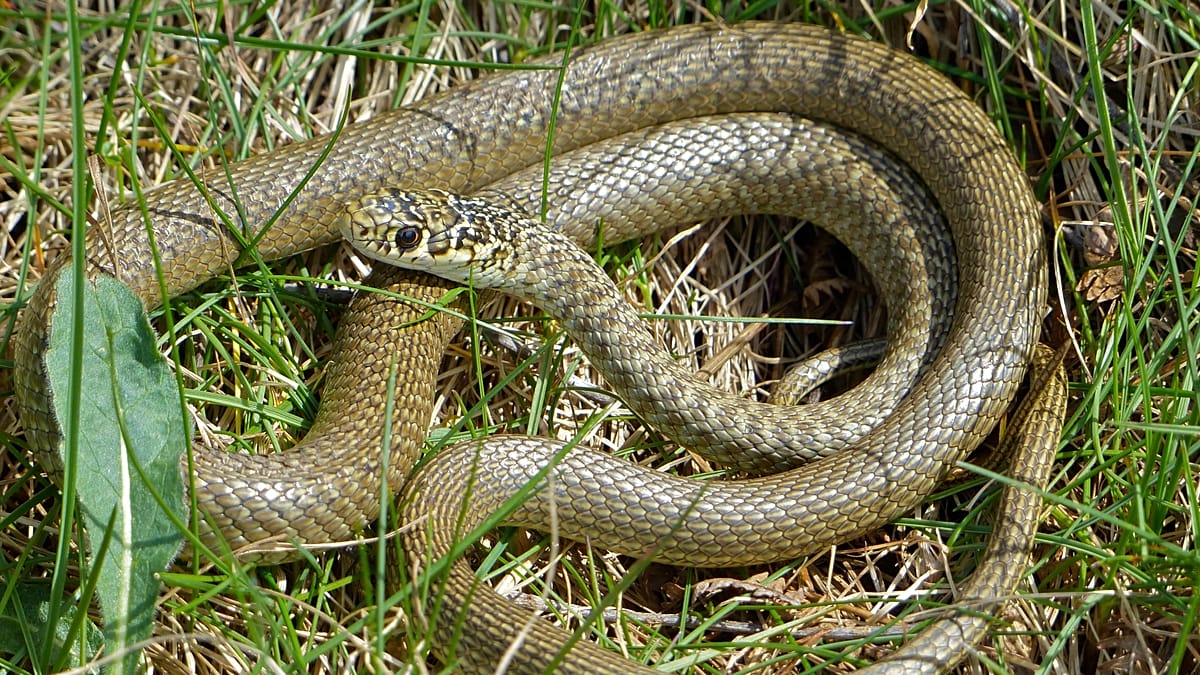
In the western Palatinate region of Germany, a striking green-yellow snake is causing concern among conservationists. The western whip snake (Coluber viridiflavus), known in German as the Zornnatter for its aggressive defensive behavior, has established a foothold at a landfill site near Zweibrücken, about 40 kilometers from Saarbrücken. Since its likely introduction in 2017 via waste shipments, the species has spread into surrounding areas, prompting a targeted capture effort by reptile expert Hubert Laufer.
An Invasive Species with a Taste for Native Lizards
Hubert Laufer, a landscape ecologist and amphibian protector from Offenburg, has been tracking the snakes for years. He has caught over 300 specimens, often using a cloth bag to handle the animals. “When you catch a Zornnatter, it tries to bite the person catching it. But if the snakes can escape, they do. If you leave the snakes alone, they won’t do anything,” he told Euronews. The bites, he explains, feel like scratches from a blackberry bush and are not dangerous to humans.
The real problem, Laufer says, is the impact on native fauna. “There are almost no lizards left at the landfill site. If there is nothing else, they eat mice or young rats. But lizards are their favorite food.” The snakes, which can grow up to two meters in length, are mostly black with a fine yellow-green pattern that camouflages them well in grass. They thrive under roofing felt at the dump, which heats up quickly in the sun—a welcome warmth for a species native to southern France and Italy.
Laufer’s work has been recognized by the Baden-Württemberg branch of BUND (Friends of the Earth Germany), which awarded him the Gerhard Thielcke Nature Conservation Prize in 2025. He passes captured snakes to keepers who can house them appropriately, ensuring they do not continue to prey on native reptiles.
How the Snakes Arrived and Spread
Laufer believes the snakes arrived at the Mörsbach landfill in 2017 with waste that was disposed of there. “Among it there was certainly a pregnant animal. They reproduced.” Since then, several hundred snakes have been observed on the site and in adjacent areas. The Umwelt- und Servicebetrieb Zweibrücken (UBZ), which manages the landfill, has set up a reporting portal for sightings, asking residents to send photos of any suspected Zornnattern.
This year, around 25 reports have come in, though not all are accurate. “Other native species have also been reported. But we would rather receive observations of grass snakes as well than have a Zornnatter go unreported,” Laufer said. The species is now considered invasive in Germany, threatening local biodiversity in a manner similar to how the poisonous pufferfish has displaced other fish in the Mediterranean.
Broader Context: Germany’s Environmental Challenges
The spread of the western whip snake is just one example of how invasive species can disrupt ecosystems. Germany has been grappling with other environmental issues, from economic pressures driving top earners to consider leaving to record solar power generation that underscores the country’s energy transition. The snake’s presence also highlights the unintended consequences of global trade and waste management, as the landfill in Zweibrücken became an accidental gateway for a non-native species.
While some conservationists view the Zornnatter as a sign of an intact natural environment—since it thrives in well-vegetated areas—the consensus among experts like Laufer is clear: the species must be removed to protect native lizards and other reptiles. The capture campaign continues, with Laufer urging anyone who spots a green-yellow snake in the region to report it immediately.