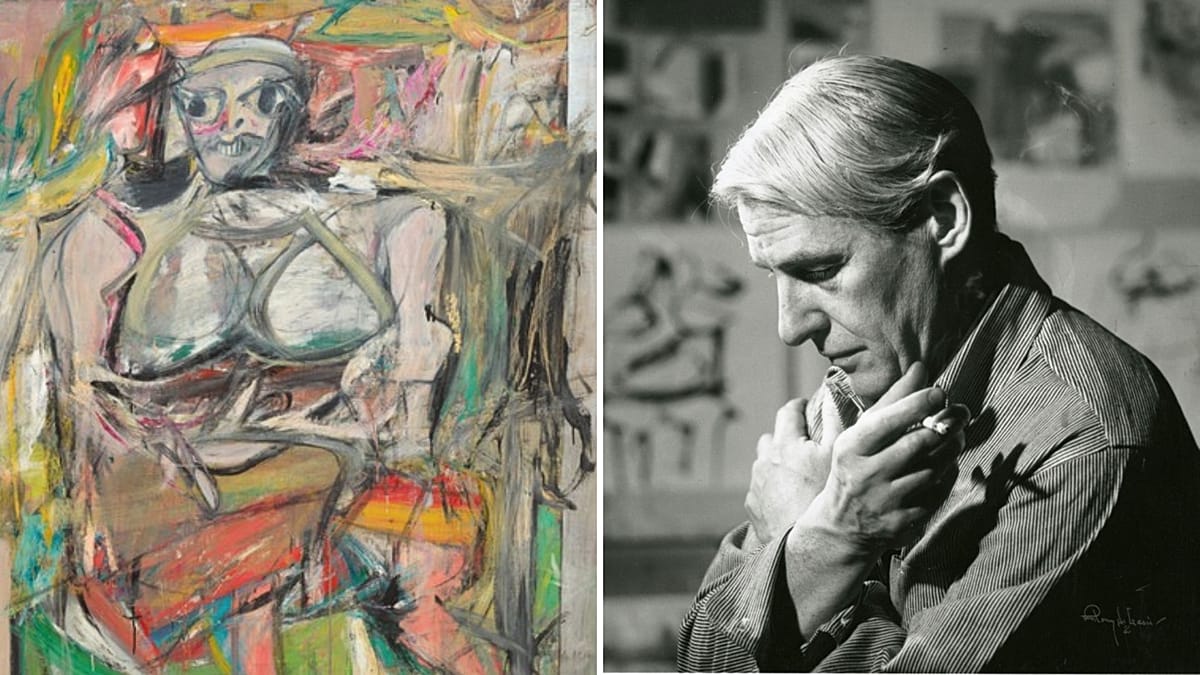
Nearly a century after Willem de Kooning boarded a cargo ship bound for New York, the Dutch-born artist returns to his homeland in a landmark exhibition at the Rijksmuseum in Amsterdam. Opening on 9 October and running until 17 January 2027, Willem de Kooning at work is the most comprehensive European retrospective of his oeuvre in more than forty years, placing him alongside the likes of Van Gogh and Rembrandt in the museum's hallowed halls.
From Rotterdam to the New York avant-garde
De Kooning left the Netherlands in 1926 as a stowaway on a freighter, settling in New York where he became a central figure in the Abstract Expressionist movement. Alongside artists such as Jackson Pollock and Franz Kline, he helped redefine painting in the post-war era, blending gestural abstraction with figural traces that challenged conventional boundaries.
The exhibition, curated by the Rijksmuseum in collaboration with the Stedelijk Museum in Amsterdam, brings together more than 120 works spanning his entire career. Visitors will see early figurative paintings from the 1930s, the explosive Woman series of the 1950s, and the late, almost lyrical abstractions that marked his final years. Many pieces have never before been shown in Europe, and several have been loaned from major American institutions, including the Museum of Modern Art in New York and the National Gallery of Art in Washington.
“De Kooning’s work is a dialogue between chaos and control, between the urban energy of New York and the quiet precision of his Dutch training,” said Taco Dibbits, general director of the Rijksmuseum. “This exhibition allows us to see how his European roots shaped one of the most influential artists of the twentieth century.”
A homecoming with a contemporary lens
The Rijksmuseum has arranged the show thematically rather than chronologically, highlighting recurring motifs such as the human figure, landscape, and the act of painting itself. Archival materials, including photographs and letters, offer insight into his working methods, which often involved scraping, repainting, and leaving traces of earlier compositions visible.
De Kooning’s connection to the Netherlands remained strong throughout his life, even as he became an American icon. He returned to Rotterdam in 1968 for a retrospective at the Stedelijk Museum, and his later works reflect a renewed interest in the light and space of his native country. This exhibition, therefore, is not merely a display of masterpieces but a homecoming of sorts, reconnecting the artist with the culture that formed him.
The show also coincides with a broader European effort to reassess the contributions of modern artists from the continent. In a similar vein, the Prado and Rijksmuseum have joined forces to spotlight women artists, underscoring how major institutions are expanding the canon. De Kooning’s retrospective, while focused on a single figure, fits into this larger conversation about artistic legacy and national identity.
For those unable to visit Amsterdam, the Rijksmuseum has launched an extensive online catalogue, including high-resolution images and video interviews with curators. The museum also plans a series of lectures and workshops exploring de Kooning’s influence on contemporary European artists, from Gerhard Richter to Marlene Dumas.
As the exhibition opens, it invites a new generation to engage with an artist who once said, “I change myself to suit the painting.” That fluidity, between abstraction and figuration, between America and Europe, remains as compelling today as it was in the heyday of the New York School.
With its ambitious scope and intimate presentation, Willem de Kooning at work is set to be one of the cultural highlights of the season, drawing visitors from across the continent and beyond. It is a rare chance to see the full arc of a career that transformed modern art, and to understand how a boy from Rotterdam became a titan of the avant-garde.