The 2026 World Cup will feature several historic national teams returning to the global stage, but it will also leave a number of footballing powerhouses watching from home. For some, the absence is a temporary setback; for others, it has become a chronic wound.
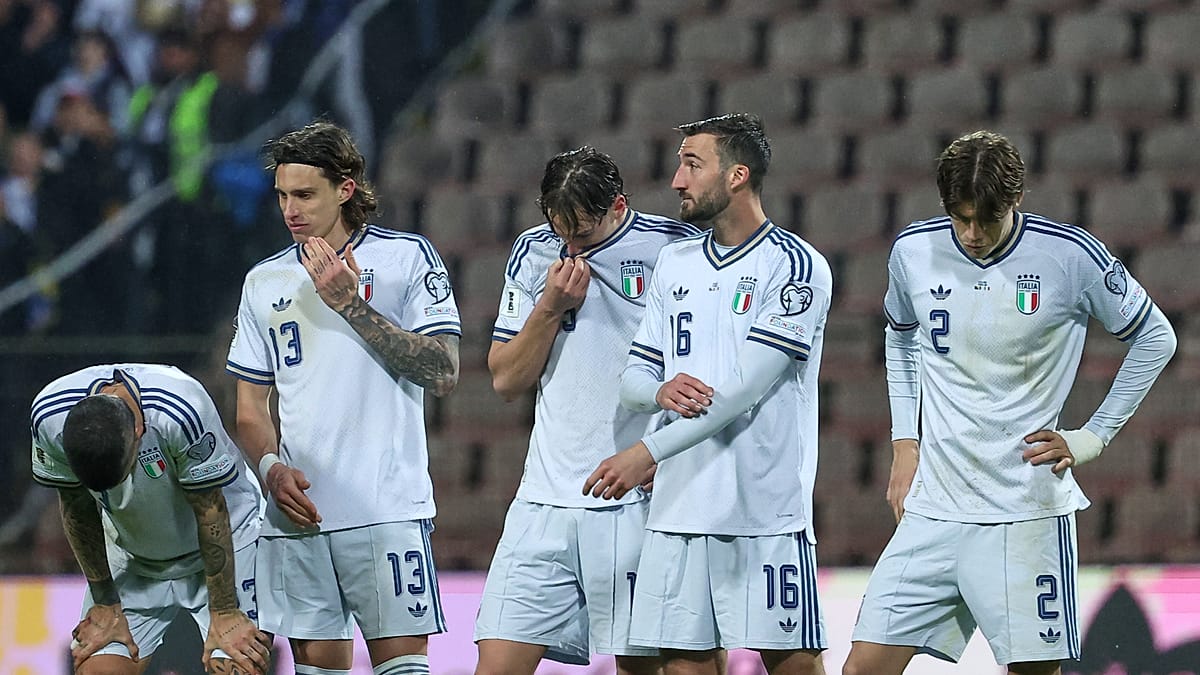
Italy, a four-time world champion, will miss a third consecutive tournament, having last appeared in Brazil in 2014. The Squadra Azzurra’s decline is one of the most dramatic in international football, especially given their triumph in Berlin in 2006, when they defeated France in a final remembered for Zinedine Zidane’s infamous head-butt on Marco Materazzi. Since then, failure to qualify for 2018, 2022, and now 2026 has left Italian football in a deep crisis, with each disappointment compounding the last.
Other nations that featured in Qatar 2022 will also be absent. Denmark, Poland, Wales, Cameroon, Serbia, and Costa Rica all failed to secure qualification. Nigeria, Russia, and Iceland will miss a second straight World Cup, having last competed in Russia in 2018. The absences of Slovakia and Slovenia extend to four consecutive tournaments since their last appearances in South Africa in 2010. Greece and Chile will each miss three straight World Cups, with both last participating in Brazil in 2014.
Long-term absentees: Romania and Ireland
Among the most notable long-term absentees are Romania and Ireland. Romania will miss a seventh consecutive World Cup, having last qualified for France 1998. Their golden generation, led by Gheorghe Hagi—often called the “Maradona of the Carpathians”—reached the quarter-finals in 1994, playing some of the tournament’s most exciting football. Since then, they have failed to qualify for seven straight tournaments, although recent performances at European Championships suggest a slow recovery.
Ireland, whose finest hour came at the 1990 World Cup under Jack Charlton, reached the quarter-finals in their debut tournament. They also qualified in 1994 and 2002 but have not returned since, making their run in Italy their greatest footballing achievement to date. The absence now stretches to six consecutive World Cups.
Wales, after a 64-year gap, returned to the World Cup in 2022, inspired by Gareth Bale. Their greatest achievement remains the 1958 tournament, where they reached the quarter-finals before being eliminated by Brazil thanks to a goal from a 17-year-old Pelé. Their elimination from 2026 qualification at the hands of Bosnia and Herzegovina was a bitter blow for Welsh supporters.
North Korea, which produced one of the greatest shocks in World Cup history by defeating Italy in 1966 and reaching the quarter-finals, returned in 2010 after a 44-year absence. That campaign ended in disappointment, with three losses and a goal difference of 1–12. Since then, they have not qualified again.
Canada, which first appeared at a World Cup in 1986 without scoring a goal, returned in 2022 after a 36-year absence, led by Alphonso Davies. Although they again failed to win a point, they scored twice. Now, as co-hosts of the 2026 World Cup, Canada has a genuine opportunity to reach the knockout stages—an achievement that would represent the greatest moment in the country’s footballing history.
Italy’s absence also resonates beyond football. The country’s struggles on the pitch come amid broader political and economic challenges, as highlighted by recent reports on Italy seeking to redirect EU defence loans to combat rising energy costs. Meanwhile, cultural ties between Italy and Kazakhstan were recently strengthened with a Rome concert and Vatican embassy, as noted in this report.
As the 2026 tournament approaches, the list of absentees serves as a reminder of football’s cyclical nature. For Italy, Romania, and Ireland, the wait continues. For Canada, a new chapter begins.