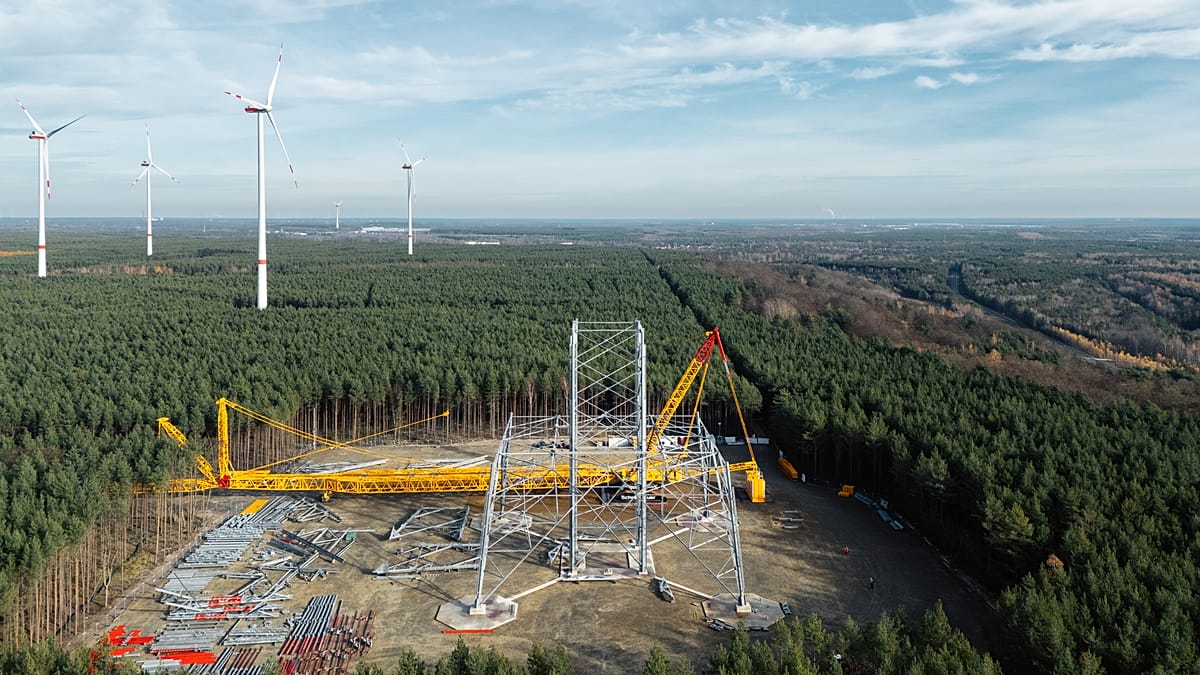
In a striking symbol of Germany's energy transition, the world's tallest wind turbine has reached its full height in Schipkau, a small town in Brandenburg. The structure, which stands 365 meters from foundation to rotor tip, is just three meters shorter than the Berlin TV Tower and ranks among the tallest buildings in Germany.
The turbine, built by the construction company GICON, was raised using a patented telescopic system. It was initially assembled at 150 meters, then extended to its full height. The project, which began about two years ago, faced a setback in late 2025 when problems with steel components halted work. "Safety and quality have absolute priority in this globally unique project," said Jochen Großmann, GICON's CEO and founder, at the time.
If all goes according to plan, the turbine will be connected to the grid in November. GICON expects an annual electricity yield of 30 to 33 gigawatt hours, with production costs below five cents per kilowatt hour. That is 220 percent more than conventional turbines in the area and enough to supply roughly 7,500 four-person households.
Why build so high?
The rationale behind the towering design is simple: winds are stronger and more consistent at higher altitudes. At over 300 meters, the wind blows more steadily, allowing for significantly more energy generation. To validate this, GICON, working with beventum GmbH, a subsidiary of the Federal Agency for Leap Innovations (SPRIND), erected a measuring mast in nearby Klettwitz. The data confirmed that wind speeds at 300 meters are indeed higher and more uniform than at the heights of conventional turbines.
This could be a game-changer for parts of Europe where ground-level winds are weak. From eastern Poland to the Iberian Peninsula, many regions have struggled to harness wind power effectively. High-altitude turbines could offer a solution. SPRIND emphasizes that "Europe needs a strong position in wind turbine construction in order to guarantee its own energy production."
The Schipkau site is located in Lusatia, a region historically dominated by coal mining. Authorities there now actively support clean energy projects, providing space, infrastructure, and political backing. In the long term, the site is planned to become a hybrid power plant, combining two levels of wind power with a ground-level solar park. This triple use is expected to quintuple the energy yield compared to solar-only installations and ensure year-round electricity generation.
The project also underscores a broader challenge facing Europe's energy transition: outdated grids. In Germany, wind power generated in the windy north-east often cannot be transported to the high-consumption south due to grid bottlenecks. As a result, turbines are sometimes throttled or switched off, forcing fossil gas plants to fill the gap. According to analysis by German media Tagesspiegel, around 9.3 terawatt hours of wind power were lost in 2023 alone, with congestion management costs reaching nearly €3 billion, borne by consumers through grid fees.
GICON and SPRIND argue that high-altitude turbines could help alleviate this dilemma. Because high-altitude winds are more consistent, turbines could be operated economically even in areas with weak ground winds, allowing for more decentralized expansion. This would reduce the strain on long-distance transmission lines.
Germany remains a leader in wind energy in Europe. At the end of 2025, Europe had about 304 gigawatts of installed wind capacity, with Germany accounting for 77.7 gigawatts, ahead of the UK (31.6 GW) and Spain (31.2 GW). Germany also added the most new capacity in 2025, with 5,735 megawatts.
The push for renewables is part of a broader policy effort. In late March, Germany's Federal Environment Minister Carsten Schneider presented the Climate Protection Programme 2026 in the Bundestag, a set of 67 measures aimed at saving an additional 25 million tonnes of CO₂ by 2030. Schneider highlighted the importance of such projects for energy independence: "This will help us to become independent of oil and gas from other regions of the world."
As Europe grapples with energy security and climate goals, the Schipkau turbine stands as a testament to what is possible. It also raises questions about how quickly grids can be modernized to keep pace with innovation. For now, the focus is on the November grid connection, a milestone that could signal a new era for wind power across the continent.