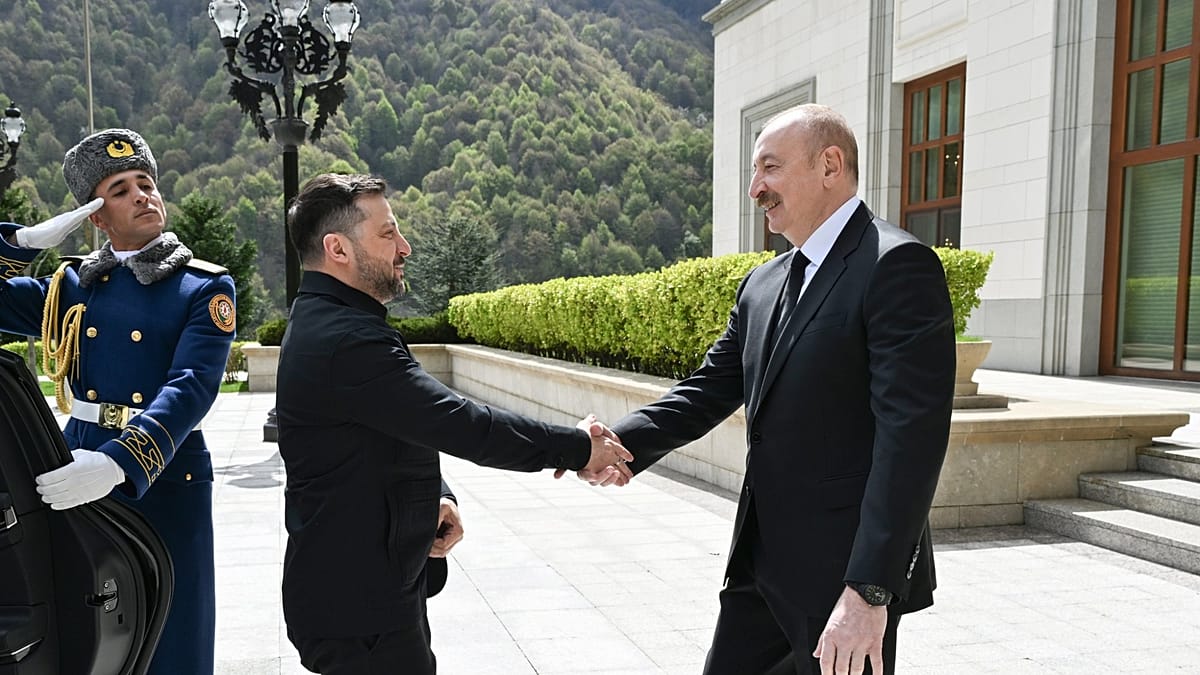
During his first visit to the South Caucasus since Russia's full-scale invasion began, Ukraine's President Volodymyr Zelenskyy declared he is ready to meet Vladimir Putin in Azerbaijan. Speaking alongside President Ilham Aliyev in Gabala, a city roughly 100 kilometres from the Russian border, Zelenskyy said Kyiv has informed Baku of its willingness to hold trilateral talks, provided Moscow is prepared for genuine diplomacy.
“It is vital for Ukraine that Russia finds the strength to end this unjust war,” Zelenskyy stated, emphasising that Azerbaijan could serve as a mediator in the stalled peace process. He noted that similar discussions have already taken place in Turkey and Switzerland, but that the Kremlin has consistently rejected any compromise and insisted on meeting only in Moscow or Belarus—both of which Ukraine has ruled out.
A shift in diplomatic strategy
The offer marks a notable shift in Ukraine's diplomatic posture. While Kyiv has long insisted that any direct talks with Putin must take place on neutral ground, the proposal to hold them in Azerbaijan—a country that shares a border with Russia and has maintained ties with both sides—underscores the urgency of breaking the deadlock. The Kremlin has so far dismissed the idea, but Zelenskyy’s visit signals that Ukraine is actively seeking alternative channels.
Aliyev, for his part, reaffirmed Azerbaijan's support for Ukraine's territorial integrity and recalled his own visit to Kyiv in January 2022, just weeks before the invasion. The two leaders agreed to hold their next meeting in Ukraine, though no date was set.
Beyond diplomacy, the talks in Gabala—a UNESCO World Heritage site that once served as a key hub on the Silk Road—focused heavily on energy cooperation. Aliyev confirmed that SOCAR, Azerbaijan's state oil and gas company, has been operating in Ukraine for years and that new joint projects and investments are under discussion. This aligns with broader European efforts to diversify energy supplies, as highlighted by the recent US and Azerbaijan launch of the TRIPP Corridor talks.
Security cooperation and military expertise
Security cooperation was a central theme. Zelenskyy confirmed that Ukrainian military experts have been deployed to Azerbaijan to share anti-drone expertise and battlefield know-how—a first publicly acknowledged step in defence-industrial collaboration between the two countries. “Ukraine is always committed to cooperation that strengthens both our partners and us,” he said, adding that Kyiv is already working with partners in the Middle East, the Gulf, and the European Union.
The timing is significant. In early March, Iranian drones targeted the passenger terminal of the airport in Azerbaijan's Nakhchivan region and a school near the village of Shakarabad, close to the Iranian border. The incident underscored the volatility of the region, which has long been viewed as part of Russia's sphere of influence.
Zelenskyy’s visit also comes as Ukraine expands its diplomatic footprint in the Caucasus. Having recently signed ten-year security agreements with Saudi Arabia, the United Arab Emirates, and Qatar, Kyiv is now “gradually turning attention to the Caucasus,” as the president put it. The symbolism of holding talks so close to Russia's border was not lost on observers, especially given Moscow's efforts to normalise ties in the South Caucasus.
Azerbaijan has provided Ukraine with humanitarian aid throughout the war, including after Russian strikes on Azerbaijani business and diplomatic facilities. Aliyev noted in Munich earlier this year that Russia had deliberately targeted Azerbaijan's energy infrastructure and embassy in Ukraine on multiple occasions. “After the first attack, we could assume that it was accidental,” he said, “but after the third, it was clearly intentional.”
While the immediate prospects for a Putin-Zelenskyy meeting remain uncertain, the offer itself represents a tactical recalibration. For Europe, which has watched the diplomatic track falter, the proposal offers a glimmer of possibility—and a reminder that the war's resolution may require unconventional mediators.