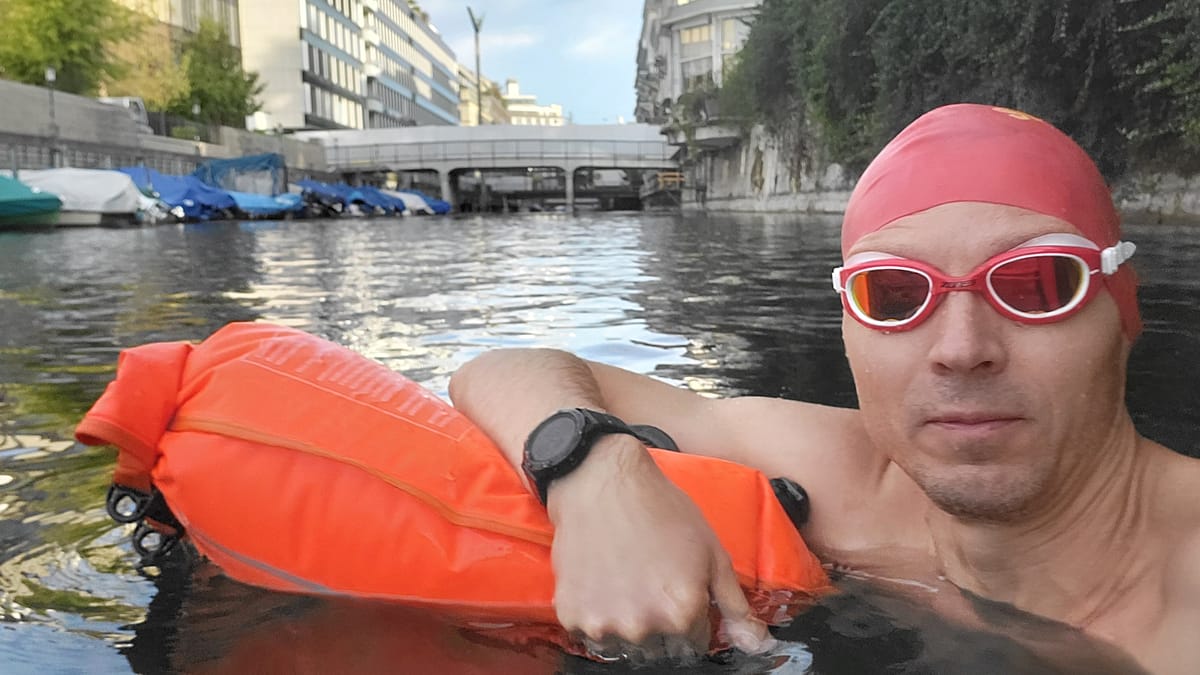
When Mischa Gurov first heard that some Swiss commuters swim to work, he thought it was “wonderfully Swiss – and slightly mad.” Now, the Russian-born IT specialist is one of them, trading crowded trams for a daily dip through Zürich’s old moat.
Since moving to Zürich in 2019, Gurov has made the Schanzengraben – a historic fortification canal – his personal commute route. On good-weather days, he takes public transport to the city centre, changes into swimwear, and with his belongings sealed in a waterproof bag, he plunges into the water for the final 1.35 kilometres to his office.
“It’s the best way to start a working day,” Gurov told European Pulse. “Sometimes I see the sunrise at the lake before my swim or I observe swans taking their morning bath. Other times, several fish swim with me for many metres – it is truly a special feeling of harmony.”
So far this year, he has swum more than 60 kilometres. But this summer’s drought-induced low water levels gave him a new perspective on his journey.
A hidden world beneath the surface
Alongside the canal, trams rattle, bicycles whir, and office workers hurry past. But when Gurov took an underwater camera on a recent commute, he discovered “fish, old stone walls and a part of the city that is much harder to see from the street.”
“I realised nature is not necessarily somewhere far away in an ocean, rainforest or mountain. Sometimes there is an entire world living almost unnoticed beneath a bridge people cross every day,” he says.
He even managed to photograph a large fish that he later – with the help of the city’s waste disposal and water protection organisation Entsorgung + Recycling Zürich (ERZ) – identified as one of the Schanzengraben’s rarer brown trout. These fish need clean, cool, oxygen-rich water to survive, so their presence is testament to the quality of the water. But a lack of care for their hidden world could be putting this at risk.
500 cigarette butts in 30 minutes
Gurov has long been frustrated by rubbish left in places he loves. Living in London in 2018, he launched an anti-littering petition to clean up Richmond Park and the River Thames. The same issue has become difficult to ignore in Zürich.
Earlier this summer, he decided to see how many cigarette butts he could collect along a short stretch beside the Schanzengraben. In 30 minutes, across roughly 30 metres, he collected more than 500.
Cigarette butts are Switzerland’s most littered item nationally, with over six billion discarded into the environment each year, costing an estimated CHF 53 million (€56m) in cleanup. In water, the toxins they leach can be lethal to fish.
Gurov’s daily swim is more than a quirky commute – it’s a reminder that urban waterways are fragile ecosystems. His efforts, documented with underwater photography, have sparked conversations about the hidden costs of littering. As he puts it, “Every butt I pick up is one less toxin in the water.”
For those inspired to follow his example, Gurov suggests starting small: “You don’t need to swim to work. Just look at the water around you – and maybe pick up a piece of litter.”