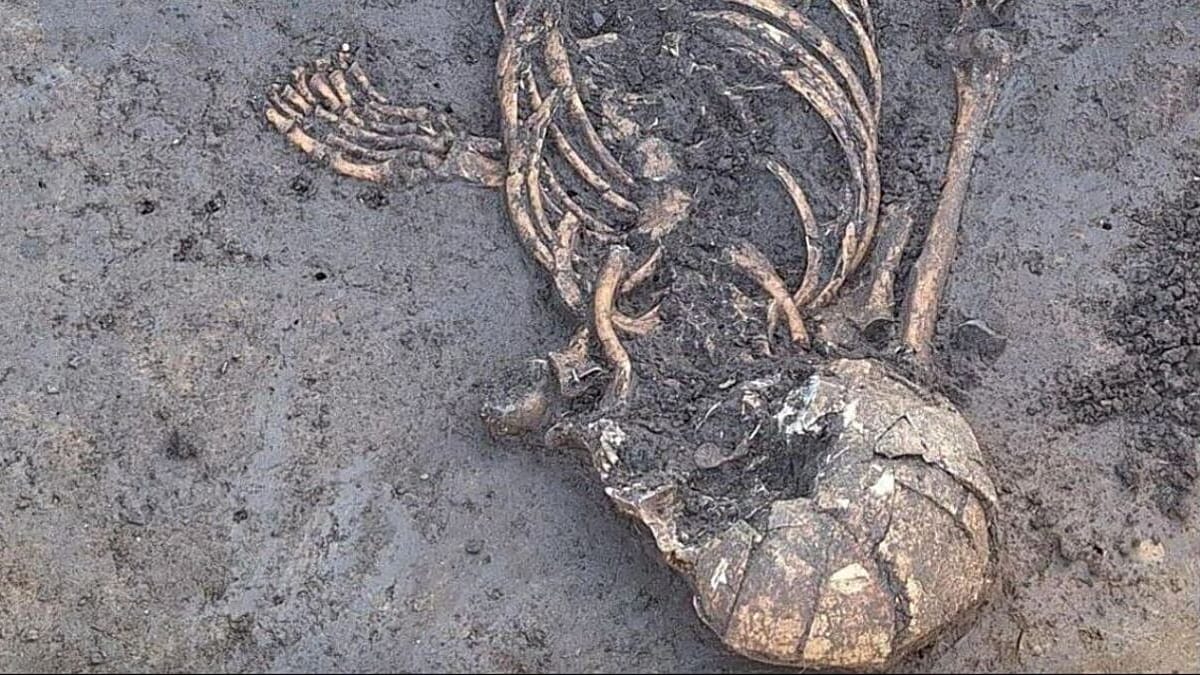
In the quiet village of Großköllnbach, in the Dingolfing-Landau district of Lower Bavaria, a routine archaeological survey has turned into a window onto a 7,000-year-old mystery. What began as a faint discolouration in the soil led to the discovery of a human skeleton buried in a way that challenges conventional understanding of Neolithic funerary rites.
The remains belong to an adolescent who lived during the era of the Linear Pottery culture (Linienbandkeramik), one of Central Europe's earliest farming societies. But unlike the typical crouched burials of that period—where the deceased were laid on their side with knees drawn up, as if sleeping—this body was found in a strikingly twisted pose. The right leg was bent sharply upward, while the left leg angled outward, a posture that has no parallel in the region's known burial record.
A burial that defies convention
The discovery was made during excavations at the future Steigäcker IV development site, where a team had been working for five weeks. District archaeologist Dr. Florian Eibl noted that the pit's uneven, sloping base may have caused the body to shift after burial, potentially explaining the unusual limb positions. Yet the possibility remains that the posture was deliberate, reflecting a ritual or social distinction we can no longer decipher.
Adding to the enigma is the condition of the cervical spine, which shows a pronounced deformation. Whether this resulted from disease, a congenital condition, or post-mortem pressure within the grave is still unknown. A detailed anthropological analysis is underway to determine what the bones can reveal about the young person's life and death.
The site has also yielded traces of a substantial Linear Pottery settlement, including the outlines of three longhouses, though only two likely stood simultaneously. Several hearths and domed clay ovens, their floors insulated with tightly packed pebbles, indicate where food was prepared and communal life unfolded. Grinding slabs found nearby may have been made from stone sourced beyond the Danube or the Bavarian Forest, suggesting that even early farmers engaged in long-distance material procurement.
For now, the skeleton has been removed to the district archaeology department for further study. The excavation site itself remains closed to the public. As Dr. Eibl and his team continue their work, they hope to piece together the story of this individual—whose final resting place has kept its secrets for seven millennia.
This find resonates beyond Bavaria, echoing similar Neolithic discoveries across Europe that remind us how much we still have to learn about our ancestors. For those interested in how ancient remains can reshape our understanding of the past, the recent Peruvian dig offers a parallel, while the hidden layers of Berlin show that even modern cities sit on millennia of history.