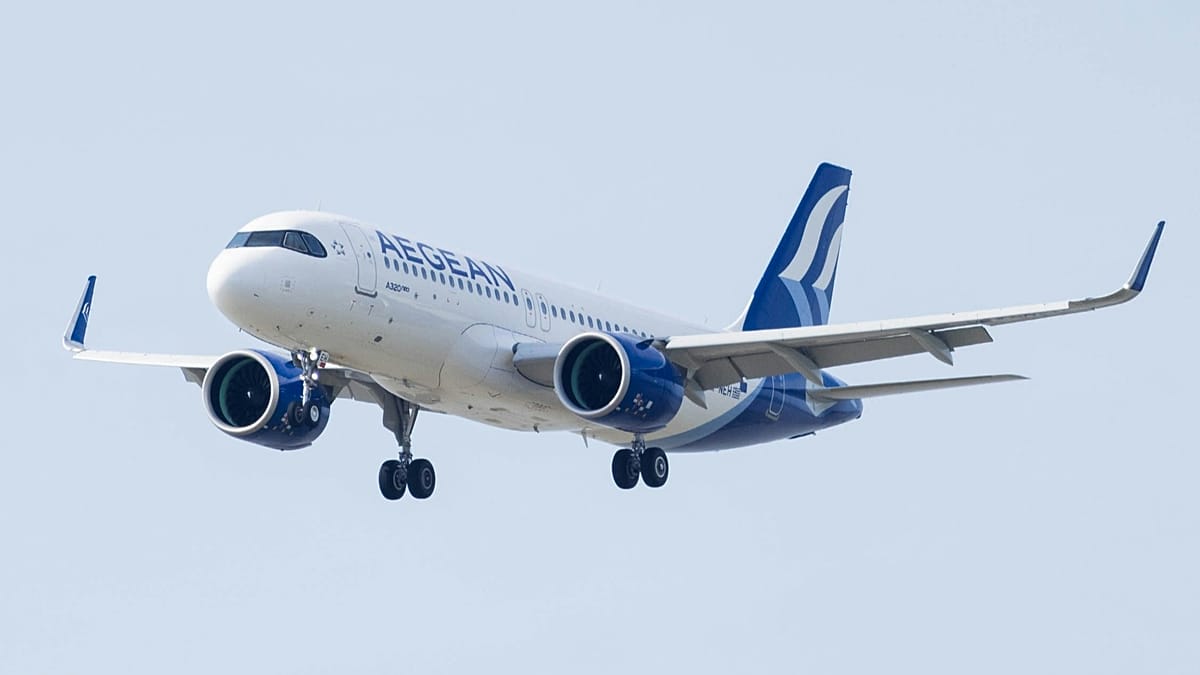
Greek flag carrier Aegean Airlines has taken the top spot in a new 10-year safety ranking of Europe's largest airlines, with Irish low-cost giant Ryanair and Austria's national carrier close behind. The index, compiled by air passenger rights firm AirAdvisor, assessed the 10 biggest low-cost and 10 biggest mainline carriers operating in Europe, based on 2025 flight volumes reported by EUROCONTROL.
Aegean scored 89 out of 100, ahead of Ryanair (86) and Austrian Airlines (85.5). Norwegian (85) and SunExpress (84.5) rounded out the top five, meaning three of the five highest-ranked carriers are low-cost operators.
How the ranking was built
Each airline was scored across six weighted categories, with safety record carrying the most weight at 40%. That category drew on accidents reported in the IATA Safety Report between 2016 and 2025. Certification and audit history accounted for 20%, operational safety systems for 15%, fleet age and technical profile for 10%, pilot training for 10%, and financial stability for the remaining 5%.
AirAdvisor said scores for operational safety, fleet, training and financial stability were based on publicly available regulatory and company information. The firm stressed that the index is “comparative and should not be read as a measure of whether any individual airline is safe or unsafe.”
Aegean achieved a perfect 40/40 for its safety record, with no qualifying accidents in the decade under review, and also scored strongly on operational safety (13/15), fleet (9/10) and financial stability (5/5). But a clean accident record alone was not enough to reach the top, the report noted. British Airways, SAS and Eurowings also earned 40/40 in that category yet finished outside the top five because the index weighs six factors together.
Low-cost carriers punch above their weight
The strong showing of budget airlines is one of the report's most striking findings. Across the full study, low-cost carriers averaged 79.2/100, compared with 82.8/100 for mainline airlines – a gap of just 3.6 points. On fleet age and technical profile, low-cost operators actually outperformed their mainline rivals, scoring 7.8/10 versus 7.1/10, with Wizz Air and Pegasus Airlines both earning a perfect 10/10 in that category.
“Many travellers assume that a cheaper ticket means accepting more safety risk, but the data doesn't support this,” Anton Radchenko, CEO of AirAdvisor, told Euronews Travel. “Low-cost and mainline airlines have very similar accident records, and their safety management systems scored the same on average. In other words, the price of a ticket tells you very little about how safe an airline is.”
Radchenko also cautioned against overinterpreting fleet age. “A young fleet can bring technological and efficiency advantages, but aircraft age should never be treated as a safety rating on its own,” he said. “An older aircraft that is properly maintained can continue operating safely for decades.”
The results come as European aviation faces broader scrutiny on passenger rights and operational transparency. Recent developments, such as the UK ban on airline fees for seating children with parents, highlight the ongoing regulatory focus on consumer protections. Meanwhile, the sector continues to evolve, with major carriers like Turkish Airlines placing a 150-plane Boeing 737 MAX order, underscoring the importance of fleet renewal and safety management.
Full ranking of 20 European airlines
Here is how the 20 carriers ranked, scored out of 100:
- 1. Aegean Airlines: 89
- 2. Ryanair: 86
- 3. Austrian Airlines: 85.5
- 4. Norwegian: 85
- 5. SunExpress: 84.5
- =6. Air France: 83.5
- =6. British Airways: 83.5
- =6. Iberia: 83.5
- =9. Turkish Airlines: 83
- =9. Lufthansa: 83
- 11. KLM: 82.5
- 12. easyJet: 82
- =13. Eurowings: 81.5
- =13. SAS: 81.5
- 15. Wizz Air: 79.5
- 16. Transavia: 79
- 17. Vueling: 77
- 18. Jet2: 73
- 19. SWISS: 72.5
- 20. Pegasus Airlines: 64.5
The index offers a useful benchmark for travellers, but experts stress that all major European airlines operate under strict regulatory oversight. The differences between the top and bottom of the list are relatively small, and even the lowest-scoring carrier, Pegasus, still meets international safety standards. As the industry continues to recover from the pandemic and adapt to new challenges, such as aircraft seizures over debts and evolving online safety rules for minors, safety remains a top priority across the continent.