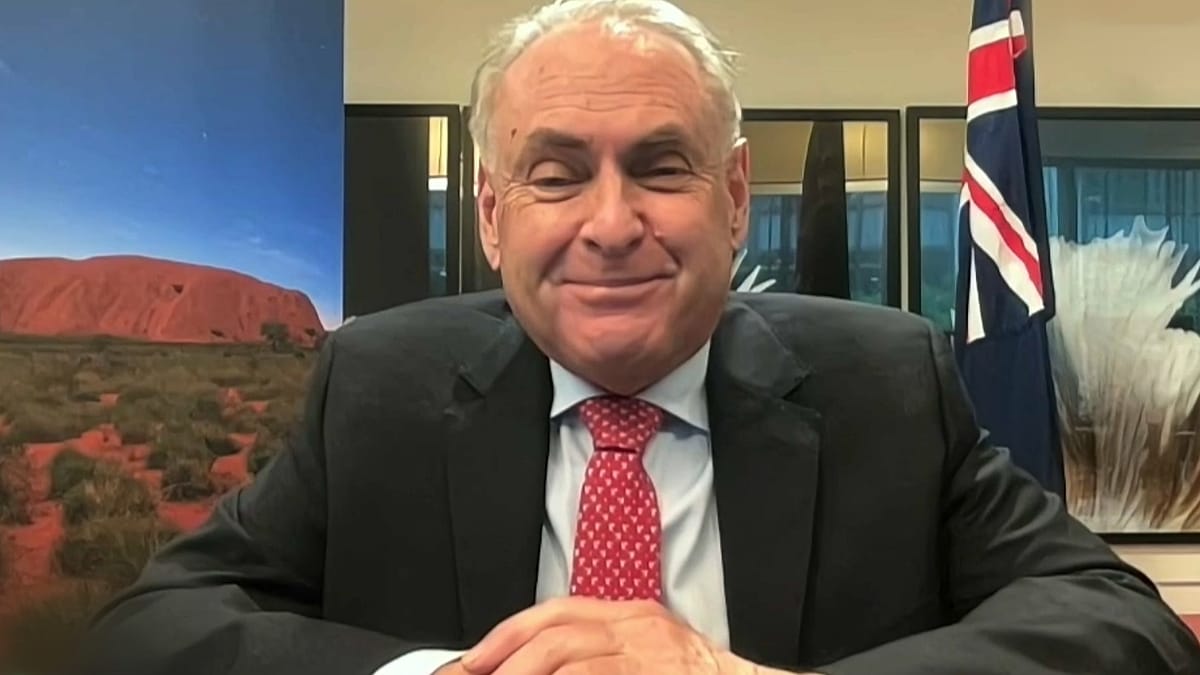
As the European Union grapples with recalibrating its trade relationship with China, Australian Trade Minister Don Farrell has a straightforward piece of advice for Brussels: patience. In an interview with Euronews's Europe Today, Farrell drew on Canberra's own experience of navigating a bitter trade dispute with Beijing to counsel European leaders against hasty decisions.
“Patience is a good first start with the Chinese,” Farrell said. “One of the things that we've been very focused on is as a middle power in the region is ensuring that we project our policies of a peaceful region.” He noted that Australia's steady approach had allowed it to maintain largely uninterrupted trade relationships even amid global turmoil, adding, “That's been very good for Australia in recent months, particularly with the troubles around the rest of the world. We've been able to continue pretty much uninterrupted our trade relationships, and that's the way we'd like to keep it.”
EU's Delicate Balancing Act
Farrell's comments come at a critical juncture for the EU, which is simultaneously managing trade tensions with both China and the United States. Last week, European Commissioners convened to discuss the bloc's approach to Beijing, with the European Commission reporting a record-high trade deficit of €359.9 billion with China in the previous year. Brussels has articulated a strategy of “de-risk, not decouple,” aiming to reduce dependence on Chinese imports without severing economic ties entirely. Yet the spectre of a full-scale trade war looms larger than ever.
The EU's efforts to diversify supply chains have been reflected in initiatives such as the EU's tech sovereignty package and proposed caps on supply chains to reduce reliance on China. However, the bloc's trade deficit underscores the depth of its economic entanglement with Beijing.
Australia's Trade Spat as a Cautionary Tale
Canberra knows the risks of a trade confrontation with China all too well. From 2020 to 2022, Australia was embroiled in a major trade dispute after then-Prime Minister Scott Morrison called for an international inquiry into the origins of the COVID-19 pandemic. Beijing retaliated by imposing bans and tariffs on Australian exports—including barley, wine, beef, and lobsters—affecting goods worth AUD$19 billion (€11.7 billion).
The election of Prime Minister Anthony Albanese's government in 2022 marked a turning point. By 2024, all Chinese import duties had been lifted. “We'd had a very rocky relationship with the previous government,” Farrell told Euronews. “We didn't get it fixed overnight. But by the end of our last term in government, we had resolved all those trade impediments.”
This diplomatic reset enabled Australia to secure free trade agreements with the United Kingdom, India, the United Arab Emirates, and—after eight years of deadlock—the European Union. “The hardest of them all was a free trade agreement with the Europeans, but we signed that a few [months] ago in Sydney,” Farrell said.
US Tariff Threats Add Pressure
The broader context for these trade manoeuvres is the disruption caused by US President Donald Trump's tariff policies. In January 2025, Trump announced steep import levies on numerous trade partners, including the EU and Australia. The situation escalated further in early April, with Trump declaring tariffs of 10 to 12.5 percent on imports from 60 countries, again targeting both the EU and Australia.
These moves have injected fresh uncertainty into global trade, prompting European capitals to seek stable partnerships elsewhere. The EU's de-risking strategy has gained urgency, though Farrell's message suggests that a confrontational approach may be counterproductive. Instead, he advocates for sustained dialogue and incremental progress—a lesson Australia learned the hard way.
For European policymakers, the Australian example offers a template: patience, combined with a willingness to rebuild trust, can yield results even after severe disruptions. Whether Brussels can apply that lesson amid competing pressures from Washington and Beijing remains an open question.