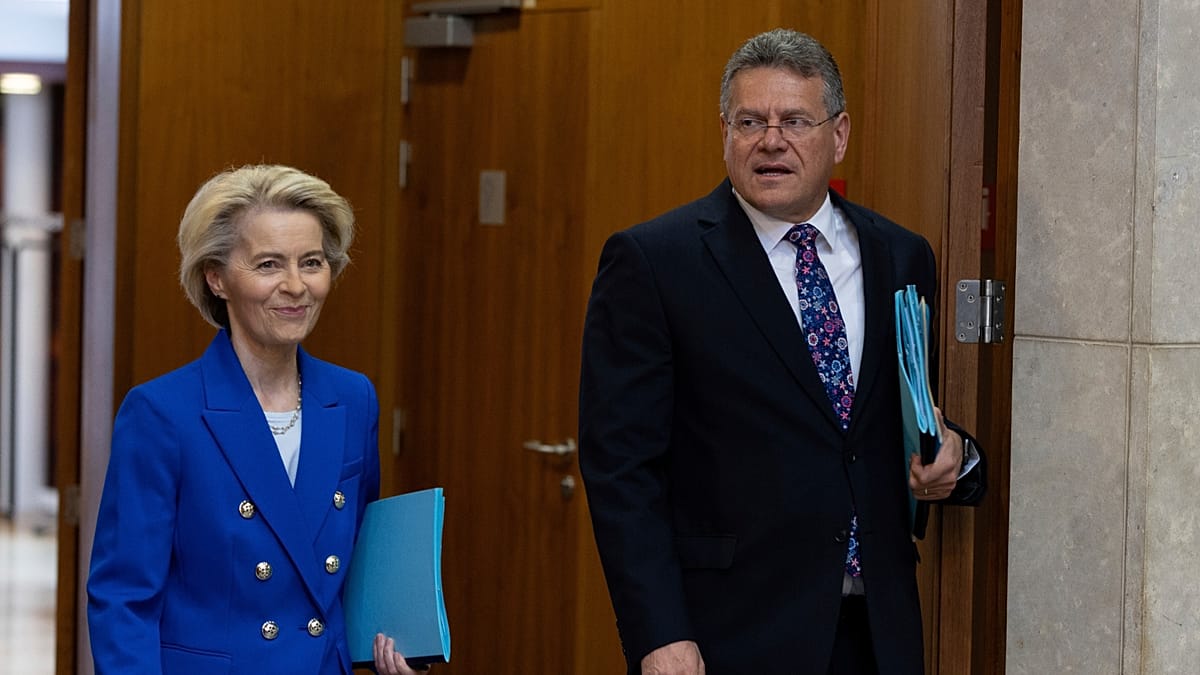
On 29 May, European Commissioners met to address a growing concern: the bloc's trade relationship with Beijing has become unsustainable. The Commission acknowledged that the current state of trade and investment with China is no longer tenable, and agreed on a strategy of de-risking rather than decoupling. This marks a significant shift from treating the issue as a mere trade concern to recognising it as a matter of competitiveness and security.
Europe's Over-Dependency Problem
Europe's reliance on China has grown steadily, driven by a focus on efficiency over resilience. According to Andrew Small, Director of the Asia Programme at the European Council on Foreign Relations, this was a deliberate long-term strategy by Beijing. "China has deliberately made sure that any other attempts to build alternative sources of supply would be squashed," Small said. This leverage allows Beijing to potentially weaponise trade, leaving the EU vulnerable to disruptions and price shocks.
In 2025, the EU's trade deficit with China reached €359.9 billion, up 2.7% from the previous year. A 2024 Commission study found that of 204 goods on which the EU is dependent, one-third come from China. Today, China supplies Europe with 98% of solar panels, 54.4% of machinery and vehicles, and 9.8% of chemicals. The dependency extends beyond finished products: China controls critical mid-supply chain processes, including refining of rare earths and processing of lithium. The EU imports 97% of magnesium for next-generation batteries and 100% of rare earths used for permanent magnets are refined in China.
Jacob Gunter, Head of Program at MERICS, noted that Europe benefited from cheap intermediate goods but failed to act on its dependencies. "It was a series of reasonable democratic choices that were made, I think in large part, because most people are unaware of what the Chinese economic model is," Gunter said.
De-Risk, Not Decouple
The Commission's de-risking strategy aims to maintain trade relations while reducing exposure in strategic areas like raw materials, batteries, chips, and solar. Alicia Garcia Herrero, adjunct professor at Hong Kong University of Science and Technology, explained that the goal is to avoid situations where economic efficiency becomes a security issue, particularly when reliance on a single supplier creates leverage for geopolitical coercion.
Europe has the technologies and capital for de-risking, but Gunter questioned the political will. "It is not a matter of 'do we have the money to do it', but rather 'do we have the political will to do it', and I don't think we have that yet," he said. Garcia Herrero added that duplicating Chinese manufacturing ecosystems in a short time is unrealistic, but partial diversification through new procurement rules is achievable within five years.
The EU's de-risking framework includes several legislative pillars: the 2023 Economic Security Strategy, the 2024 Critical Raw Materials Act, the Chips Act (2023), and the Net-Zero Industry Act (2024). The Commission has also implemented the Foreign Direct Investment Regulation (2025), the International Procurement Instrument (2012), and the Anti-Coercion Instrument (2023). These tools aim to promote, protect, and partner with European industries while shielding them from unfair competition.
However, the credibility of the agenda remains in question. Gunter warned that many European leaders are not seriously considering dependency risks and are focused on short-term gains. The success of de-risking hinges on member state cooperation and sustained political commitment.
For further context, the EU's strategic autonomy push is part of a broader effort to reduce dependence on China in critical sectors, as detailed in this analysis. Meanwhile, an OECD report highlights how China's state subsidies distort markets, complicating the EU's de-risking efforts. The bloc is also exploring partnerships like the Pax Silica chip alliance to counter China's AI ambitions.
The cost of resilience is high. Last year, European factory managers faced supply shortages after China curtailed rare earth exports, essential for EV motors, wind turbines, and defence equipment. The question remains whether the EU can muster the political will to build a more resilient, less dependent economic relationship with China.