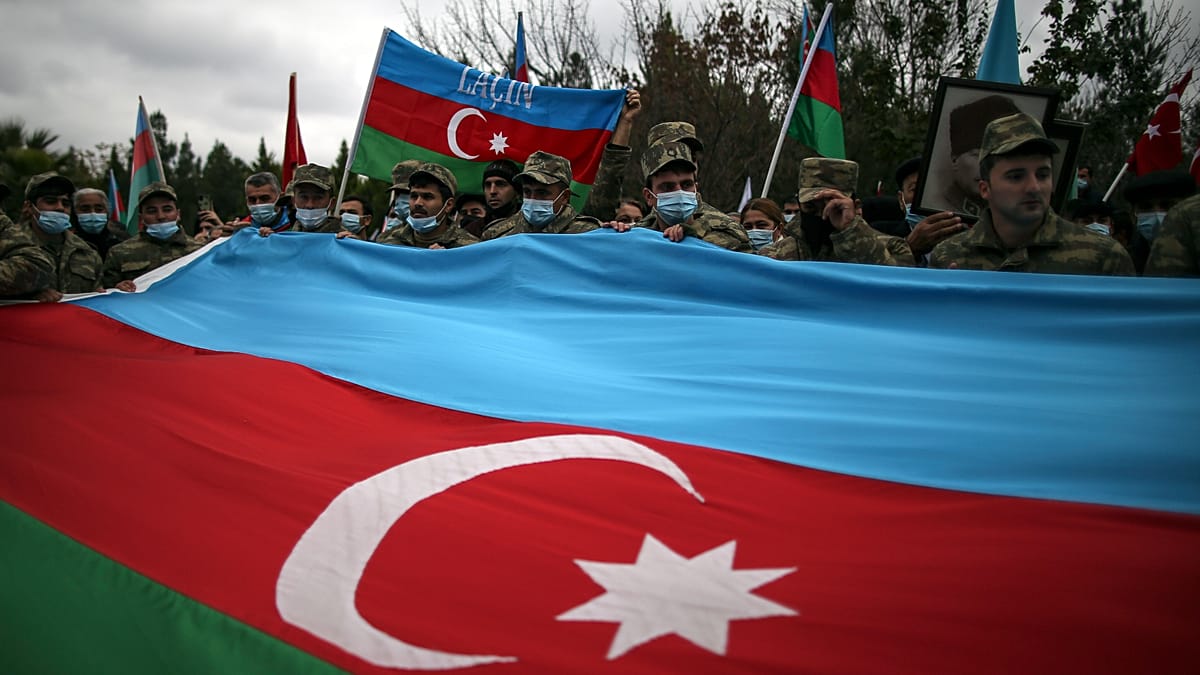
Azerbaijan held its annual Remembrance Day this week, honouring the soldiers killed during the 44-day war of autumn 2020 while pointing to a peace with Armenia that has begun to alter the economic geography of the South Caucasus. The conflict ended three decades of stalemate that had persisted since the collapse of the Soviet Union, and the November 2020 ceasefire set in motion a political process that has since produced a framework peace agreement covering border delimitation, reconciliation and the reopening of regional transport links.
Six years on, officials in Baku describe the legacy of that war as having moved from post-war reconstruction into active regional integration. The shift is visible less in diplomatic communiqués than in the freight moving across the border.
Rail freight becomes the clearest signal
After Azerbaijan lifted transit restrictions in late 2025, cargo began flowing steadily towards Armenia. Shipments routed via Azerbaijan Railways from Bilajari station to the Boyuk Kasik junction on the Georgian border now serve both direct bilateral trade and third-country transit. According to state customs data, Azerbaijani exports to Armenia between January and August 2026 exceeded $17 million (roughly €15 million) — a modest 0.08% of Azerbaijan's global exports, but a substantial physical volume.
Direct consignments have included about 17,000 tonnes of diesel and some 5,000 tonnes of AI-92 and AI-95 petrol. In March, Azerbaijan recorded a symbolic $960 in imports from Armenia, the first reciprocal exchange of its kind. The corridor also carries third-country goods: nearly 60,000 tonnes of wheat, barley and buckwheat, more than 9,000 tonnes of fertiliser, over 1,400 tonnes of propane gas, plus coal, timber and aluminium.
Digital traffic follows the same route
Cooperation has extended into telecommunications. National operators AzerTelecom and Telecom Armenia have implemented a digital transit agreement under which part of Armenia's international internet traffic is routed across Azerbaijan. Both companies framed the arrangement as a way to diversify connection routes in the region and improve network reliability. It also supports the broader Digital Silk Way project, and in return allows Azerbaijan to send data traffic to its Nakhchivan exclave directly through Armenian networks — a practical workaround that reduces reliance on alternative paths.
The infrastructure groundwork for wider transit is being laid in parallel. Armenia's state programme for 2026 to 2031 sets out plans for full commercial ties with Azerbaijan and the unblocking of regional transport links once a final peace treaty is signed. Railway construction in the Ordubad direction is already under way. Officials expect that a comprehensive agreement would let Armenia use Azerbaijan's transit network for wider international trade, creating an interconnected corridor across the South Caucasus.
Washington provides the political framework
The economic opening rests on a diplomatic milestone. On 8 August 2025, at a trilateral summit hosted at the White House by US President Donald Trump, Azerbaijani President Ilham Aliyev and Armenian Prime Minister Nikol Pashinyan signed a joint declaration for a comprehensive peace agreement. The meeting gave the bilateral process its strategic framework and signalled wider international interest in the corridor, as Washington has sought to link the peace deal to Trans-Caspian trade.
Reconciliation is also being felt beyond the negotiating table. In Karabakh, Udi Christians have returned to monasteries as security conditions have improved, a small but symbolically significant marker of normalisation. Baku has separately moved to repair ties with European capitals, including a normalisation with France after a prisoner release, while pursuing a domestic technology agenda that officials say will support the digital economy.
None of this is guaranteed. A final treaty has yet to be signed, physical exports from Armenia across Azerbaijani territory are not yet active, and the reconciliation process remains vulnerable to domestic politics on both sides. But the direction of travel is clear: a conflict that once froze a region is slowly being converted into a transport and data corridor — and, for Azerbaijan, into a Remembrance Day observed with an eye on what comes next rather than only on what was lost.