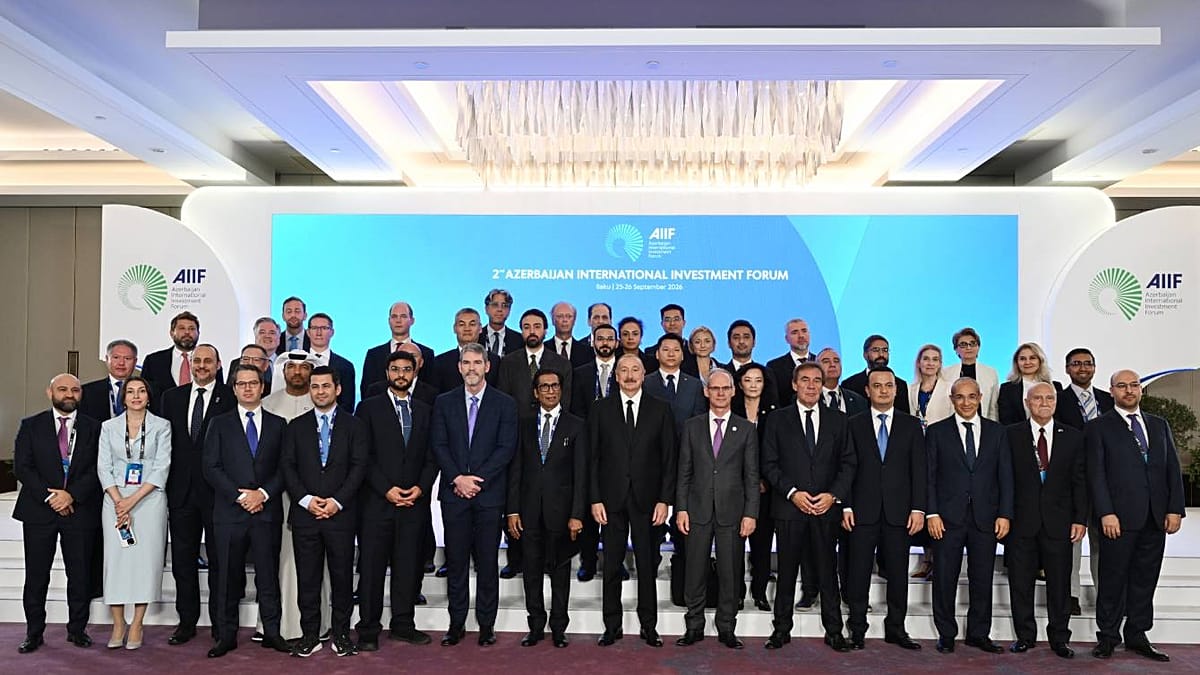
Azerbaijan has concluded contracts worth $10.8 billion (about €9.7 billion) at the second Azerbaijan International Investment Forum in Baku, according to Economy Minister Mikayil Jabbarov, as the South Caucasus state intensifies its effort to draw international capital into sectors well beyond hydrocarbons.
Speaking to Euronews, Jabbarov said 26 agreements had been executed across fields ranging from artificial intelligence and energy to manufacturing and production. He added that Baku is increasingly looking at opportunities beyond its own borders, through partnerships that extend to markets as distant as the United States and Italy.
"We tend to look at opportunities not only within our geographical borders but also through partnerships," Jabbarov said.
The figure follows more than $10 billion in agreements signed at the inaugural forum in 2025, of which over $7 billion concerned the non-oil sector. This year's event, held alongside the Azerbaijan Infrastructure Investment Dialogue, brought together firms managing a combined $30 trillion in assets, according to the state oil fund SOFAZ. Among the participants were BlackRock, Global Infrastructure Partners and Brookfield Asset Management.
A pivot away from hydrocarbons
The breadth of the deals speaks to a structural challenge for Azerbaijan: converting foreign interest into a more varied industrial base. In an address to the forum, President Ilham Aliyev said the non-oil sector accounted for 72% of GDP in 2025, with real non-oil growth averaging 5% annually since 2020. He pointed to manufacturing, transport and logistics, renewable energy, digital technologies, agriculture, tourism and infrastructure as areas open to investors.
Yet Aliyev also acknowledged that energy remains the anchor of the country's investment appeal. He noted that the oil and gas contracts signed three decades ago remain unchanged, a continuity he presented as evidence of Azerbaijan's reliability as a partner.
"The contracts which actually led to the development in oil and gas sector signed 30 years ago still are absolutely untouched — not a single word was changed," he told a closed-door session.
The infrastructure dialogue, hosted by SOFAZ and BlackRock, marked a step up in ambition. BlackRock manages $15.3 trillion in assets, while Global Infrastructure Partners, which has operated within BlackRock since 2024, oversees roughly $170 billion.
Flows in both directions
According to the Central Bank of Azerbaijan, foreign direct investment reached more than $3 billion in the first half of 2026, a 13.8% year-on-year increase. The leading sources were the United Kingdom, Türkiye, Cyprus, Russia and Iran. Over the same period, Azerbaijani capital exported abroad exceeded $5 billion, directed mainly to Italy, Türkiye, the UK, the UAE and Georgia.
Baku has also been working to raise its commercial profile internationally, a push that intersects with its broader diplomatic outreach, including peace dividends in the South Caucasus and efforts to modernise its digital economy.
Orkhan Mustafayev, founder and chairman of Sabah Investment Group, told Euronews that marketing efforts are paying off. He cited the Sea Breeze project as a flagship, noting that overseas sales are rising by 20% year on year and that the sales mix has shifted from 95% domestic to 70% local and 30% international. He said smaller investors were seeing returns of 40% to 50%.
For European investors, Azerbaijan's pitch rests on its position as a bridge between the Caspian and European markets, its energy ties with the EU and its ambitions in transport corridors. Whether Baku can translate this week's headline figure into durable non-oil growth will depend on execution — and on whether the world's largest asset managers return for a third edition.