Iraq's Interior Ministry is pressing ahead with an ambitious effort to bring an estimated six million weapons held outside official institutions under state control, even as Baghdad has quietly softened a 30 September deadline that had been presented as a hard cut-off for armed factions to surrender their arsenals.
Deputy Interior Minister Hussein al-Awadi said the government now treats that date as the beginning of a regulatory process rather than its conclusion. A four-member committee that includes Prime Minister Ali al-Zaidi and former premier Mohammed Shia al-Sudani is working on a revised mechanism, he added, speaking during a visit to Salah al-Din province.
Al-Awadi said the ministry had made measurable progress in roughly 100 days since al-Zaidi took office, and that the government's focus had shifted from counter-terrorism to organised crime. Security files, he said, would be transferred to provincial authorities one by one in the coming months.
Negotiation, not force
The disarmament campaign is being conducted through talks rather than military pressure. Al-Zaidi said in August that his government had no intention of using force against the factions, noting that some had already handed over weapons while discussions continued with others. In recent days he argued that the withdrawal of US-led coalition troops would leave "no justification or need for any resistance in Iraq", and that he would not accept "a state within the state".
Washington has applied significant pressure of its own. In June it asked Baghdad for a clear timetable for bringing weapons under state control, and the Trump administration has tied compliance to Iraq's continued access to dollar flows that are critical to its economy.
Tehran-aligned factions at the centre
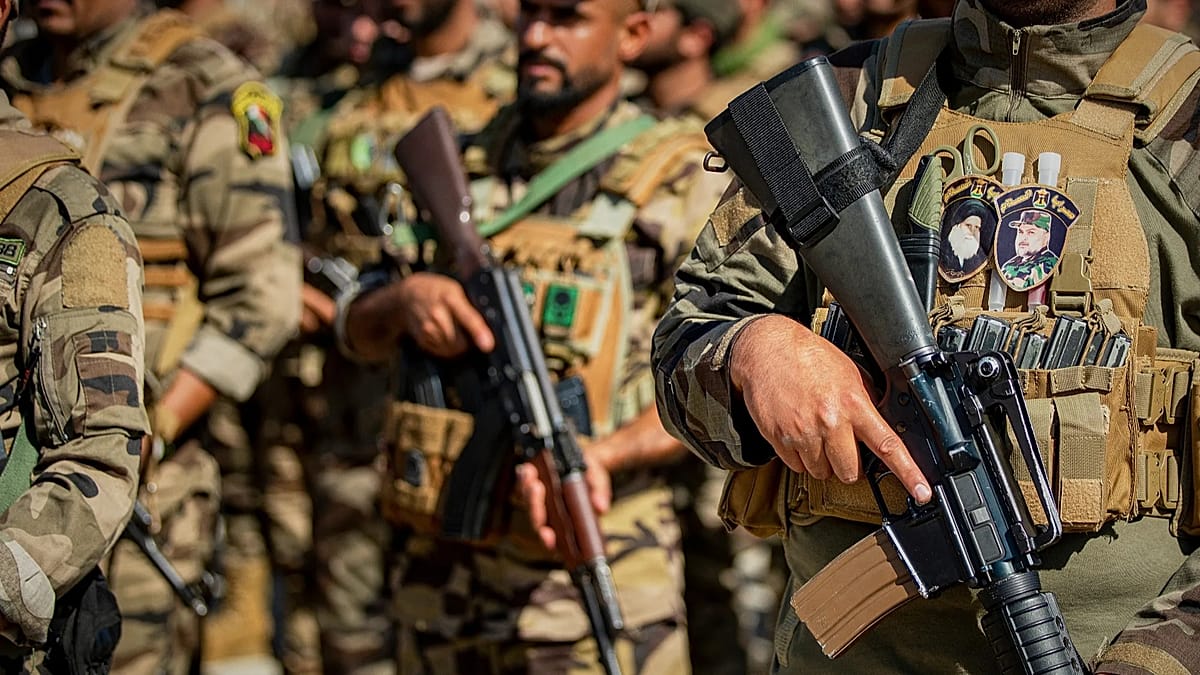
The standoff is centred on Shia militias that formed under Iranian guidance and operate with Tehran's backing. They are loosely grouped under the Popular Mobilisation Forces (PMF), an umbrella body created in 2014 after Iraq's most senior Shia cleric, Ayatollah Ali al-Sistani, called on volunteers to fight the so-called Islamic State group.
Some PMF factions have been formally folded into Iraq's state security architecture. Others have kept independent command chains and continue to receive weapons, funding and direction from Iran's Islamic Revolutionary Guard Corps.
Kataib Hezbollah and Harakat al-Nujaba — two of the most hardline Tehran-aligned groups, both of which have previously targeted US forces in Iraq and launched attacks on Gulf states during the ongoing Iran war — have refused to surrender what they describe as "resistance weapons".
By contrast, Saraya al-Salam, Asaib Ahl al-Haq and Kataib Imam Ali have reached an understanding with the government to hand over weapons or regularise their status. Saraya al-Salam formally separated from cleric Muqtada al-Sadr's movement and was integrated into the Iraqi security forces at a ceremony in Samarra in June.
The political context is delicate. Al-Zaidi, a 40-year-old billionaire businessman with no prior political or government experience, was approved as prime minister by parliament on 14 May as a compromise candidate after months of deadlock within the Shiite Coordination Framework.
For European governments, the outcome matters beyond Iraq's borders. A durable monopoly on legitimate force in Baghdad would reduce the risk of Iran-aligned militias drawing the region into wider confrontation — a scenario that has repeatedly disrupted energy markets, shipping routes and European air traffic. It would also shape the security vacuum left by the coalition's departure, a question that has preoccupied NATO capitals from Berlin to Paris.
Iraq's courts have meanwhile become a venue for sensitive security cases, including the trial of French IS suspects in Baghdad, underscoring how closely European judicial and counter-terrorism interests remain entangled with Iraq's stabilisation efforts.
Whether Baghdad can translate its negotiating strategy into real disarmament remains uncertain. The government's revised timetable offers no firm endpoint, and the factions most central to the standoff have shown little appetite for giving up their arsenals. For now, the process is defined less by deadlines than by the slow, contested work of persuading armed groups to accept the authority of a state they have long operated alongside — and sometimes against.