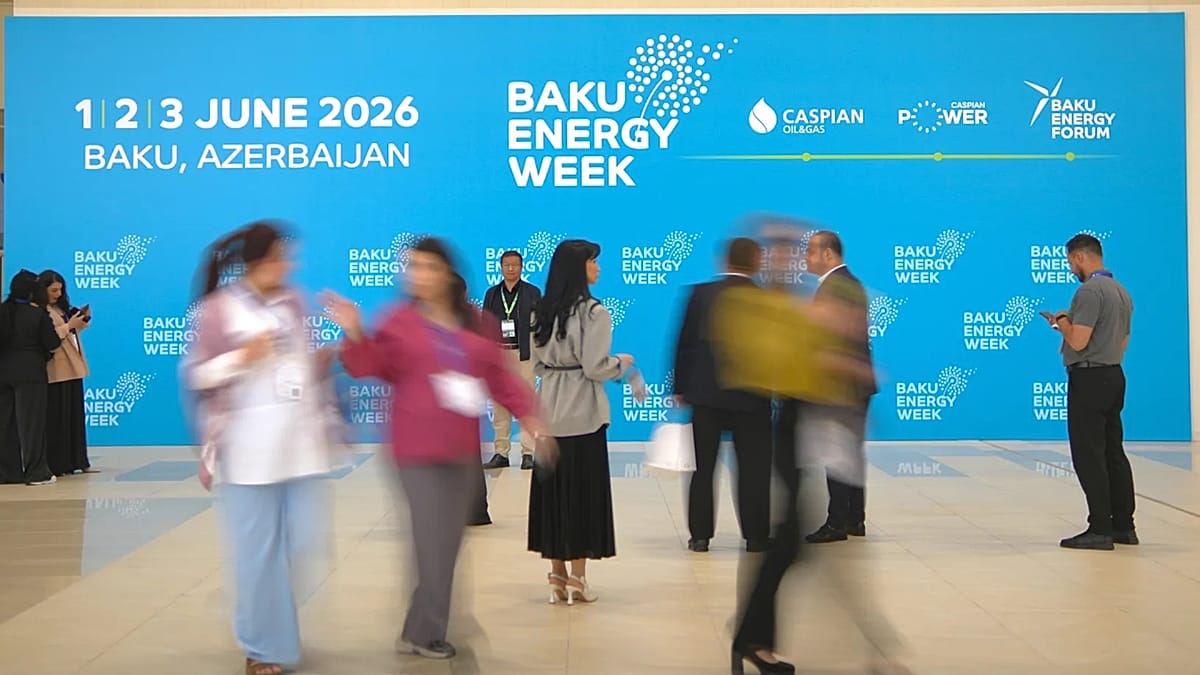
At the final day of Baku Energy Week, a senior official from the International Gas Union (IGU) delivered a blunt assessment: the world is not transitioning away from fossil fuels but adding more energy from every source. Damjan Krnjević Mišković, chief of staff to the IGU secretary-general, told the forum that global consumption of oil, gas, coal, nuclear, biomass, and renewables is all rising simultaneously, directly challenging the conventional narrative of an energy transition.
“There is not so much energy transition as there is an energy addition,” Krnjević Mišković said. “We’re consuming more and more oil and gas and coal and nuclear and biomass and renewables than we ever have before in the world.”
Grids as the New Bottleneck
The dominant theme of the day was not the phasing out of hydrocarbons but how to expand renewable capacity without abandoning the fossil fuels that still underpin energy security and export revenues for producer economies. Transmission infrastructure emerged as the defining concern. Fuat Age Aslan, international business development manager at HT Solar, argued that grid upgrades are as critical as generating capacity itself.
“The grid is always important because grids are the roads and highways for electricity transmission. Once we are implementing renewable-energy systems, the grid efficiency and transmission capabilities need to improve urgently,” Aslan said. He noted that the Caspian Sea region, including Azerbaijan, has high potential for wind, solar, and hydro power, but without modern grids, that potential remains untapped.
Battery storage, digital energy management, and AI-driven grid systems were widely discussed as components of the next phase. Nuran Karimov, managing partner of Deloitte Azerbaijan, said AI had been a defining theme across the forum, with discussions moving from niche to mainstream. “The discussion around green energy is not put in opposition to conventional fossil fuel. Most speakers spoke about energy mix,” he said.
Azerbaijan’s Dual Strategy
Azerbaijan’s President Ilham Aliyev set out his country’s renewable targets at the forum’s opening ceremony, saying Azerbaijan would have 2 gigawatts of solar capacity installed by the end of next year and aimed for 8 gigawatts by 2032. At the same time, he emphasized that countries should not be judged by whether they have oil or not, but by how they use revenues to develop and invest in green agendas.
Aliyev also noted that Azerbaijan now exports gas to 16 countries, 10 of which are EU members, and pointed to new electricity and green energy corridors linking the Caspian region to European markets via the Black Sea. This dual strategy—expanding renewables while maintaining fossil fuel exports—reflects a broader trend across producer economies in the Caucasus and Central Asia.
The forum also highlighted the role of digital systems in managing these corridors. As AI and digital systems transform energy corridors linking the Caspian to Europe, the need for robust infrastructure becomes even more pressing. Meanwhile, the European Union’s approach to energy costs remains a point of contention, with limited fiscal flexibility offered in response to Italy’s demands.
Implications for Europe
For European policymakers, the message from Baku is clear: the energy transition is not a simple replacement of fossil fuels with renewables, but a complex addition that requires massive investment in grids, storage, and digital management. The continent’s reliance on imported gas from Azerbaijan and other Caspian suppliers means that developments in Baku have direct implications for energy security in Berlin, Rome, and Warsaw.
As the EBRD recently cut its growth forecast amid an Iran conflict-driven energy shock across Europe, the need for resilient and diversified energy systems has never been more urgent. The Baku forum underscored that without addressing grid bottlenecks, the addition of renewables will not be enough to meet climate goals or ensure stable supplies.