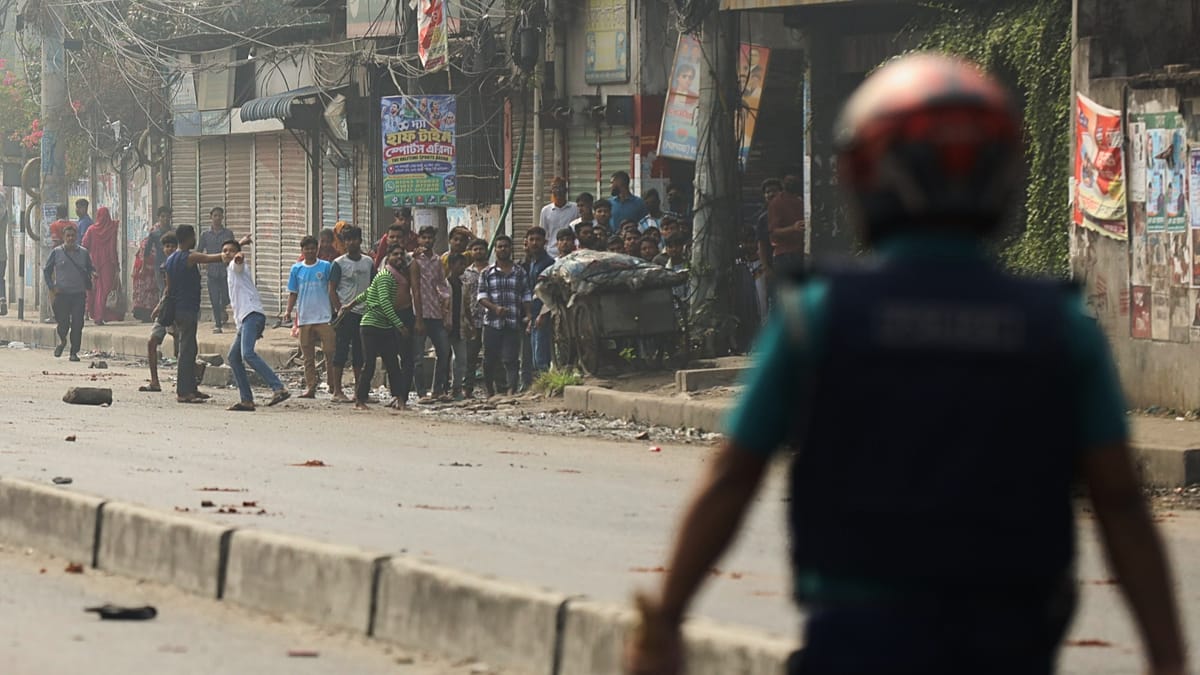
Police in Bangladesh clashed with thousands of garment workers on Wednesday as protests over minimum wages intensified, disrupting the country's most important export industry. The unrest, which has simmered for weeks, turned violent in the industrial belts surrounding Dhaka, the capital.
Local media reported that around 20,000 workers from a garment factory blocked the Dhaka-Aricha Highway in Savar, just outside Dhaka, before police moved in with tear gas, stun grenades, and baton charges. The number of injuries was not immediately clear.
The violence quickly spread to nearby Ashulia, a major manufacturing hub, where police chief Saiful Alam said officers acted after protesters blocked roads and threw stones. About 25 factories in Ashulia were forced to close as a result of the unrest, according to police.
In Gazipur, another industrial zone north of Dhaka, demonstrators blocked the Dhaka-Mymensingh highway and set fire to a police vehicle. Police again responded with tear gas and stun grenades, according to local reports.
A sector under strain
The garment industry is the backbone of Bangladesh's economy, generating roughly $40 billion (€36 billion) a year from exports through about 2,500 factories. It employs around 4 million workers directly, most of them women from rural areas, with millions more working in related supply chains.
Workers are demanding a minimum monthly wage of 30,000 takas (€215), up from the current 12,500 takas (€89). They argue that soaring living costs and inflation have severely eroded their purchasing power, making it impossible to make ends meet.
The protests, which began earlier this month, have become a near-daily occurrence. Hundreds of factories have shut down, and many owners have invoked a “no work, no pay” clause in labour laws, suspending operations and wages during the unrest.
The government has set up a board to negotiate a new wage package, but so far its efforts have failed to satisfy the protesters. The Bangladesh Garment Manufacturers and Exporters Association and the Bangladesh Knitwear Manufacturers and Exporters Association have both called for better protection of their factories, which have been targeted in some incidents.
The standoff highlights a broader tension across global supply chains, where European and international brands rely on low-cost production in South Asia. As inflation bites worldwide, workers in exporting countries are pushing back against wages that have not kept pace with the cost of living.
For European retailers and consumers, the unrest in Bangladesh could mean higher prices or supply delays, as the country supplies many of the continent's major fashion brands. The situation also raises questions about the social responsibility of European companies that source from the region.
Similar labour disputes have occurred elsewhere, and European policymakers have often weighed in on workers' rights in global supply chains. The outcome of the wage negotiations in Dhaka will be watched closely in Brussels and other European capitals, where ethical sourcing and fair wages are increasingly part of the political agenda.