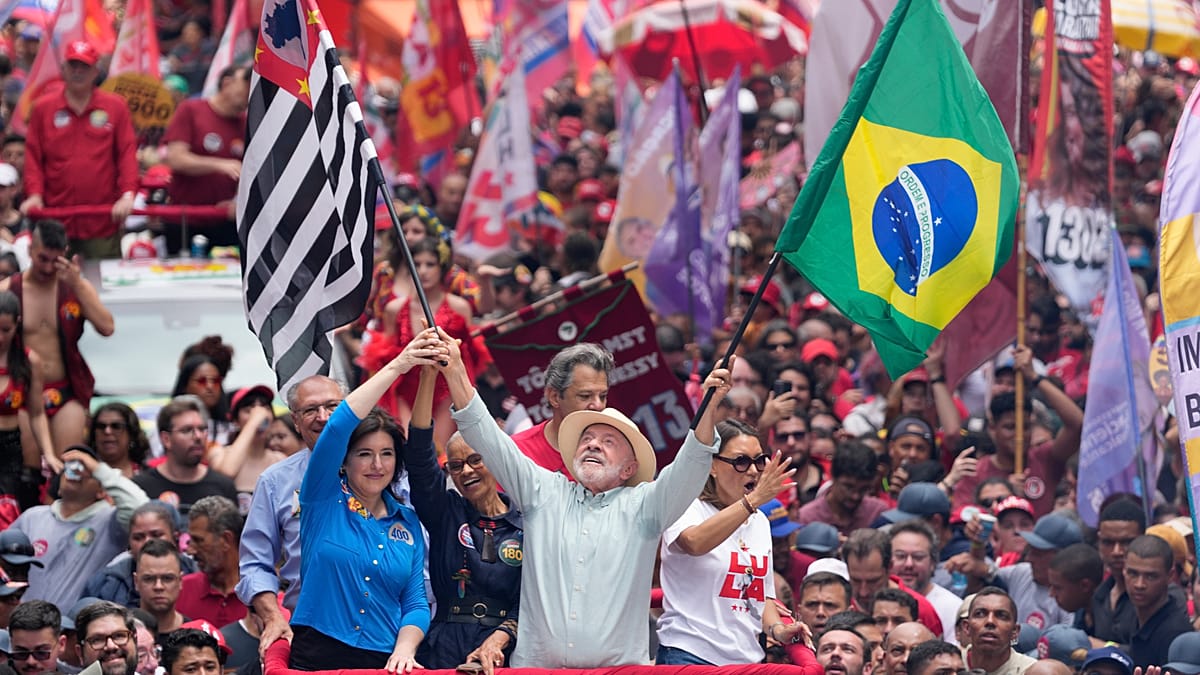
With just one day left before Brazilians head to the polls, President Luiz Inácio Lula da Silva and Senator Flávio Bolsonaro are making their final appeals to voters in the country's two largest cities. The election, set for Sunday, pits the 80-year-old left-wing incumbent against the 45-year-old right-wing senator, son of former president Jair Bolsonaro, whom Lula narrowly defeated four years ago.
The two candidates represent sharply divergent visions for Latin America's largest economy. Lula, seeking a fourth term, has made the defence of national sovereignty a central theme, warning that Brazil risks falling under undue influence from Washington. Flávio Bolsonaro, meanwhile, has campaigned on a platform of hardline security and fiscal discipline, portraying Lula as ineffective and out of touch with ordinary Brazilians' concerns about the cost of living.
Final rallies in São Paulo and Rio
Lula will close his campaign in the megacity of São Paulo, where supporters are expected to gather under banners reading "Lula president again" and "Brazil belongs to Brazilians." His team has also released a Portuguese-language version of Bad Bunny's song "Lo que le pasó a Hawaii," using the US annexation of Hawaii as a cautionary tale about foreign domination.
Flávio Bolsonaro, who spent Saturday at a bikers' rally in the interior of São Paulo state, will end his day with a final event in Rio de Janeiro. His rallies have featured large US flags and inflatable figures of Donald Trump, who has said he is following the Brazilian election closely but has not formally endorsed the senator.
The race remains extremely close. Opinion polls suggest neither candidate will secure the majority needed to win outright on Sunday, making a second round on 25 October highly probable. Twelve candidates are on the ballot, but only Lula and Bolsonaro are considered viable contenders.
A campaign dominated by scandals and insults
The campaign has been unusually bitter, even by Brazilian standards. Personal attacks and allegations have overshadowed policy debates, with both camps using social media to amplify every gaffe or rumour. AI-generated images and slick videos have become standard tools in the digital war for undecided voters.
One of the most damaging revelations came when it emerged that Flávio Bolsonaro is under investigation for corruption linked to the financing of a biopic about his father. The film, titled "Dark Horse," was reportedly funded by jailed banker Daniel Vorcaro, who is himself implicated in one of Brazil's largest financial scandals. The affair has also touched the Supreme Federal Court, where some judges have been linked to Vorcaro, sparking a public row within the judiciary.
Lula has sought to tie his rival to the Trump administration's policies, pointing to the 50% tariffs Washington imposed on Brazilian goods last year and the recent designation of Brazilian drug-trafficking gangs as foreign terrorist organisations. He has also criticised the US for what he calls interference in Brazil's electoral process. Earlier this year, Brazil opened an inquiry into alleged US funding of far-right groups, adding another layer of tension to bilateral relations.
Flávio Bolsonaro, for his part, has framed the election as a choice between order and chaos. He has promised to crack down on organised crime and to rein in public spending, echoing the fiscal austerity measures adopted by other right-wing governments in the region. If he wins, Brazil would join Argentina, Chile, Colombia, Costa Rica and Peru in a recent wave of rightward shifts across Latin America.
The stakes are high not only for Brazil but for the wider geopolitical balance in the Americas. A victory for Flávio Bolsonaro would align Brazil more closely with the Trump administration, while a Lula win would likely maintain a more independent foreign policy. As the campaign enters its final hours, both candidates are urging their supporters to turn out, knowing that every vote could prove decisive.
Around 160 million Brazilians are registered to vote, and they will also elect members of parliament, governors and some senators. The first-round results are expected late Sunday, with a likely runoff to follow in three weeks.