The European Commission is resisting calls to reopen the debate on financial support for Ukraine, even as Russia's intensified war effort raises questions about whether the €90 billion loan agreed by EU leaders last year will stretch to the end of 2027 as originally planned.
Brussels intends to disburse €45 billion this year and another €45 billion in 2026. So far, Ukraine has received €3.2 billion in budgetary aid and €8.35 billion in military support under the loan scheme.
"In terms of longevity, that is what is foreseen: that this €90 billion loan should be disbursed (over) the two years," Paula Pinho, the Commission's chief spokesperson, said on Tuesday in response to a question from Euronews. She added that disbursements are tied to reforms in Ukraine, which remain a critical condition.
"We are focused now on what is already a very ambitious disbursement plan, and for the moment that's where our focus lies," Pinho said.
Russia's escalation drives up costs
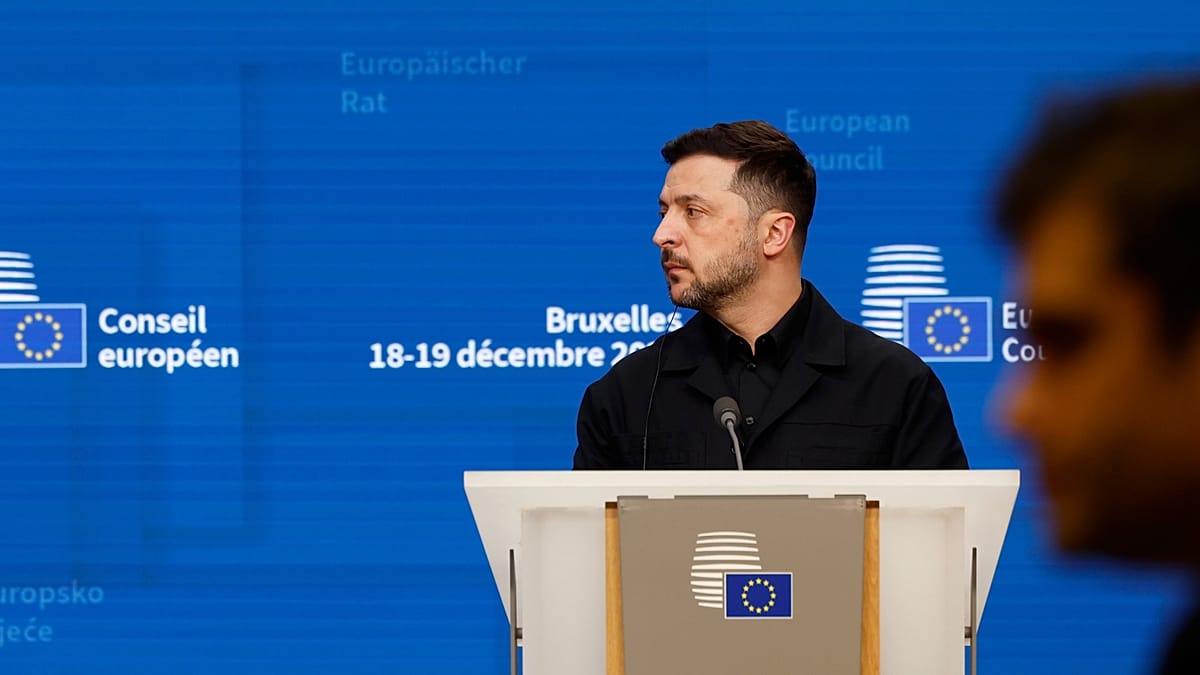
Russia has adopted a new tactic of relentless drone attacks aimed at disrupting daily economic life and terrorising civilians, while also stepping up ballistic missile strikes on critical infrastructure ahead of winter. The mounting pressure has led Ukrainian President Volodymyr Zelenskyy to ask allies to fill a €23 billion gap in the Ministry of Defence to fund weapons and remain "competitive" in deep strikes.
"We need more money, much more," Zelenskyy said last week. He has suggested that the EU front-load a portion of the €45 billion earmarked for next year, which would leave less available in 2027. The Commission has not yet received a formal request from Kyiv on this matter.
Member states discussed the issue on Tuesday during an informal ministerial meeting in Ireland, where support for Ukraine topped the agenda. Irish Foreign Minister Helen McEntee said there was "consensus across the room" to "bring forward funding" under the existing loan, but acknowledged that further deliberations in Brussels are needed.
Renewed calls to tap frozen Russian assets
Meanwhile, Sweden, the Netherlands, Spain and Poland have revived the idea of using the immobilised assets of the Russian Central Bank to provide additional support for Ukraine, warning that the €90 billion loan "will not be enough." The EU holds €210 billion of these assets, which have been sanctioned since February 2022.
"What we see is that Ukraine needs more support and, to be honest, we're not providing enough support bilaterally and through the EU, and then what is left is the frozen assets," Swedish Foreign Minister Maria Malmer Stenergard told Euronews. "This is what is fair to Ukraine, it's what is fair to taxpayers," she added.
The Commission is treading carefully on this divisive issue. Last year, the executive backed an inventive proposal to turn the Russian assets into a financial lifeline for Ukraine, but the plan met fierce opposition from Belgium, which holds the majority of the €210 billion. It collapsed at a make-or-break summit in December, when leaders instead opted for joint debt to finance the €90 billion loan.
Officials in the Commission have not abandoned the idea of tapping the Russian assets, but they are wary of tabling a new proposal without a guarantee of success, especially as capitals are already embroiled in fraught negotiations over the next EU budget.
Instead, Brussels is turning up the pressure on Western allies, who are expected to complement the loan by covering one-third of Ukraine's needs. "There is one-third which cannot be covered by the EU and where we have been urging our partners to come in and step in," Pinho said.
The debate comes as Sweden urges the EU to tap frozen Russian assets for Ukraine, and as the EU presses Greece and Spain to send Patriot interceptors to bolster Kyiv's air defences. The Russian warning of massive strikes on Ukraine's grid underscores the urgency of the situation.