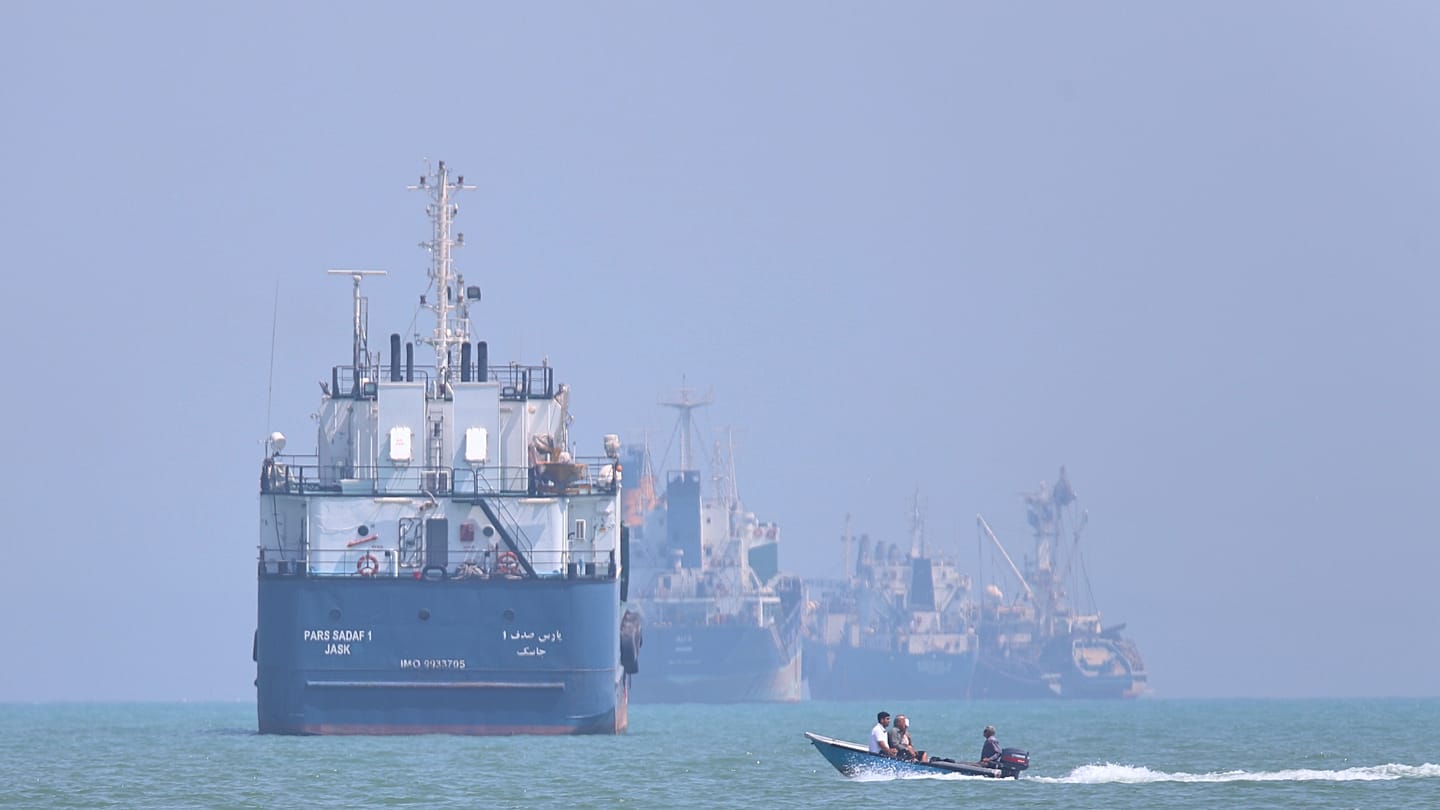
A cargo ship navigating the Strait of Hormuz under a United Nations-backed corridor was struck by a projectile on Tuesday, damaging its bridge, the British military confirmed. The incident occurred just hours after Iran’s Islamic Revolutionary Guard Corps (IRGC) issued a renewed warning that vessels transiting the waterway without Iranian authorization were doing so “illegally.”
The vessel, which was operating on the new Omani-mediated route designed to de-escalate tensions in one of the world’s most critical maritime chokepoints, sustained structural damage but remained seaworthy. No casualties have been reported, and the ship is continuing its journey under escort, according to UK Maritime Trade Operations (UKMTO).
The attack marks a significant escalation in the ongoing standoff over navigation rights in the Strait of Hormuz, through which roughly a fifth of the world’s oil supply passes. The IRGC’s warning, issued earlier on Tuesday, explicitly stated that any vessel not coordinating with Iranian authorities would be considered in violation of international law and subject to interception.
European Interests at Stake
For European capitals, the incident underscores the fragility of supply chains that depend on the free flow of energy from the Gulf. The European Union imports approximately 15 percent of its crude oil from the region, and any sustained disruption could send prices soaring across the continent. Brussels has been closely monitoring the situation, with diplomats from Paris, Berlin, and Rome urging restraint from all parties.
The attack also comes amid a broader diplomatic push by the United States and Iran to negotiate a framework for maritime security in the Gulf. Earlier this month, US and Iran made headway on Hormuz and Lebanon ceasefire despite Trump's threats, raising hopes for a de-escalation. However, the IRGC’s latest actions suggest that hardliners in Tehran may be seeking to undermine any potential agreement.
Environmental groups have also raised alarms. Greenpeace has slammed the EU's 'deep incoherence' on energy policy, arguing that the bloc’s continued reliance on Gulf oil exposes it to geopolitical blackmail and environmental risks. A major spill in the narrow strait could have catastrophic consequences for marine life and coastal communities in Oman, Iran, and the UAE.
The Omani corridor, which was established with UN backing in late 2024, was intended to provide a safe passage for commercial shipping outside the direct control of any single state. But the IRGC has consistently rejected its legitimacy, viewing it as a challenge to Iran’s sovereign claims over the waterway. In a statement, the IRGC said the corridor was “a violation of Iran’s territorial integrity” and warned that it would “take all necessary measures to protect national security.”
Analysts in London and Brussels note that the attack is likely to harden positions on both sides. “This is a clear message from Tehran that it will not accept any arrangement that diminishes its control over the strait,” said Dr. Elena Marchetti, a security expert at the European Council on Foreign Relations. “European leaders must now decide whether to push for a more robust naval presence or to engage diplomatically with Iran to find a compromise.”
The United States has already deployed additional naval assets to the region, and the Pentagon warned that any further attacks on commercial shipping would be met with a “swift and decisive response.” Meanwhile, the UKMTO has advised all vessels transiting the strait to exercise extreme caution and to report any suspicious activity immediately.
For European businesses, the immediate concern is the potential for insurance premiums on Gulf shipping to skyrocket, adding to the cost of imported goods. The incident also raises questions about the viability of the Omani corridor, which was seen as a model for de-escalation in other contested waterways, such as the South China Sea.
As the situation develops, European Pulse will continue to monitor the impact on energy markets and diplomatic efforts. The coming days will be critical in determining whether the attack is an isolated incident or the beginning of a broader campaign to challenge international navigation rights in the Gulf.