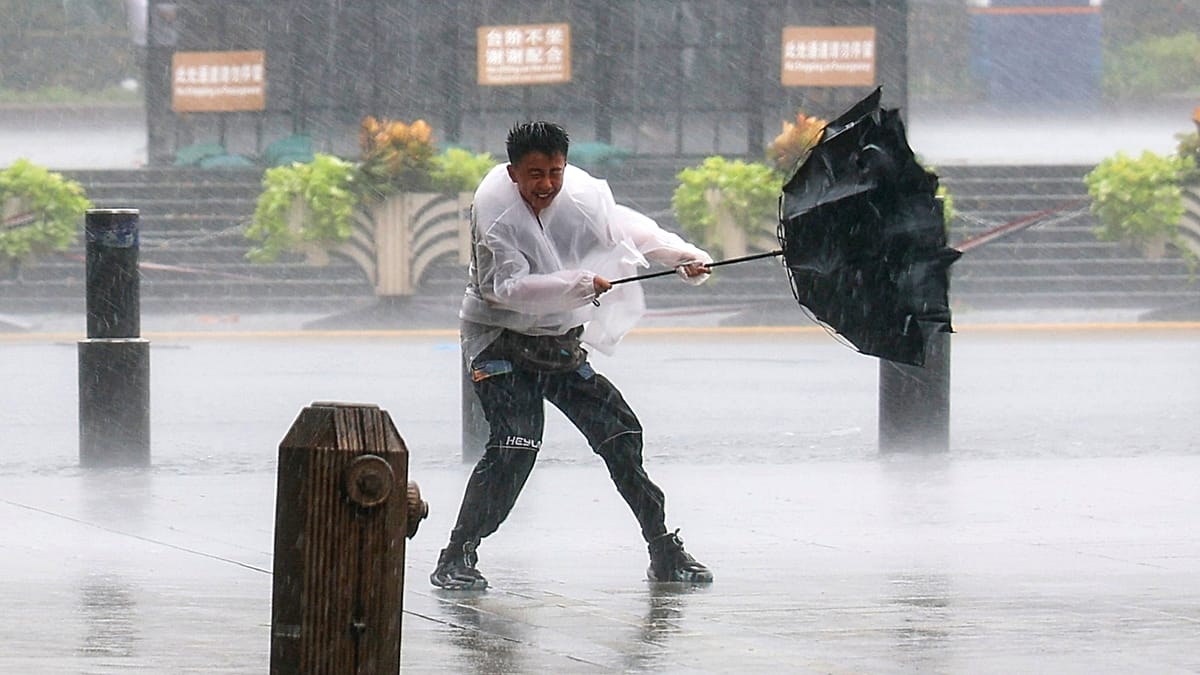
Typhoon Dolphin slammed into China's densely populated eastern seaboard on Sunday, prompting the evacuation of over a million residents and the cancellation of more than a thousand flights. The storm, which had already lashed Japan's Okinawa, made landfall near Yuhuan City in Zhejiang Province at around 5:30 pm local time, according to China's National Meteorological Centre.
With maximum sustained winds exceeding 150 kilometres per hour at landfall, the typhoon brought torrential rain and severe disruption to a region that is home to major industrial and financial hubs. Authorities issued a red alert, the highest level in China's four-tier warning system, forecasting "extraordinary torrential rain" in parts of central and eastern Zhejiang.
Mass evacuations and transport chaos
More than 900,000 residents were relocated from the city of Wenzhou alone, with over 1,000 emergency shelters opened across the province. In neighbouring Fujian, nearly 99,000 people were moved from high-risk areas on Saturday evening, state news agency Xinhua reported.
The storm's impact on travel was severe. Nearly 1,400 flights in and out of Shanghai's two main airports were cancelled on Sunday, according to state broadcaster CCTV. Hangzhou's airport in Zhejiang saw 270 cancellations. Ferry services were suspended on more than 200 routes in Zhejiang and Fujian, and some train services were halted to ensure passenger safety.
Offshore construction work was also stopped, with 474 vessels called to port by Friday morning, Xinhua said. The region is still recovering from the economic fallout of the pandemic, and such disruptions add further strain on supply chains that extend across Europe.
Regional ripple effects
The typhoon's influence reached far beyond the immediate landfall zone. In Hong Kong, the observatory recorded a record high temperature of 36.9°C, caused by warm, subsiding air pushed over the city by the storm's outer circulation. The observatory warned that extreme heat would persist until Tuesday.
In Taiwan, dozens of ferry services were suspended and more than 180 flights cancelled as the storm brought downpours and strong winds to the island's north. In Okinawa, seven people suffered minor injuries, including a man over 100 years old who was blown over by gusts and hit his head. By Sunday afternoon, 5,290 households in Okinawa were without power, according to regional utility Okinawa Electric Power.
The storm is expected to weaken as it moves northwest over eastern China, but heavy rain is forecast for Shanghai and parts of Fujian, Anhui and Jiangsu provinces through Monday afternoon.
Typhoon Dolphin's arrival comes just two weeks after Typhoon Noul struck southern Guangdong province, which authorities described as the strongest storm to hit China this year. The back-to-back storms highlight the increasing intensity of tropical cyclones in the region, a trend scientists link to human-driven climate change.
For European readers, the disruption in China is a reminder of how interconnected global supply chains are. As trade tensions between the EU and China simmer, extreme weather events can further complicate the flow of goods and components that European manufacturers rely on. The growing Chinese investment in Morocco and Turkey also underscores the shifting dynamics of global production, where climate risks are increasingly factored into business decisions.
While the immediate focus is on the human cost and recovery efforts, the longer-term implications for regional stability and economic resilience are significant. As Europe watches these developments, the need for robust disaster preparedness and international cooperation on climate adaptation has never been clearer.