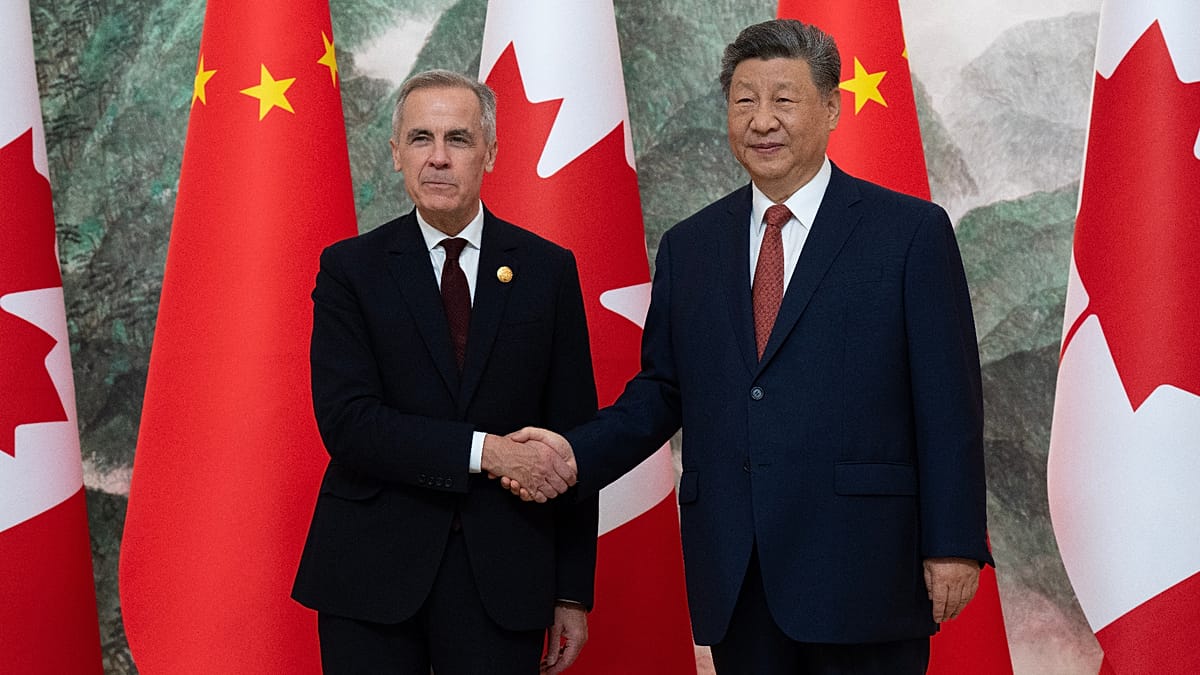
Speaking at the Asia-Pacific Economic Cooperation (APEC) summit in the Chinese tech hub of Shenzhen, Canadian Prime Minister Mark Carney delivered a stark warning: the world's failure to establish global governance for artificial intelligence is an 'enormous risk' that demands urgent action.
'We are of the view, and many others share this, that the absence of any global governance around AI is an enormous risk,' Carney told reporters on Wednesday. He elaborated that the threat spans multiple domains: 'It's an enormous economic risk, but it's also a biohazard risk, and it's a risk to democracy, human dignity, and other factors.'
Carney, a former central banker who has led both the Bank of Canada and the Bank of England, stressed that this concern is not confined to policymakers. 'That isn't just our view. That is the view of the individuals who run the world frontier labs, you know who they are,' he said, pointing to the rare alignment between industry leaders and regulators.
'It is exceptionally rare in my experience that leaders of an industry are amongst... those warning of risks in their own industry,' Carney added. 'So it is past time to develop global governance frameworks for these sectors.'
A call for international cooperation
Carney said he had shared his ideas on how such frameworks could be built with Chinese President Xi Jinping during the summit. The goal, he suggested, should be 'at a minimum' to establish monitoring mechanisms and to share lessons on responding to AI-related 'incidents'.
The risks are not hypothetical. Recent incidents include AI agents—autonomous tools that perform real-world tasks—that have hacked into websites, including an Australian government data portal and several US government sites, as acknowledged by OpenAI. Such breaches highlight the potential for AI to be used in cyberattacks, disinformation campaigns, or even the development of bioweapons.
For Europe, the stakes are particularly high. The European Union has been at the forefront of AI regulation with its AI Act, but the absence of a truly global framework leaves gaps that could undermine these efforts. As the European Central Bank has warned, AI-driven market dynamics can also pose risks to financial stability, a concern that resonates across the eurozone.
Carney's remarks come as APEC's 21 member economies grapple with a range of issues, from trade tensions to technological disruption. The Canadian leader's call for global governance echoes similar appeals from European officials, who have long argued that no single nation can manage the cross-border challenges posed by AI.
However, the path to international consensus remains fraught. Differences in values, legal systems, and geopolitical rivalries—particularly between the US, China, and Europe—have stymied previous attempts at global tech governance. Carney acknowledged the difficulty but insisted that the urgency of the moment demands action.
'We need to move from discussion to implementation,' he said. 'The frameworks we build must be robust enough to protect our societies, yet flexible enough to adapt to a rapidly evolving technology.'
For European readers, the message is clear: the continent's own regulatory efforts, while pioneering, are insufficient without global cooperation. As UNESCO has highlighted, AI systems can even distort scientific facts, underscoring the need for international standards that safeguard truth and human dignity.
Carney's warning is a reminder that the AI revolution is not just an economic or technological story—it is a test of global governance. Whether leaders can rise to the challenge remains to be seen, but as Carney put it, 'it is past time' to try.