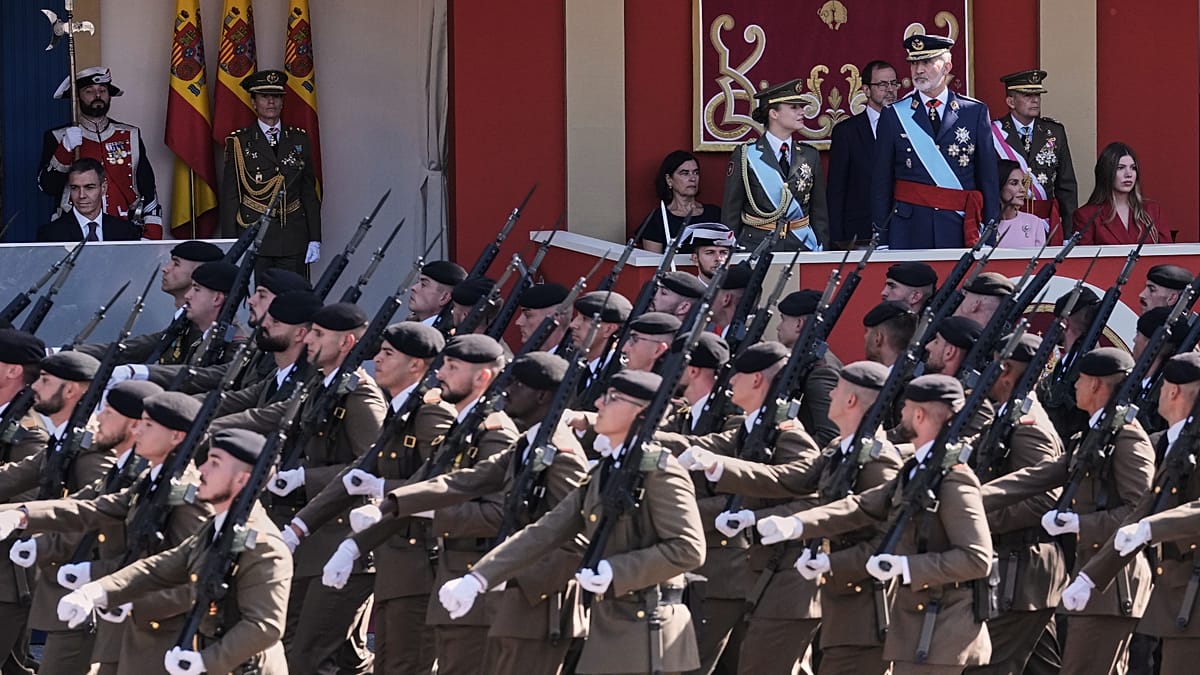
Spain's National Day parade unfolded on Madrid's Paseo del Prado on Monday with a conspicuous absence: not a single soldier from Ceuta marched in the annual display. The autonomous city on the North African coast was represented only by its continued deployment of Spanish troops, kept in place since July, when tens of thousands of migrants crossed the border from Morocco in a matter of days.
King Felipe VI and Queen Letizia presided over the ceremony in the capital, and will travel to Ceuta on Tuesday — a visit that underscores the territory's symbolic weight at a moment of political uncertainty. The royal trip follows the clearance of a beach camp in the enclave, a move that drew attention to the situation on the ground in Ceuta ahead of the monarch's arrival.
A parade under political cloud
The event took place against a fraught backdrop. Prime Minister Pedro Sánchez called a snap general election for 29 November, dissolving parliament just days before the parade. His arrival at the ceremony was met with jeers from members of the public gathered along the route — a reminder that the campaign is already in full swing.
Sánchez's decision to call an early vote has injected fresh volatility into Spanish politics, with the opposition seeking to capitalise on discontent over migration, the cost of living and regional tensions. The atmosphere in Madrid reflected that unease, even as the parade sought to project unity and military strength.
Under clear skies, 82 aircraft took part in the aerial display, led by two F/A-18 jets. On the ground, the army's new 8x8 Dragón armoured vehicles took centre stage for the first time, signalling a shift in procurement priorities. Marine Corps vehicles equipped with the Aracne anti-drone system also made their debut, alongside two Asturcón drones from the Military Emergencies Unit — a clear indication of where the Defence Ministry intends to invest.
In total, 3,850 men and 530 women participated in the parade, according to official figures. The inclusion of women remains a modest but visible feature of Spain's armed forces, though the overall composition continues to draw scrutiny from equality advocates.
Ceuta's shadow and the wider election
The absence of Ceuta's troops was not merely a logistical detail. It highlighted how the enclave — one of two Spanish territories on the African mainland, alongside Melilla — remains a flashpoint in the national conversation. The July crisis saw thousands of migrants, many of them unaccompanied minors, cross into Ceuta after Moroccan authorities relaxed border controls, straining local services and prompting a fierce political row in Madrid.
Defence sources have indicated that forces remain in Ceuta to maintain security and support local authorities, but the decision to keep them there during the national parade was read by some as a tacit acknowledgment of the territory's unresolved challenges. The royal visit on Tuesday is expected to focus attention on the enclave's needs, including calls for greater investment in reception facilities and border management.
Elsewhere in Spain, National Day was marked by rallies and counter-rallies, with unity demonstrations in Barcelona and a far-right presence in Ceuta itself. The contrasting scenes illustrated the broader fragmentation of Spanish politics as the 29 November vote approaches.
For Sánchez, the parade offered a brief moment of ceremonial duty amid a gruelling campaign. For the armed forces, it was an opportunity to showcase modernisation. But for Ceuta, the day served as a reminder that its security and its place in Spain remain live questions — ones that the next government, whatever its complexion, will have to answer.