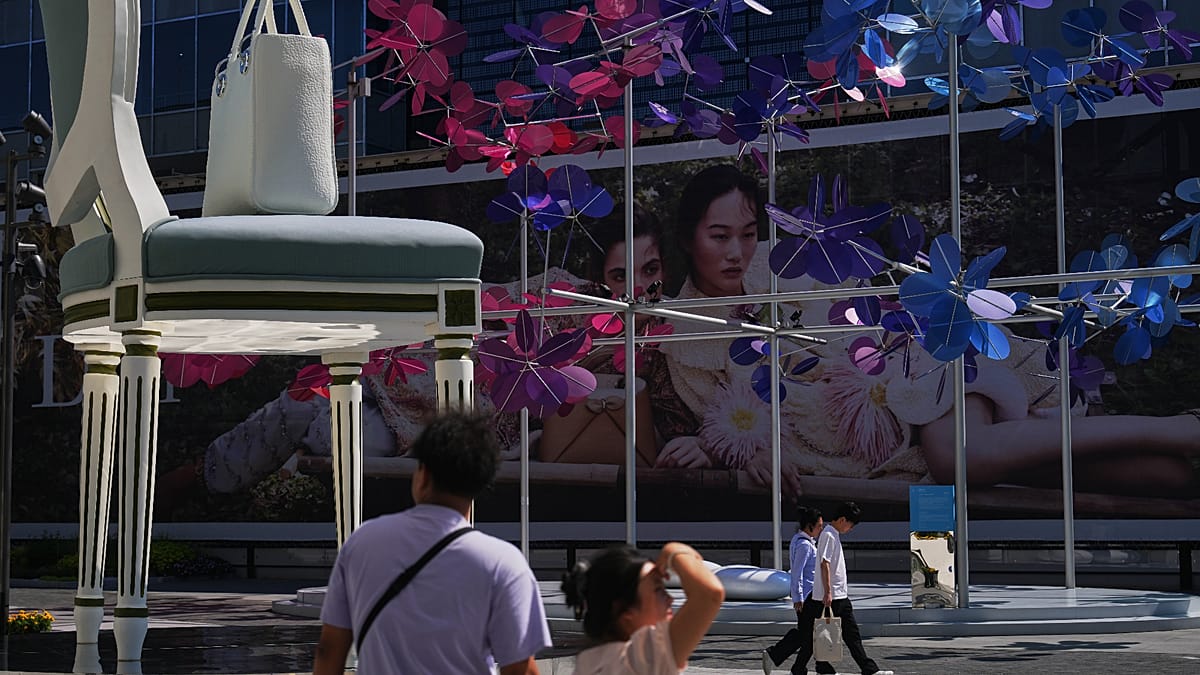
For decades, Chinese shoppers were the engine of European luxury, snapping up Louis Vuitton trunks and Hermès silk scarves as markers of success. But a generational shift is underway: thrift and savvy deals now carry more cachet than conspicuous consumption, and that is rattling the continent's biggest fashion houses.
China's economy grew 4.5% year-on-year in the third quarter, yet domestic demand remains weak. The country's once-insatiable appetite for Western labels—which accounted for roughly a third of global luxury spending—has cooled. LVMH recently blamed a "slowdown in demand in China" for a drop in organic sales in its fashion and leather goods division, while Hermès has also noted softer footfall in the region.
The belt-tightening is visible on the ground. Louis Vuitton has closed five stores in mainland China over the past two years, including a chocolate boutique in Shanghai, and Galeries Lafayette shuttered its Beijing flagship in May. Meanwhile, the second-hand luxury market is booming. Consultancy Bain & Company estimates that mainland China's personal luxury goods market contracted by 3–5% in 2025 after a steeper 18–20% decline in 2024, while the pre-owned segment grew 15–20%.
At Super Zhuanzhuan, a warehouse-style second-hand store in central Shanghai, shoppers browse rows of handbags, belts, and jewellery while wearing black gloves to protect the merchandise. Dance teacher Yuan, 24, told AFP that the old status game has inverted: "People used to compare who had spent more. But now everyone compares who got a better deal and spent less."
Domestic consultancy Insight & Info Consulting puts total second-hand luxury sales at 38.4 billion yuan (€5.1 billion) in 2025, with forecasts of 100 billion yuan (€13.3 billion) by 2030. That growth is partly driven by younger consumers who see pre-owned items as both economical and environmentally conscious.
Generation Z turns away from heritage logos
Phoebe Ma, a 24-year-old freelancer, says her mother's generation viewed Louis Vuitton as the pinnacle of prestige because China was less developed when they first encountered Western brands. "They formed a deep-seated impression that, OK, Louis Vuitton was the absolute best and most prestigious," she told AFP. But Ma now finds the monogram dated. "It suits my mother's generation, but Gen Z would rather buy trendy Korean brands," she said.
Chen Luo, head of China consumer research at Bank of America, sees a broader evolution. Shoppers are moving away from luxury as a pure status signal toward "self-identity, distinction, experience, quality, emotional value (and) cultural relevance." He adds that China's digital and social-media-driven retail landscape is unique, and "foreign brands should work very hard to stay relevant in this context."
Adding to the friction is a growing cultural and legal pushback. Louis Vuitton recently won a trademark case against Chinese beverage chain Molly Tea over a four-petal floral pattern resembling its monogram. Molly Tea plans to appeal, but the lawsuit sparked an online backlash, with some Chinese internet users and state media arguing the motif derives from ancient Chinese patterns.
"It feels a bit absurd," said Echo Wang, a 31-year-old marketing professional. "Molly Tea may be doing well in China, but it's nowhere near Louis Vuitton's global profile... I think some people feel the lawsuit was inappropriate." LVMH called its intellectual property "an absolute key asset" but acknowledged the controversy "had a negative impact."
Despite these headwinds, analysts stress that China remains indispensable. "In our view, China will still be an important market, although it may not be a growth engine in two to three years," said Luo. For European luxury groups, the challenge is clear: adapt to a more discerning, value-conscious Chinese consumer—or watch their once-reliable growth engine sputter.
As the continent's fashion capitals look east, the lesson from Shanghai and Beijing is that prestige alone no longer sells. The brands that thrive will be those that blend heritage with relevance, and that may mean rethinking everything from store networks to digital engagement. For more on how Europe's luxury sector is navigating global shifts, see our analysis of luxury travel trends in 2027.