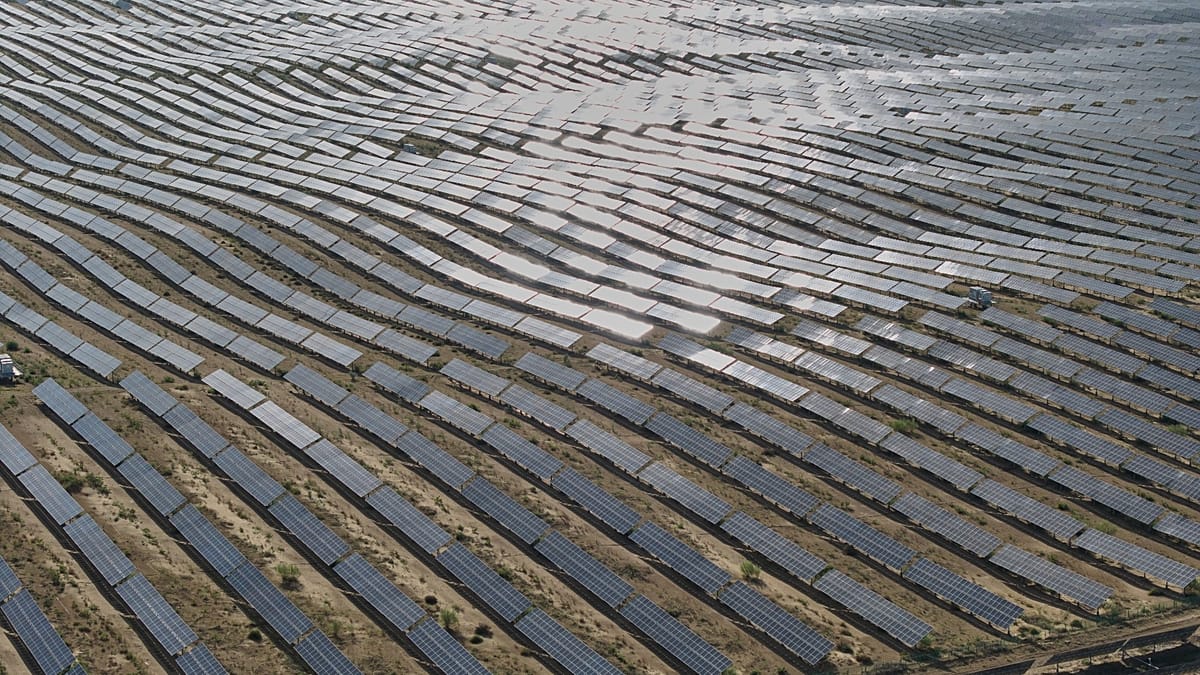
For the first time, China's installed solar capacity has surpassed that of coal-fired power, a historic shift in the world's largest emitter of greenhouse gases. According to the National Energy Administration (NEA), solar capacity reached 1.286 billion kilowatts by the end of July, edging past coal's 1.285 billion kilowatts. The agency called it a turning point, with photovoltaics now the country's largest power source category.
Solar generation in China rose 15.5% in the first seven months of 2026 compared to the same period last year, reaching 802.4 billion kilowatt-hours—about one-eighth of the nation's total electricity output. The NEA noted that solar installations and generation have maintained rapid growth, playing an increasingly prominent role in securing electricity supply and driving the energy transition.
Coal has dominated China's power mix for decades, but its share is now declining. Data reviewed by AFP showed coal-fired generation fell by nearly 2% in 2025, despite rising energy demand—the first such decline in six years, and possibly the first time on record that coal output dropped while power consumption grew. China has pledged to peak carbon emissions by 2030 and reach carbon neutrality by 2060.
How does Europe compare?
European Union member states are trailing China in the race to expand renewables, partly because Beijing began its clean-energy push much earlier and at a larger scale. In 2023, China installed between 180 and 230 gigawatts of solar, while all European countries combined added just 58 gigawatts. That gap reflects not only timing but also structural advantages: China's dominance in clean-tech manufacturing and patents, coupled with lower labour costs, makes installations faster and cheaper.
Europe's electricity grid, often described as outdated, also struggles to integrate variable renewable sources efficiently. Experts have recommended hybridisation—combining solar, wind, and storage at the same site—as a way to improve grid flexibility. Yet progress remains uneven across the continent. Germany, for instance, has seen its exports cushion the energy shock, but its grid still faces bottlenecks when integrating northern wind power with southern solar output.
The European Commission has acknowledged the need to reduce dependence on Chinese clean-tech imports. EU climate chief Wopke Hoekstra has argued that cutting reliance on China will cost more in the short term but pays off later, while also urging Brussels to confront Beijing on unfair trade practices. Hoekstra's accusations highlight a growing tension: Europe wants to accelerate its own green transition, but it risks falling further behind if it cannot scale up domestic manufacturing.
Despite the challenges, there are bright spots. London's New Spitalfields Market now hosts the city's largest rooftop solar array, a small but symbolic step in urban renewable adoption. Meanwhile, the upcoming 2027 solar eclipse has driven accommodation prices in Andalusia to extraordinary levels, underscoring how solar energy is becoming embedded in everyday life—even in tourism.
China's milestone is a reminder that the energy transition is accelerating globally, but Europe must modernise its grid and boost its own manufacturing capacity to keep pace. The EU's Green Deal and recent trade measures aim to address this, but the clock is ticking. As Hoekstra has warned, the cost of inaction may be higher than the price of investing now.