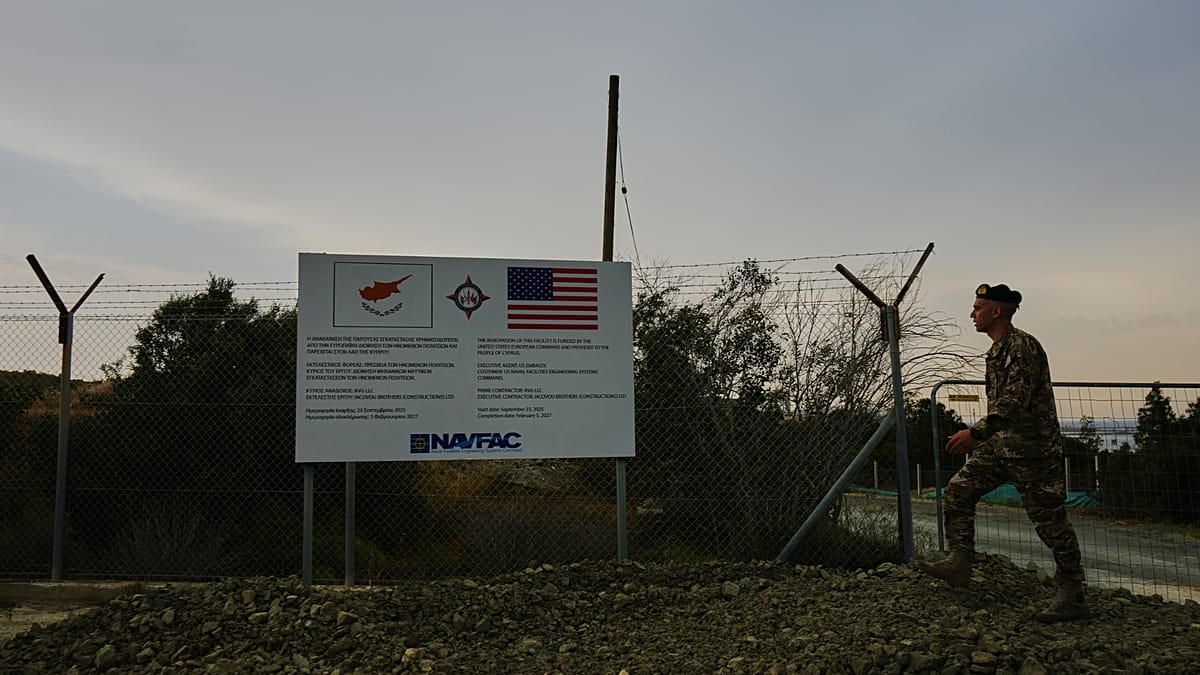
Cyprus is moving forward with a significant upgrade of two military installations, backed by US and EU funding, to solidify its position as a critical humanitarian hub for evacuations from the Middle East. The projects, announced by Cypriot officials, aim to expand the Andreas Papandreou Air Base in Paphos and the Evangelos Florakis naval base at Mari, both of which have played key roles in recent crises.
Air Base Expansion for Heavy-Lift Operations
The Andreas Papandreou Air Base will receive a new parking apron designed to accommodate dozens of heavy-lift military transport aircraft, such as the C-17 Globemaster and C-130 Hercules. This expansion will enable faster refuelling and maintenance during large-scale humanitarian operations, a capability that proved essential during the 2024 Gaza aid corridor and the evacuation of third-country nationals from Sudan in 2023. The US has provided €500,000 for a development plan to assess the overall cost, which Cyprus Defence Minister Vasilis Palmas estimates at around €14 million.
Lt Col Paris Samoutis, a Cyprus National Guard spokesperson, told the Associated Press that the funding will help determine the precise scope of the work. Construction is expected to begin in 2027, pending final cost assessments and EU co-financing for the naval base component.
Naval Base Heliport for Rapid Evacuations
At the Evangelos Florakis naval base, located just 229 kilometres from Lebanon's coast, a new heliport funded by US European Command will accommodate large Chinook transport helicopters. These aircraft are capable of airlifting evacuees directly from conflict zones, a capability that Cyprus has relied on during past emergencies. The naval base project could exceed €200 million, with Nicosia seeking additional EU funding to cover the gap.
Cyprus has carved out a strategic role as the closest EU member state to crisis zones in the Middle East. In 2006, the island facilitated the evacuation of around 30,000 people from Lebanon during the Israel-Hezbollah war. More recently, in June 2025, when the US and Israel struck Iran's nuclear facilities, Cyprus again acted as a waystation for people leaving Israel and for Israelis stranded abroad to return home.
The upgrades are part of a broader programme to enhance both bases' capacity to support large-scale humanitarian responses. President Nikos Christodoulides has made clear that the installations will be restricted to humanitarian operations and will not be used for offensive military action, a stance that has helped maintain Cyprus's neutrality in regional conflicts.
Growing US-Cyprus Military Cooperation
Bilateral military cooperation between EU member Cyprus and the US has deepened in recent years. In January 2025, experts from the 435th Contingency Response Group, based at Germany's Ramstein Air Base, conducted an infrastructure assessment at Andreas Papandreou Air Base. US Army Col Kenneth Evans, senior defence attache at the US Embassy in Nicosia, noted that "events in Sudan, Lebanon, Israel and Gaza in 2023 and 2024 demonstrated the criticality of the Republic of Cyprus as a security partner in the eastern Mediterranean."
The US also deployed a Marine contingent with V-22 Osprey tiltrotor aircraft to Paphos Air Base in 2024 to assist with potential evacuations from Lebanon. These developments underscore the island's growing importance as a logistical hub for humanitarian missions, particularly as the EU seeks to bolster its crisis response capabilities.
Cyprus's role has not been limited to evacuations. In 2024, it deployed the Amalthea maritime corridor to ship thousands of tonnes of humanitarian aid to Gaza, initially directly and later through Israel's Ashdod port. The island's proximity to conflict zones—just 229 kilometres from Lebanon and 300 kilometres from Gaza—makes it an ideal staging point for relief operations.
The upgrades come as the EU grapples with broader security challenges, including energy price spikes linked to Middle East conflicts. EU Energy Chief Warns of Years-Long Recovery as Middle East Conflict Drives Up Costs, highlighting the interconnected nature of regional stability and European interests. Meanwhile, EU Leaders Gather in Cyprus for Crisis Talks on Energy, Defence, and Middle East, further cementing the island's role as a diplomatic and logistical hub.
With work set to begin in 2027, Cyprus is positioning itself as a reliable partner for humanitarian operations, balancing its EU membership with pragmatic cooperation with the US. The upgrades will ensure that the island remains ready to respond to future crises, whether in Lebanon, Gaza, or beyond.



