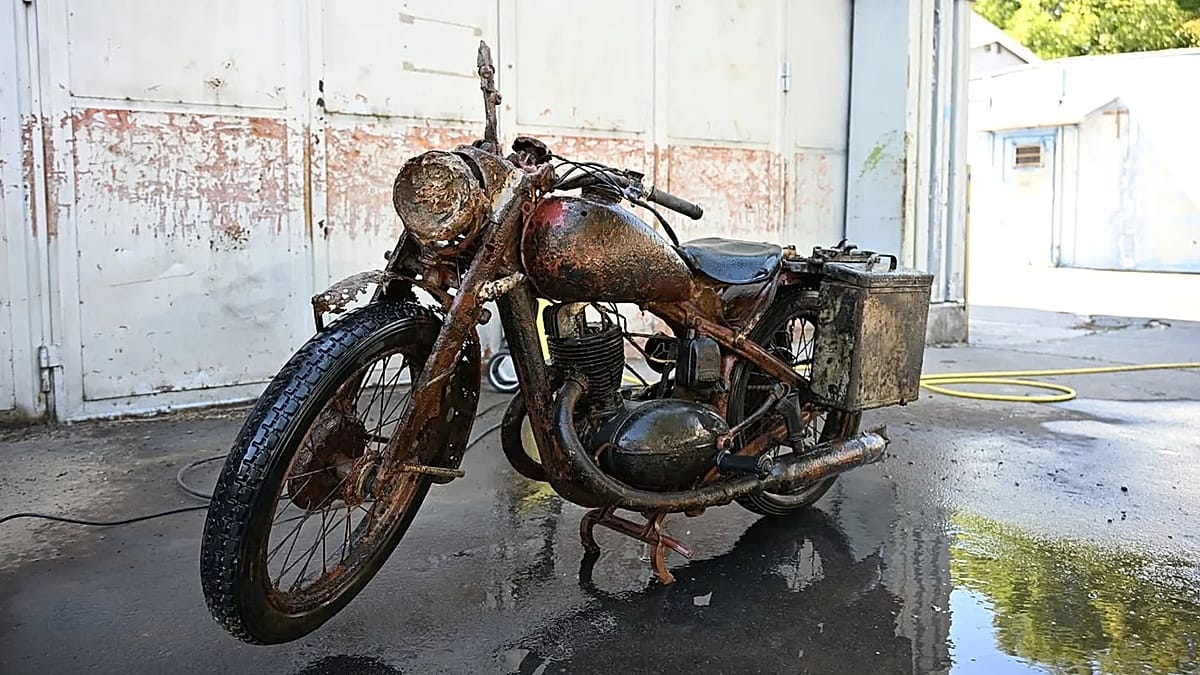
When the Danube receded to historic lows this summer, it exposed more than just sandbanks and shipwrecks. In Budapest, a team from Hungary's Institute and Museum of Military History pulled a nearly intact Wehrmacht motorcycle from the riverbed on 2 August, opposite the parliament building at Batthyány Square. The machine, a DKW NZ 350-1, has since been cleaned and conserved in the museum's hangar, and photos of the find have circled the globe—from the Times of India to the Daily Mirror and Yahoo Autos.
A relic of wartime engineering
The DKW NZ 350-1 was a purpose-built military variant introduced in 1944, derived from the civilian NZ 350 and NZ 250 models that were renowned among motorcyclists for their toughness and reliability. Just under 12,000 units were produced before the war ended. The recovered bike is almost completely preserved; when raised, it weighed over 200 kilograms, saturated with water and mud.
One of the most intriguing details is a small fin on the rear frame, designed to scrape mud and snow from the tyre before it could clog the chain drive—a modification reportedly born from the harsh experience of the Russian winter. Another notable feature is the engine block made of grey cast iron, a material chosen partly because of wartime aluminium shortages. Despite the wealth of information, experts have not yet been able to date this particular machine to a specific month of production.
From Zschopau to the Danube
DKW's roots trace back to Danish engineer Jørgen Skafte Rasmussen, who founded a mechanical engineering firm in Zschopau, Saxony, in 1907. The brand name initially stood for "Dampfkraftwagen" (steam-powered vehicle), but by 1922 the company was producing two-stroke engines. DKW grew into one of Germany's leading motorcycle manufacturers, and in 1932 it merged with Audi, Horch, and Wanderer to form Auto Union AG, with the Zschopau plant remaining the hub for motorcycle production.
As Germany rearmed in the 1930s, DKW's output shifted increasingly toward military needs. The 350,000th DKW motorcycle rolled off the line in 1934, and the 500,000th in 1939. With the outbreak of the Second World War, civilian production was scaled back in favour of military machines like the NZ 350-1.
After the war, the Zschopau plant was dismantled by Soviet occupation forces, with machinery shipped to the USSR and engineers taken to Izhevsk. There, the NZ 350's legacy continued: the IZh-350, largely based on the DKW design, was produced from 1946, with over 127,000 units built by 1951.
Personal effects and human remains
Alongside the motorcycle, the dried-out riverbed yielded other wartime artefacts: a petrol can, a Y-strap (a leather harness used to carry equipment such as ammunition pouches and water bottles), and a bayonet frog. Beneath the bike, the remains of two German soldiers were discovered. Their identity tags, fully preserved, could finally reveal who they were and what happened to them after more than eight decades. A so-called "Kuban" sleeve shield, awarded in 1943 to soldiers who fought in the Kuban bridgehead on the Eastern Front, was also found.
The discovery has resonated far beyond Hungary, partly because of the motorcycle's remarkable condition. The saddle, once made of leather, is surprisingly intact, and the speedometer still bears witness to the machine's last journey. As the museum continues its careful restoration, the bike is expected to become a striking exhibit, offering a tangible link to a turbulent past.
This find is one of several remarkable revelations from the Danube's low waters. In Budapest, the exposed riverbed has even become an unlikely party venue, while further afield, the river's recovery has allowed the Paks nuclear plant to restart its second turbine. The motorbike, however, stands out as a poignant reminder of the human cost of war, now brought to light by the receding waters.