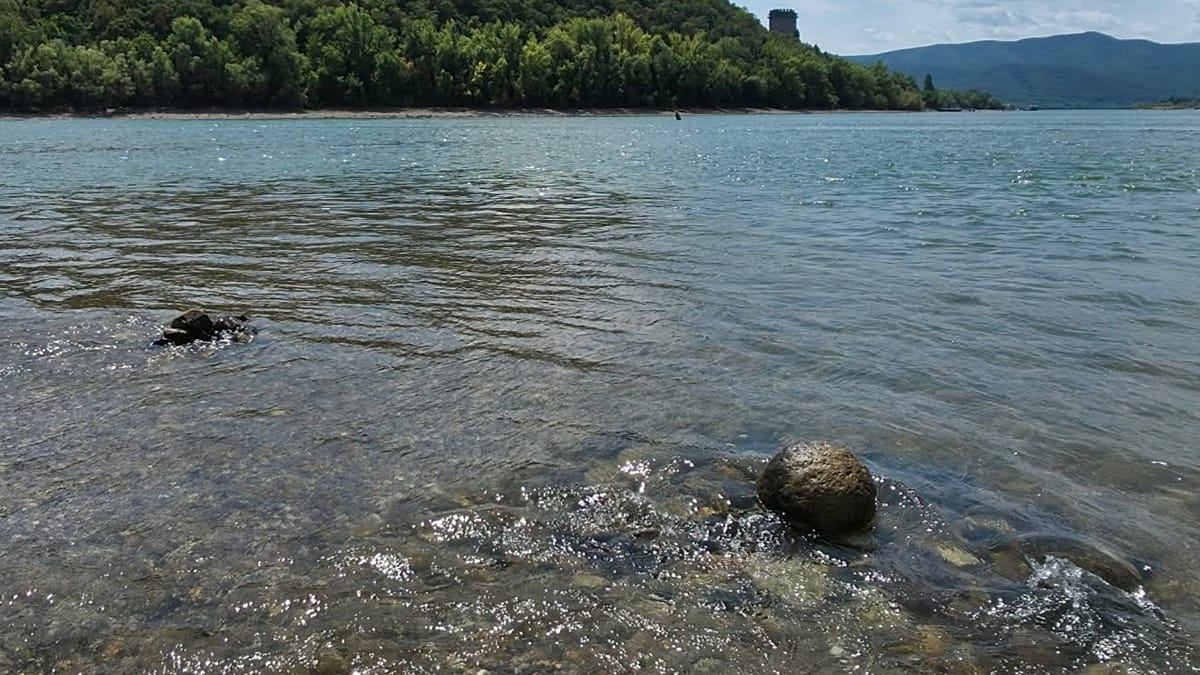
Budapest's Danube River has sunk to its lowest level ever recorded, dropping to 23 centimetres on Wednesday, 29 July. The previous record low of 33 centimetres, set in 2018, has been shattered. By midday Wednesday, the water had crept back up to 25 centimetres, but forecasters see little chance of meaningful recovery. The summer's second major heatwave is now bearing down on Hungary, promising more evaporation and further strain on the river.
The receding waters have turned the riverbed into an impromptu archaeological site. Gábor Dezső Kürti, president of the Hungarian Cyclists' Club, took advantage of the exposed terrain to cycle along the dry bed from Budapest to Vác. Near Visegrád, a reader of this publication stumbled upon a perfectly spherical stone, which immediately drew attention. The object has been reported to the Mátyás Király Museum in Visegrád, where archaeologists suspect it may be a catapult projectile.
A stone with a long history
Gergely Buzás, the museum's director and an archaeologist, told Euronews that such finds are not unusual in the area. Visegrád Castle endured numerous sieges, each involving hundreds of stone balls hurled at its walls, and the museum's storeroom already holds similar projectiles. Experts will visit the site next week to examine the sphere and confirm whether it is indeed a catapult stone.
If confirmed, the object's age can only be estimated. Buzás notes that such projectiles were used at least until the 16th century, but they could be far older. A Roman fort once stood on this spot, and stone-throwing machines were already in use then. That means the sphere could be anywhere from 400 to 2,000 years old, having lain on the riverbed for centuries.
This is not an isolated discovery. Last week, the hull of a Second World War shipwreck emerged from the drying riverbed near Mohács, a reminder of the Danube's role as a wartime waterway. The removal of Nazi warships from the river has become a recurring challenge as droughts expose more wrecks.
Satellite images show dramatic change
The European Union's Copernicus satellite programme released a comparison of the Danube Bend, where the stone was found. Images from 14 July 2025 and 25 July 2026 reveal a stark difference: this year, vast sandbanks have appeared on the river's curves, making navigation extremely difficult. In several stretches, both cargo and passenger vessels have been forced to halt operations, and Budapest has imposed restrictions on river traffic. The low water levels are also disrupting industry and energy production across the region, as seen in similar problems on the Rhine.
Hungary's government has responded by declaring a state of heightened alert. László Gajdos, head of the ministry responsible for the living environment, announced on Wednesday that 66 of the country's 84 water-shortage management districts have drought indices above the legal threshold. That means three-quarters of Hungary is suffering severe water shortages.
Forecasts offer little comfort. No rain is expected for at least two weeks. The heatwave now arriving is predicted to peak in about a week, with temperatures in Budapest reaching around 39°C. Some relief may come only towards the end of next week, and even then highs of 31–33°C are expected.
This is not merely a run of bad luck. A study published last week found that Europe's current droughts are driven less by a lack of rainfall and more by extreme heat, which pulls moisture from rivers, soil, and vegetation at an unprecedented rate. Scientists calculate that such intensely evaporative conditions are now up to 80 times more likely than before the industrial era, a direct consequence of human-induced climate change. The degradation of Europe's landscapes is amplifying these extremes, making the continent more vulnerable to the kind of severe drought now gripping Hungary.