Budapest's Danube has dropped to levels not seen in generations, and the receding water has begun to reveal what the river has kept hidden for decades. Among the mud and debris near the Hungarian Parliament, a team from the Institute and Museum of Military History made a remarkable discovery: a nearly intact DKW NZ 350-1 motorcycle used by the Wehrmacht during the Second World War.
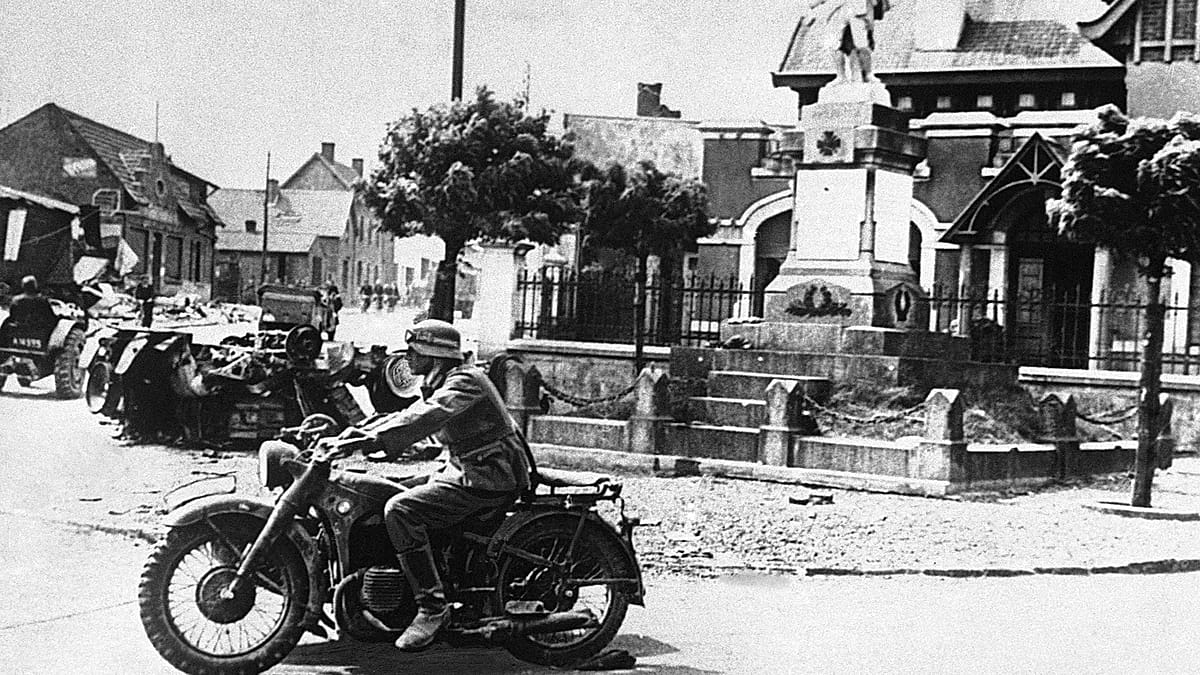
The bike, manufactured by Auto Union AG in Zschopau, Saxony, was designed specifically for military use and produced from 1944 onward. Its two-stroke engine delivered 11.5 horsepower, and its robust construction made it a favourite among troops for dispatch, reconnaissance, and courier duties. The model's distinctive metal side pannier is still attached, preserved by the river's fine sediment.
According to the Hungarian institute, the motorcycle is in exceptional condition, a rarity for any wartime vehicle recovered from a river. The mud that concealed it also protected it from the corrosive effects of oxygen and water movement. Around 12,000 units of this model were built before the war ended in 1945, and the predecessor DKW NZ 350 could reach speeds of up to 105 km/h, according to the ADAC.
A riverbed full of wartime relics
The discovery is not isolated. Alongside the motorcycle, the riverbed has yielded German Teller mines 35, used against tanks, as well as remnants of hand grenades and artillery shells. The Hungarian Institute of Military History suggests this stretch of the Danube may have served as a dumping ground for war debris during the fierce fighting that engulfed Budapest in late 1944 and early 1945.
German troops laid siege to the Hungarian capital in March 1944, and the Battle of Budapest raged from October 1944 to February 1945. The conflict between the Soviet Red Army and German and Hungarian forces resulted in the deaths of roughly 30,000 German, 17,000 Hungarian, and 80,000 Soviet and Romanian soldiers. The remaining German units capitulated on 13 February 1945.
Beneath the motorcycle, the team found human remains. The Volksbund Deutsche Kriegsgräberfürsorge, the German War Graves Commission, has taken charge of the recovery. The remains are believed to belong to two Wehrmacht soldiers, possibly the motorcycle's crew. Their identity tags are well preserved, which should allow for identification. The two men are to be reburied at the German war cemetery in Budaörs, west of Budapest, where more than 16,000 German soldiers are already interred.
The Volksbund, a non-profit organisation that works on behalf of the German federal government to locate and bury war dead abroad, has been active in the region for decades. In 2025, the organisation handled more than 5,500 cases across Europe.
The low water levels that made this discovery possible are part of a broader pattern affecting the continent. Balkan rivers have also hit record lows, stranding ships and exposing riverbeds. The Danube's decline has had practical consequences, too: the Paks nuclear plant, located south of Budapest, had to shut down one of its turbines due to insufficient cooling water, though it has since restarted operations as water levels recovered.
For historians, the motorcycle offers a tangible link to a dark chapter in European history. It also serves as a reminder of the human cost of war, as the two soldiers beneath it have yet to be named. The Volksbund's work ensures that even decades later, the fallen are not forgotten.
As the Danube's waters recede further, more secrets may emerge from the mud. But for now, the DKW NZ 350-1 stands as a silent witness to the past, awaiting its final journey to a place of rest.