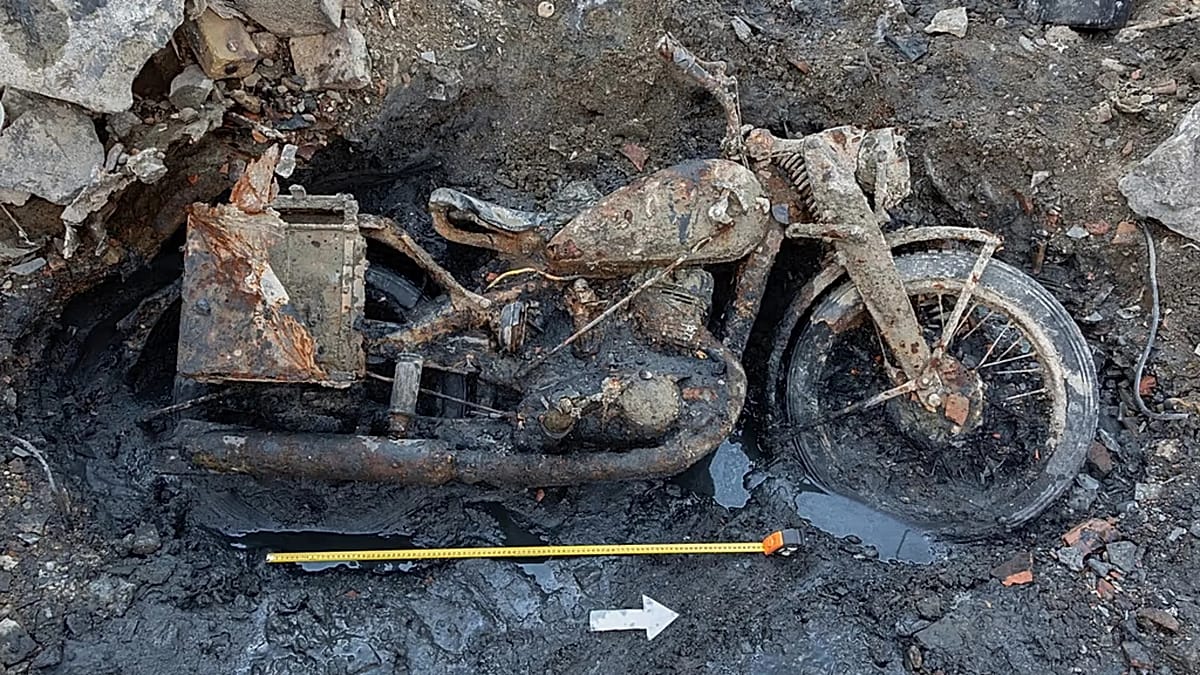
Budapest's Danube has dropped to levels not seen in over a century, and the receding waters have begun to surrender secrets long buried in the riverbed. Among the most striking finds is a near-pristine Wehrmacht motorcycle, a DKW NZ 350-1, discovered just steps from the Hungarian parliament building. The vehicle, preserved by the river's mud, has been hailed by the local Institute and Museum of Military History as a once-in-a-century discovery.
A wartime workhorse emerges
The motorcycle is a model built specifically for military use from 1944 onward. Its single-cylinder, two-stroke engine delivered 11.5 horsepower, and its robust design made it a favourite among troops. The DKW NZ 350-1 is easily identifiable by its metal side pannier, which remains intact on the recovered bike. Around 12,000 units were produced before the war ended in 1945.
DKW, short for Dampfkraftwagen, was a German brand rooted in the Saxon town of Zschopau, later absorbed into Auto Union AG. That company, formed in 1932 through the merger of several manufacturers including Audi, was the second-largest carmaker in Germany after Opel. The NZ series marked a shift in production techniques: earlier models had bolted frames, while the NZ used welded construction. Because welding demanded significant electricity, the work was done at night to avoid straining the power grid.
Within the Wehrmacht, motorcycles like this served as dispatch, reconnaissance, and courier machines, ferrying orders, reports, and maps across the front. The predecessor model, the NZ 350, could reach 105 km/h, according to the German automobile club ADAC.
War remnants and human remains
The discovery site, on the Buda side of the river near Batthyány Square, has also yielded German Tellermine 35 anti-tank mines, fragments of hand grenades, and artillery shells. The Hungarian Institute of Military History suggests this stretch of the Danube may have served as a war rubble dump during the conflict.
Beneath the motorcycle, recovery teams found human remains. The Volksbund Deutsche Kriegsgräberfürsorge, a German non-profit that locates and buries war dead abroad, confirmed they belong to two Wehrmacht soldiers. Their identity discs are well preserved, allowing for identification. The two men are believed to have been the motorcycle's crew. They are to be interred at the German war cemetery in Budaörs, west of Budapest, where more than 16,000 German soldiers already rest.
The timing of the find is poignant. From March 1944, German troops occupied Budapest. The Battle of Budapest, fought between October 1944 and February 1945, saw intense urban combat between Soviet forces and the German-Hungarian defenders. Casualties were staggering: around 30,000 German, 17,000 Hungarian, and 80,000 Soviet and Romanian soldiers died before the German units capitulated on 13 February 1945.
A river's memory
The Danube's record low has also exposed other relics and even turned the riverbed into an unlikely party venue, as Budapest residents and tourists explore the newly revealed terrain. The motorcycle's recovery is part of a broader pattern across Europe, where drought and low water levels are stranding ships and exposing riverbeds from the Balkans to the Danube.
After the war, DKW's production facilities were dismantled and shipped to the Soviet Union as reparations. Using that equipment, Soviet factories produced the nearly identical ISCH-350 in large numbers until 1951. The Budapest motorcycle, however, remains a rare and tangible link to a dark chapter in the city's history.
The Volksbund, which handles more than 5,500 recoveries annually, will ensure the two soldiers receive a proper burial. For historians, the find offers a rare glimpse into the material culture of the Wehrmacht and the brutal final months of the war in Hungary. For the public, it is a sobering reminder of what lies beneath the waters that flow through Europe's capitals.