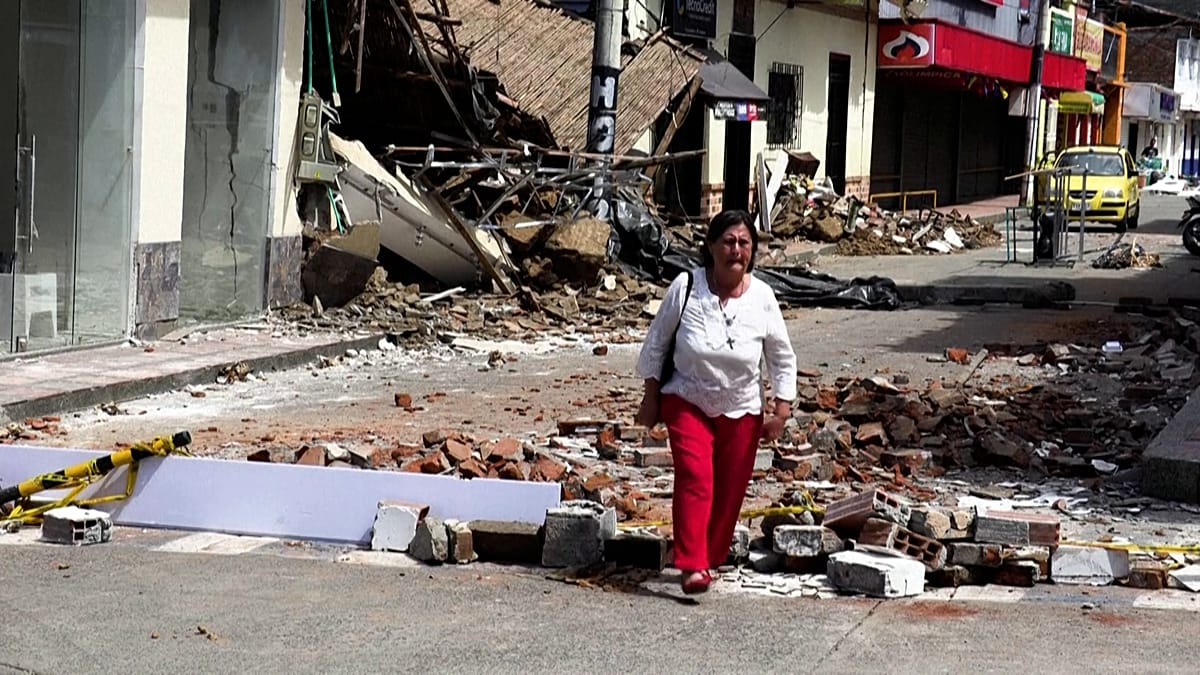
A powerful earthquake has torn through western Colombia, leaving a trail of destruction across the Valle del Cauca region. The quake, which struck early on Tuesday, has killed at least dozens of people and injured hundreds more, with entire towns reduced to rubble. Local authorities have declared a state of emergency as rescue workers dig through collapsed homes and shops in search of survivors.
The worst-hit areas include the towns of Zarzal, Roldanillo and El Cairo, where entire blocks have been flattened. In Zarzal, a bustling agricultural hub known for its fruit trade, the main square is now littered with debris. Residents described scenes of panic as the ground shook violently for nearly a minute, toppling concrete structures and triggering landslides on the surrounding hillsides.
Rescue efforts under way
Colombia's national disaster response agency has deployed hundreds of firefighters, soldiers and medical teams to the affected zone. Helicopters are ferrying the wounded to hospitals in Cali, the regional capital, while volunteers use shovels and bare hands to clear rubble. In Roldanillo, a popular destination for paragliding enthusiasts, the local clinic has been overwhelmed, with patients treated in the open air.
“We are facing one of the worst tragedies in the region's recent history,” said the governor of Valle del Cauca, Dilian Francisca Toro, in a televised address. “Every minute counts. We are doing everything we can to reach those still trapped.” The quake, measured at magnitude 6.1 by Colombia's Geological Service, struck at a shallow depth, amplifying its destructive force.
In El Cairo, a small mountain town, landslides have cut off road access, leaving residents isolated. Emergency teams are working to clear the routes, but heavy rain is hampering progress. The town's mayor, Jesús Elías Giraldo, told local radio that at least 15 people have been confirmed dead there, with many more missing.
Regional impact and international solidarity
The earthquake has also rattled neighbouring departments, including Chocó and Risaralda, though damage there appears less severe. In the Pacific coastal city of Buenaventura, port operations were briefly suspended as a precaution. Colombia sits on the Pacific Ring of Fire, a zone of intense seismic activity, and has experienced devastating quakes before, including the 1999 Armenia earthquake that killed more than 1,000 people.
International offers of help have poured in, with the United Nations and the Red Cross mobilising emergency supplies. In Europe, solidarity has been swift: Spain's government has offered technical assistance, while the European Union's Civil Protection Mechanism has been activated, ready to deploy search-and-rescue teams if requested. This echoes the bloc's response to other recent disasters where European coordination proved vital.
For Colombians abroad, the news has struck a personal chord. In Madrid, where a large Colombian community resides, vigils are being planned outside the embassy. Meanwhile, celebrities have stepped in to help: Shakira, who was born in Barranquilla, and Howard Buffett, son of investor Warren Buffett, have announced a joint initiative to rebuild schools in quake-hit Chocó, a region that has also suffered from the tremors.
As the rescue operation continues, the focus is shifting to the long road to recovery. The Colombian government has pledged emergency housing and financial aid for affected families. But for many, the loss is irreplaceable. “I lost my house, my shop, and my neighbour,” said María Eugenia López, a 58-year-old resident of Zarzal, speaking through tears. “But we are alive. We will rebuild.”
Seismologists warn that aftershocks are likely in the coming days, urging residents to stay vigilant. The disaster serves as a stark reminder of the region's vulnerability, and the importance of preparedness, a lesson that institutions in Europe have also been promoting, given the seismic risks in parts of the Mediterranean.
For now, the people of Valle del Cauca are counting their dead and hoping for miracles. The world watches, and offers its support, as Colombia begins the painful process of healing.