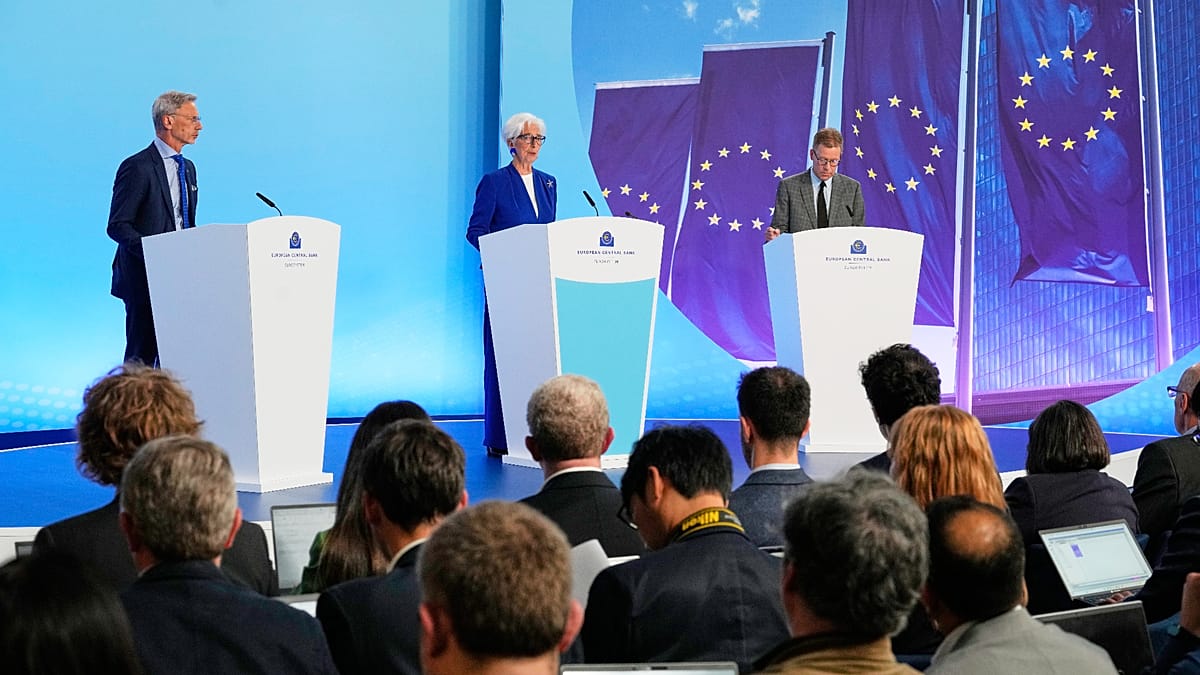
New research from the European Central Bank (ECB) reveals that the public remarks of its policymakers can sway financial markets just as powerfully as the formal decisions taken at Governing Council meetings. The study, published on Thursday, challenges the conventional focus on the bank's six-weekly policy announcements and suggests that the broader communication strategy deserves far more attention.
Economists Klodiana Istrefi, Florens Odendahl, and Giulia Sestrieri built a comprehensive database covering 304 formal policy decisions and roughly 5,000 public communication events between January 1999 and early 2024. They examined speeches and interviews by ECB presidents, Executive Board members, and the governors of the national central banks of Germany, France, Spain, and Italy—the euro area's four largest economies.
The authors found that while only about 45% of formal policy announcements triggered significant market reactions, the cumulative effect of inter-meeting communication was comparable. "Our findings show that the market reaction to inter-meeting communication events is often as large as the reaction to formal announcements of Governing Council decisions," they wrote in an ECB blog post.
This is not to say that every off-the-cuff comment moves markets. The study notes that individual speeches and interviews are more varied in content and therefore less consistently impactful. "Formal policy announcements following Governing Council meetings are inherently focused on monetary policy decisions, whereas inter-meeting communication events cover a much broader range of topics," the authors explained. Yet because such interventions occur far more frequently, their combined influence is substantial.
Who moves markets most?
The research also ranked the market impact of different speakers. ECB presidents—from Wim Duisenberg to Christine Lagarde—had the largest average effect, followed by national central bank governors, and then Executive Board members. This hierarchy underscores the importance of looking beyond the president and board when assessing monetary policy communication.
"This highlights the importance of looking beyond the ECB President and Executive Board members when analysing monetary policy communication in a heterogeneous monetary union, where countries differ significantly in their economic structures, public debt levels, and household and firm financial situations," the report states.
The findings arrive as the ECB navigates a delicate balancing act between taming inflation and supporting growth. The euro area's fragmented national rules—which cost the bloc an estimated €120 billion annually—add another layer of complexity to the transmission of monetary policy. Understanding how communication shapes market expectations is therefore not just an academic exercise; it has real consequences for inflation and unemployment across the currency union.
The study's authors argue that their database, which they call the Euro Area Communication Event Study Database, could help economists better estimate the economic impact of monetary policy. "We also find that inter-meeting communication events can help us better estimate the economic impact of monetary policy in the euro area," they added.
For investors and analysts, the takeaway is clear: the ECB's message is not confined to the podium of its press conferences. A single interview with a national central bank governor in Frankfurt, Paris, or Madrid can be as market-moving as a rate decision. As the ECB's communication strategy evolves, the market's attention will likely broaden to include the full chorus of voices shaping euro-area monetary policy.