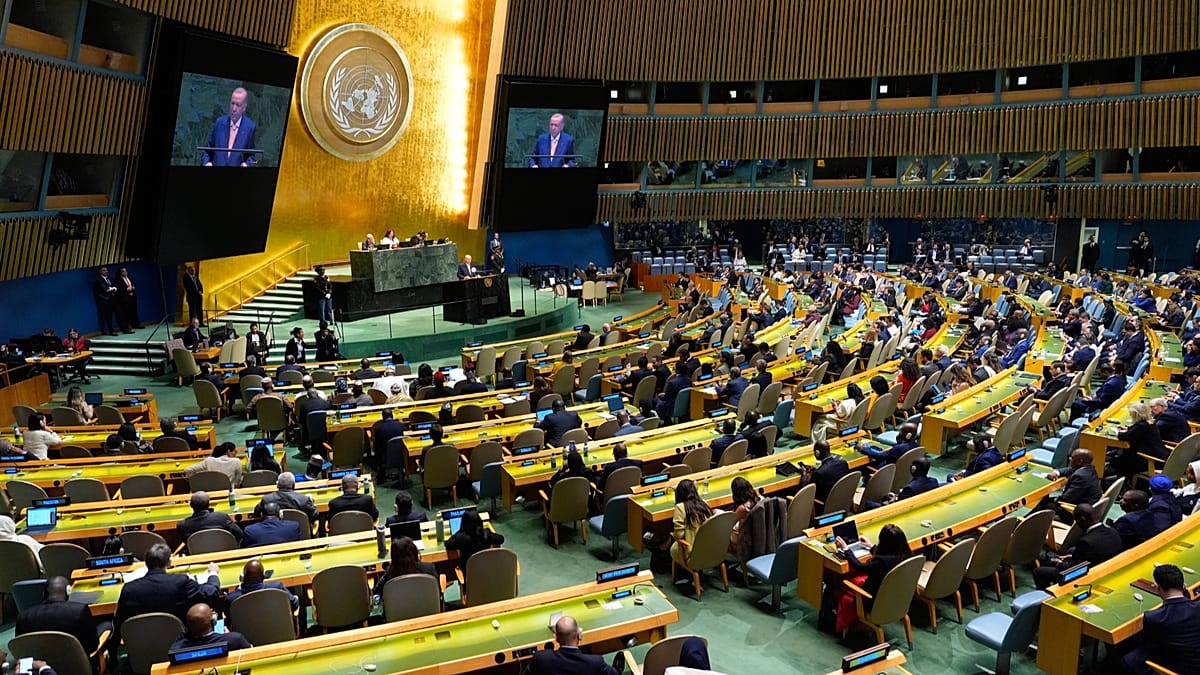
Turkish President Recep Tayyip Erdoğan has used the run-up to the UN General Assembly to press for a radical overhaul of the Security Council, arguing that the veto power held by five permanent members is an anachronism that blocks meaningful reform. In an opinion piece published by Bloomberg, Erdoğan proposed replacing permanent seats with a system of rotating members elected by the General Assembly for fixed terms, with no state able to permanently block the will of the international community.
Speaking in New York ahead of the 81st session of the General Assembly, Erdoğan met with US business leaders and reiterated Turkey's interest in deepening cooperation with Washington in defence, energy, and trade. He also set a target of $100bn in bilateral trade with the United States, which he described as within reach.
A system built for 1945
Erdoğan argued that the Security Council's structure still reflects the balance of power that emerged after World War II, when the United States, Russia, China, the United Kingdom, and France were granted permanent seats and veto rights. He contended that contemporary challenges—pandemics, energy crises, supply-chain disruptions, and regional conflicts—cannot be left to the discretion of a handful of capitals.
“Scrapping the veto privilege must be both the starting point and the key strategic objective of any meaningful reform,” Erdoğan wrote. “Reform cannot mean extending the same privilege to other states.” He dismissed the idea of simply adding new permanent members, arguing that this would not address the concentration of decision-making authority.
The Turkish president called for a concrete roadmap and a broad coalition within the General Assembly, built on the principle that no state should be able to permanently block the will of the majority. He first voiced this sentiment in 2019, when he declared that “the world is bigger than five.”
Rotating seats and accountability
Under Erdoğan's model, Security Council members would be elected by the General Assembly on a rotating basis for limited terms. Countries wishing to remain on the Council would have to stand for re-election and secure majority support. He argued that this would strengthen the Council's representativeness and make it more accountable to the wider UN membership.
Erdoğan noted that Asia's economic weight is growing, Africa is demanding representation commensurate with its potential, and developing countries are asserting their priorities more forcefully. He insisted that global problems cannot be solved with methods imposed from outside, and called for guarantees on developing countries' right to development and access to finance.
“In today's world, it is clear that lasting peace cannot be built by multiplying separate blocs that are cut off from each other and do not talk to one another,” he wrote. “For a 'fairer world', we must bring together the experience, capacity and will of different regions on common ground.”
Turkey's role in European security
In his address to the General Assembly, Erdoğan returned to a theme he has stressed repeatedly: that Europe cannot be strong or safe without Turkey. “It is not possible for a Europe to be stronger or safer if Türkiye is excluded from its security architecture,” he said.
That message echoes his remarks at the Antalya Diplomacy Forum last year, where he said European security is “unthinkable without Turkey” and that Ankara is ready to take responsibility for the continent's defence. As trans-Atlantic relations have cooled under the Trump administration, NATO member Turkey—which fields the alliance's second-largest military and has a well-developed defence industry—is seeking a broader role.
The White House has warned that Europe must look after its own security, including Ukraine, and has shown little appetite for backing a largely European force in Ukraine in the face of Russian hostility. Turkey has positioned itself as a key broker in the Black Sea region, maintaining working relations with both Kyiv and Moscow. Erdoğan has also highlighted his personal rapport with President Trump, saying he expects bilateral ties to flourish during Trump's second term.
Turkey's EU accession process, which began in 1987, has been frozen since 2018. Erdoğan's push for UN reform comes as European leaders grapple with their own institutional questions, including the bloc's capacity to act on security and defence. The debate over the Security Council's structure is likely to resonate in Brussels, where calls for a more representative global order have grown louder.