European aviation has climbed back to near pre-pandemic levels, according to fresh data from Eurostat. In 2025, the European Union recorded roughly 6.9 million commercial flights, a 3.8% increase over the previous year and just shy of the seven million flights logged in 2019.
The figures mark a steady recovery since the sharp downturn of 2020 and 2021. Eurostat notes that the number of flights has risen continuously since 2021, and by the end of 2025 had essentially returned to the volumes seen before COVID-19 disrupted air travel across the continent.
Scheduled vs. non-scheduled traffic
Of the total, 91.5% were scheduled services, defined by Eurostat as commercial air operations run according to a published timetable or with a regular frequency open to direct booking by the public. The remaining 8.5% were non-scheduled flights, including charters and special services.
Unsurprisingly, the summer months saw the highest share of non-scheduled traffic. June recorded 648,707 commercial flights, with 11.2% non-scheduled; July saw 690,855 flights (12.3% non-scheduled); and August peaked at 693,046 flights, of which 11.4% were non-scheduled.
Amsterdam leads, Paris and Frankfurt follow
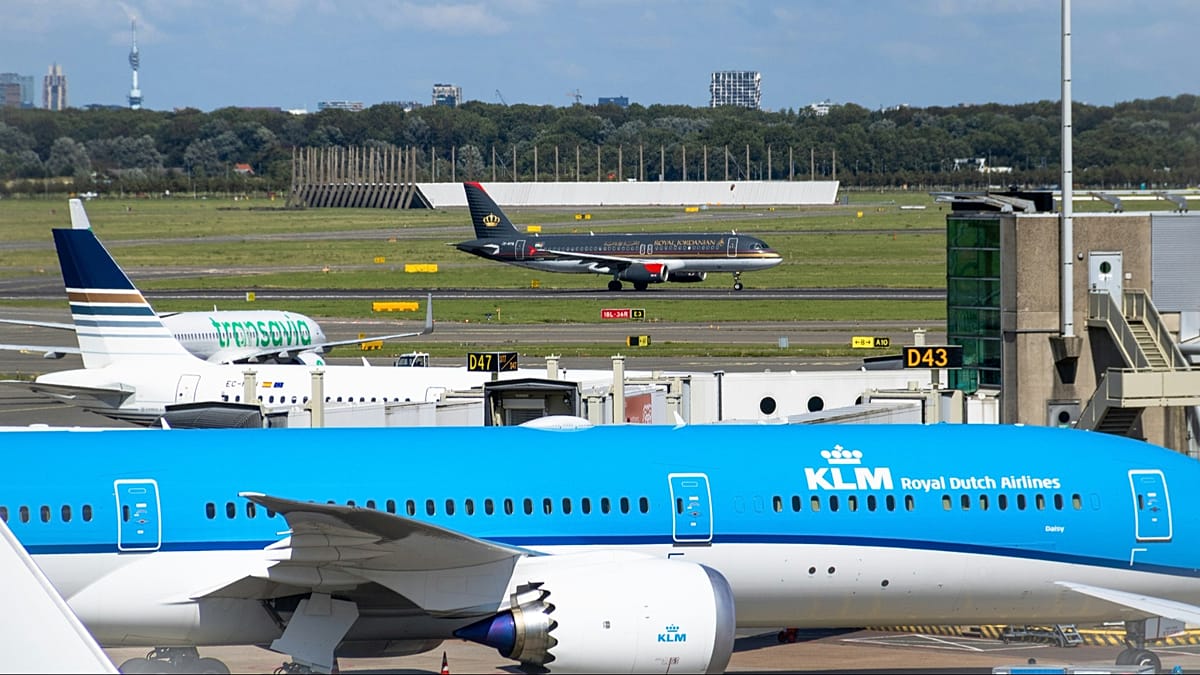
Amsterdam Schiphol in the Netherlands was the EU’s busiest airport for commercial flights in 2025, handling 488,000 departures and arrivals. Paris Charles de Gaulle came second with 476,000 flights, while Frankfurt/Main in Germany was third with 457,000.
Two Spanish hubs made the top five: Adolfo Suárez Madrid-Barajas with 423,000 flights and Barcelona-El Prat with 356,000. The rest of the top ten included Munich (329,000), Rome Fiumicino (320,000), Athens/Eleftherios Venizelos (271,000), Copenhagen/Kastrup (254,000), and Dublin (252,000).
Among the top ten, Athens/Eleftherios Venizelos had the highest share of non-scheduled flights at 5.2%, followed by Madrid-Barajas at 4.8% and Copenhagen/Kastrup at 4.1%.
The recovery is not uniform across the continent. While major Western European hubs have largely bounced back, some smaller airports and regions still lag, reflecting broader economic and geopolitical pressures. The ongoing effects of the war in Ukraine, for instance, continue to reshape airspace and route planning in Eastern Europe.
For travellers, the rebound means more choice and frequency, but also renewed congestion at key hubs. The summer peaks highlight the strain on infrastructure, a topic that has gained urgency as the EU debates climate-related disruptions and their impact on travel.
Looking ahead, the aviation sector faces challenges beyond passenger numbers. Sustainability targets, noise concerns, and the push for alternative fuels are all on the agenda. The data from Eurostat provides a baseline for measuring progress on these fronts.
As the EU continues to integrate its single market, the pattern of air traffic reflects deeper economic ties. The dominance of hubs like Amsterdam, Paris, and Frankfurt underscores their role as gateways for business and tourism, while the rise of southern European airports points to shifting travel patterns.