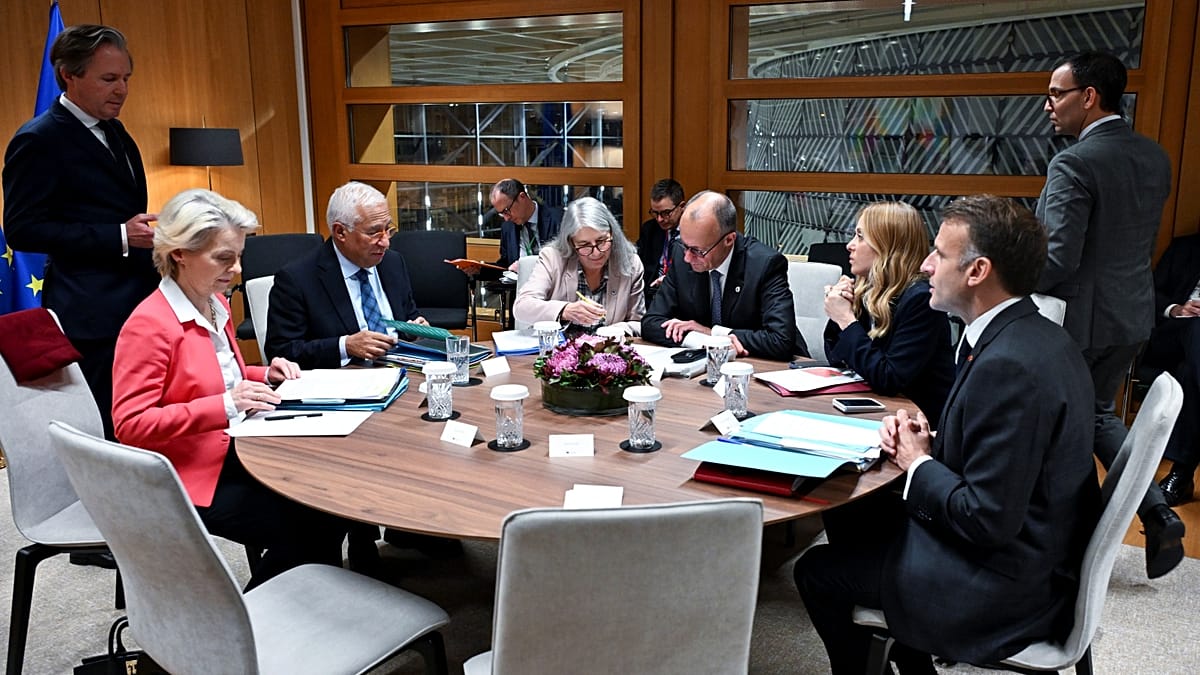
The special summit in Brussels was never intended to produce a final agreement on the European Union's next seven-year budget. Its purpose was to nudge leaders beyond their entrenched positions and repeated red lines toward a possible compromise. That did not happen.
Instead, leaders remained in their trenches, traded blame, and refused to yield. The meeting quickly descended into disarray, with simmering tensions spilling into the open. Plans to continue talks on Friday were scrapped as it became clear that no breakthrough was in sight.
The chaotic, inconclusive gathering offers an ominous preview of what may unfold when leaders reconvene on 17-18 December for what is supposed to be the final attempt. Diplomats and officials in Brussels anticipate a marathon session that could stretch into the weekend—and possibly into the following week.
What's on the table
The bitter fight over the next EU budget (2028-2034) began last year when the European Commission presented a nearly €2 trillion proposal with record spending on defence, border controls, green energy, innovation, and foreign policy. The Commission revamped the budget's traditional structure, which allocates cash for specific programmes over a seven-year horizon, to make it more flexible and reactive to unforeseen crises. Lessons from the pandemic, Russia's war on Ukraine, and natural disasters weighed heavily on the thinking.
Although the new structure was preserved, the €2 trillion volume was successively cut by the Cypriot and Irish presidencies to make it more politically palatable. The latest reduction came from European Council President António Costa, who tabled a €1.78 trillion budget in current prices—a 10% reduction of roughly €204 billion. Costa heavily cut Heading 2 (Competitiveness) and Heading 3 (Global Europe) while largely sparing Heading 1, which includes agriculture and cohesion policies.
Who's who in the fight
The budget has split member states into two irreconcilable camps. On one side are the seven "frugals": Austria, Belgium, Denmark, Finland, Germany, the Netherlands, and Sweden. All are net payers and determined to slash the overall size. They also want to focus common spending on modern-day priorities, hence their euphemistic nickname: "modernisers". For them, Costa's proposed €204 billion reduction is unacceptable. The group has now demanded an additional €50 billion decrease.
"This won't stop at €204 billion. It will be even less. How much less it will be is still open," German Chancellor Friedrich Merz said at the summit.
On the other side are the 17 "Friends of Cohesion": Bulgaria, Croatia, Cyprus, Czechia, Estonia, Greece, Hungary, Italy, Latvia, Lithuania, Malta, Poland, Portugal, Romania, Slovakia, Slovenia, and Spain. Most are net recipients of EU funds and want to preserve ambitious expenditure for both traditional and modern policies. For them, Costa has cut too much, and nothing less can be tolerated.
"We are fighting for a good budget for our region. We are taking action, and we are not backing down," Polish Prime Minister Donald Tusk said, striking a combative tone.
France, a net payer that receives hefty farming subsidies, has not picked a side but is adamantly opposed to any drastic devaluation. President Emmanuel Macron slammed Costa's €204 billion cuts as a "strategic mistake" that would make Europe more dependent on the United States and China. A similar warning came from Commission President Ursula von der Leyen, who does not have a vote but plays a crucial technical role. "We need to stay true to the priorities we have collectively agreed on for the past years," she said. Ireland and Luxembourg remain non-committal, though they are seen as more frugal-friendly.
What now?
The focus turns back to Costa, whose authority and credibility as European Council president will be defined by the outcome of these negotiations. "We need to continue to work and to try to bring all the member states closer. In any case, as you know, we need unanimity to approve the new budget," he said. "That means that all member states need to agree with each other."
Costa and his team have drawn two conclusions: the "frugals" will request further cuts, and the "cohesion friends" will oppose any reductions of Heading 1. This puts Heading 2 (competitiveness) and Heading 3 (global Europe)—the two envelopes that the "frugals" want to boost—on the chopping block. However, some "cohesion friends", like Poland and the Baltics, are ready to fight for Heading 2 because it includes funding for defence and security.
Another unresolved point is the EU-wide taxes, also known as "new own resources", to bring additional revenue into the budget. Costa has proposed a package of five taxes—digital services, carbon-intensive imports, electronic waste, tobacco products, and the Emissions Trading System (ETS)—to collect around €60 billion per year. So far, no tax has garnered the necessary unanimity. Ireland and Malta, for instance, are firmly opposed to the digital tax, while Poland is dead-set against the ETS. The fact that these own resources have a distinctly uneven impact on member states also raises eyebrows.
If the taxes are pared down and fail to raise €60 billion per year, Costa will have no choice but to cut the budget even deeper to offset the loss. The collapse of the summit has already raised doubts about whether leaders can overcome their differences by year's end. As leaders clash over strategic priorities, the risk of a prolonged deadlock grows. Meanwhile, Germany's record national budget shows the fiscal constraints Berlin faces, and Belgian farmers rallying in Brussels underscore the political stakes of agricultural spending.